.avif)


.png)
.png)


Renovation Planning for NYC Apartment Buyers: A Complete Guide
Buying a Manhattan co-op or condo that needs renovation? Learn how building rules, costs, timelines, and feasibility shape your decision before an offer.
February 19, 2026
|
.avif)
Renovation Planning for NYC Apartment Buyers: A Complete Guide
Planning to renovate after buying a NYC apartment? Gallery KBNY’s principal-led design-build team manages architecture, permits, board approvals, and construction, start to finish.
TABLE OF CONTENTS
- Why Renovation Planning Should Start Before You Close
- Step 1: Assess the Property Before You Buy
- Step 2: Understand Your Building’s Renovation Requirements
- Step 3: Build a Realistic Budget and Timeline
- Step 4: Choose the Right Renovation Partner
- Why NYC Apartment Buyers Choose Gallery KBNY
- What to Expect: Gallery KBNY’s Process for Apartment Buyers
- Frequently Asked Questions About Renovating Before Buying in Manhattan
This guide covers everything NYC apartment buyers need to know about planning a renovation, from evaluating a property before making an offer to choosing the right firm and understanding timelines and costs.
[#1]Why Renovation Planning Should Start Before You Close[#1]
Buying an apartment in New York City with the intention to renovate is one of the smartest moves a buyer can make. Fixer-uppers in Manhattan and Brooklyn typically trade at a meaningful discount to turnkey alternatives, and a well-executed renovation lets you customize every inch of the space to your life, something a move-in-ready apartment never offers.
But here’s what most buyers don’t realize until it’s too late: the renovation planning process should begin before you close, not after.
In NYC, the gap between closing day and the first day of construction is longer than most buyers expect. Between building board approvals, DOB permit filings, architectural drawings, and management company reviews, the pre-construction phase alone can take three to five months. If you wait until after closing to start this process, you’re paying carrying costs (mortgage, maintenance, and potentially rent on a separate apartment) with nothing to show for it.
The buyers who get this right engage a renovation partner during their apartment search, or at minimum, during the contract period. That way, design, feasibility, and pre-construction planning run in parallel with due diligence, financing, and closing. The result is a dramatically shorter time between closing and move-in.

[#2]Step 1: Assess the Property Before You Buy[#2]
Not every fixer-upper is a good renovation candidate. Before you fall in love with a floor plan or a neighborhood, you need to understand what the property will actually require, and whether the renovation scope aligns with your budget and timeline.
What to evaluate during walkthroughs:
- Electrical Systems: Pre-war buildings frequently have outdated knob-and-tube or aluminum wiring that will need to be replaced entirely. This is not optional. It’s a safety and code requirement.
- Plumbing: Galvanized steel pipes in older buildings corrode over time and restrict water flow. Cast iron drain lines may need to be replaced. Both add significantly to scope and cost.
- Ceiling & Wall Conditions: Uneven surfaces, cracking plaster, and water stains often point to deeper structural or moisture issues that won’t be visible in listing photos.
- Floor Plan Flexibility: Load-bearing walls, wet-wall locations, and building riser positions dictate what layout changes are feasible. Not every wall can come down.
- Building-Specific Restrictions: Some co-ops prohibit certain types of work (combining units, relocating kitchens, wet-over-dry bathroom additions). These restrictions can fundamentally change your renovation scope.
At Gallery, we offer pre-purchase feasibility assessments for buyers considering a renovation. Our principal walks the property with you, before you make an offer, and provides an honest evaluation of scope, budget range, timeline, and any red flags. This pre-purchase renovation assessment eliminates the guesswork that causes so many buyer renovations to go sideways.
-min.JPG)
[#2]Step 2: Understand Your Building’s Renovation Requirements[#2]
Every building in New York City has its own renovation rules, and the differences between co-ops and condos can significantly impact your planning timeline and approach.
Co-op renovations typically involve the most complex approval process. Most co-op boards require:
- A signed alteration agreement with the building
- Architectural plans reviewed and approved by the building’s architect or engineer
- Proof of contractor insurance (liability and workers’ compensation)
- A security deposit (often $5,000–$10,000, or a percetange of total cost refundable upon satisfactory completion)
- A detailed scope of work and construction schedule
- Neighbor notification letters
Condo renovations generally have a lighter approval process, but still require management company sign-off, proof of insurance, and adherence to building rules regarding construction hours, elevator reservations, and material deliveries.
In both cases, DOB permits are required for any work involving structural changes, plumbing relocation, electrical rewiring, or gas work. Filing these permits requires licensed professionals and takes additional time. A design-build firm that handles DOB permits and co-op board approvals in-house eliminates one of the biggest sources of delay for apartment buyers planning a renovation.
[#4]Step 3: Build a Realistic Budget and Timeline[#4]
Renovation costs in New York City are higher than anywhere else in the country, and buyers planning a renovation need to account for the full picture, not just construction costs.
Typical Renovation Cost Ranges for NYC Apartment Buyers:
Cost Ranges
Based on 2026 NYC market conditions. Gallery KBNY active project data.
Beyond Construction, Buyers Should Budget For:
- Architectural and engineering fees (included in Gallery's all-inclusive pricing)
- DOB permit filing fees and building security deposits (refundable)
- Temporary housing during construction (typically 4–8 months for a full gut renovation)
- A 20–30% contingency for unforeseen conditions, especially in pre-war buildings
- Furniture and move-in costs post-renovation
Based on 2026 NYC market conditions. Gallery KBNY active project data.
Typical Timeline - From Closing To Move-In:
Timelines vary based on building, scope, and board review process. Gallery KBNY active project data.
The most effective way to compress a true renovation timeline is to begin design and pre-construction planning before closing. Buyers who engage Gallery during their contract period can have architectural plans and board submissions ready the moment they take possession, saving two to three months of dead time.
[#5]Step 4: Choose the Right Renovation Partner[#5]
For apartment buyers planning a renovation, the single most impactful decision you’ll make is who you hire. The right partner doesn’t just build your renovation. They plan it, permit it, design it, and manage every trade from demolition to final walkthrough.
There are two fundamentally different approaches to apartment renovation in NYC, and understanding the distinction will save months of frustration: the design-build model and the traditional design-bid-build model.
Design-build (Gallery’s model): One firm handles architecture, design, permitting, construction, and project management under a single contract. The same team that designs your renovation is the team that builds it. There are no handoffs, no gaps between design intent and construction execution, and one single point of contact for the entire project.
Design-bid-build (traditional model): You hire an architect or designer separately, then bid out the construction to a general contractor. The architect and contractor operate under separate contracts with no obligation to one another. You, the homeowner, become the project manager, coordinating between parties, resolving conflicts, and managing the timeline yourself.
For buyers who are already managing a purchase, a move, financing, and potentially a sale of their current home, adding project management responsibilities on top of that is a recipe for delays and cost overruns. A full-service design-build firm that coordinates all trades, manages all subcontractors, handles DOB permits and board approvals, and provides a single point of accountability from concept to completion is the most efficient path from closing day to move-in day.
.jpg)
[#6]Why NYC Apartment Buyers Choose Gallery KBNY[#6]
- Principal-Led From Start to Finish. Gallery KBNY’s founding principal is personally involved in every project, from the first walkthrough of a prospective purchase through design development, construction oversight, and final punch list. There are no handoffs to junior project managers. The person who understands your vision is the person making decisions on-site every day.
- Pre-Purchase Feasibility Assessments. Gallery works with buyers before they close. The principal walks the property, evaluates renovation scope and feasibility, identifies red flags, and provides an honest budget range, giving buyers the information they need to make a confident purchase decision.
- In-House Architecture, Design, and Construction. Gallery’s architects, interior designers, and construction teams are employees of the firm, not outside subcontractors. This means tighter coordination, fewer miscommunications, and a finished product that matches the original design intent without dilution.
- All-Inclusive, Transparent Pricing. Gallery’s design-build proposals include architecture, interior design, materials, labor, permits, expediting, and project management in a single comprehensive estimate. There is no staggered billing across multiple vendors and no surprise change orders from gaps between design and construction teams.
- DOB Permits and Board Approvals Handled In-House. Gallery manages all Department of Buildings filings, co-op and condo board submissions, alteration agreements, and management company coordination. For apartment buyers already navigating a complex purchase, this eliminates an entire category of stress and delay.
- 3D Renderings Before Construction Begins. Every project includes photorealistic 3D renderings that let buyers see and experience their renovated apartment before a single wall comes down. Decisions are made during the design phase, not after construction is underway.
- Real-Time Project Tracking via JobTracker. Gallery’s project management platform gives clients full digital access to their renovation (daily logs, progress photos, schedules, documents, and direct messaging), so buyers are never wondering what’s happening in their apartment during construction.
- Press Track Record. Featured in The New York Times, Forbes, Architectural Digest, and Inc. Rated 4.9 stars across 100+ client reviews.
Considering a Renovation in NYC?
Click to schedule a consultation with one of the principle partners at Gallery, who will hear out your renovation plans and let you know the best way to proceed - whether we end up working together or not.
Schedule Your Consultation
[#7]What to Expect: Gallery KBNY’s Process for Apartment Buyers[#7]
Our process is specifically designed to align with the apartment buying timeline, compressing dead time and getting you into your renovated home as quickly as possible.
1. Pre-Purchase Consultation
You’re considering an apartment and want to understand what a renovation would involve. Our principal walks the property with you, evaluates the space, identifies scope considerations, and provides an honest budget range. This typically happens before you make an offer or during the contract period.
2. Design Development
Once you’re in contract (or immediately after closing), we begin architectural plans, interior design, material selection, and 3D renderings. Our goal is to have design finalized and ready for board submission the moment you take possession.
3. Approvals & Permitting
We prepare and submit all board packages, alteration agreements, and DOB permit applications. We coordinate directly with your building’s management company and board. You don’t need to manage this process yourself.
4. Pre-Construction
While permits are being processed, we finalize material procurement, coordinate trade schedules, and prepare a detailed construction timeline. When approval comes through, we’re ready to mobilize immediately.
5. Construction
Our principal conducts regular site visits throughout the construction phase. All trades (demolition, framing, electrical, plumbing, HVAC, tiling, cabinetry, painting, flooring) are coordinated and managed by our team. You receive real-time updates via JobTracker.
6. Final Walkthrough & Move-In
The same principal who walked the property with you before purchase conducts the final walkthrough. Every detail is checked against the original design intent. We handle DOB sign-offs and building closeout requirements so you can move in with confidence.
MIN.jpg)
[#7]Featured Buyer Renovations[#7]
The majority of Gallery’s projects are for apartment buyers renovating newly purchased properties. Here are a few recent examples:
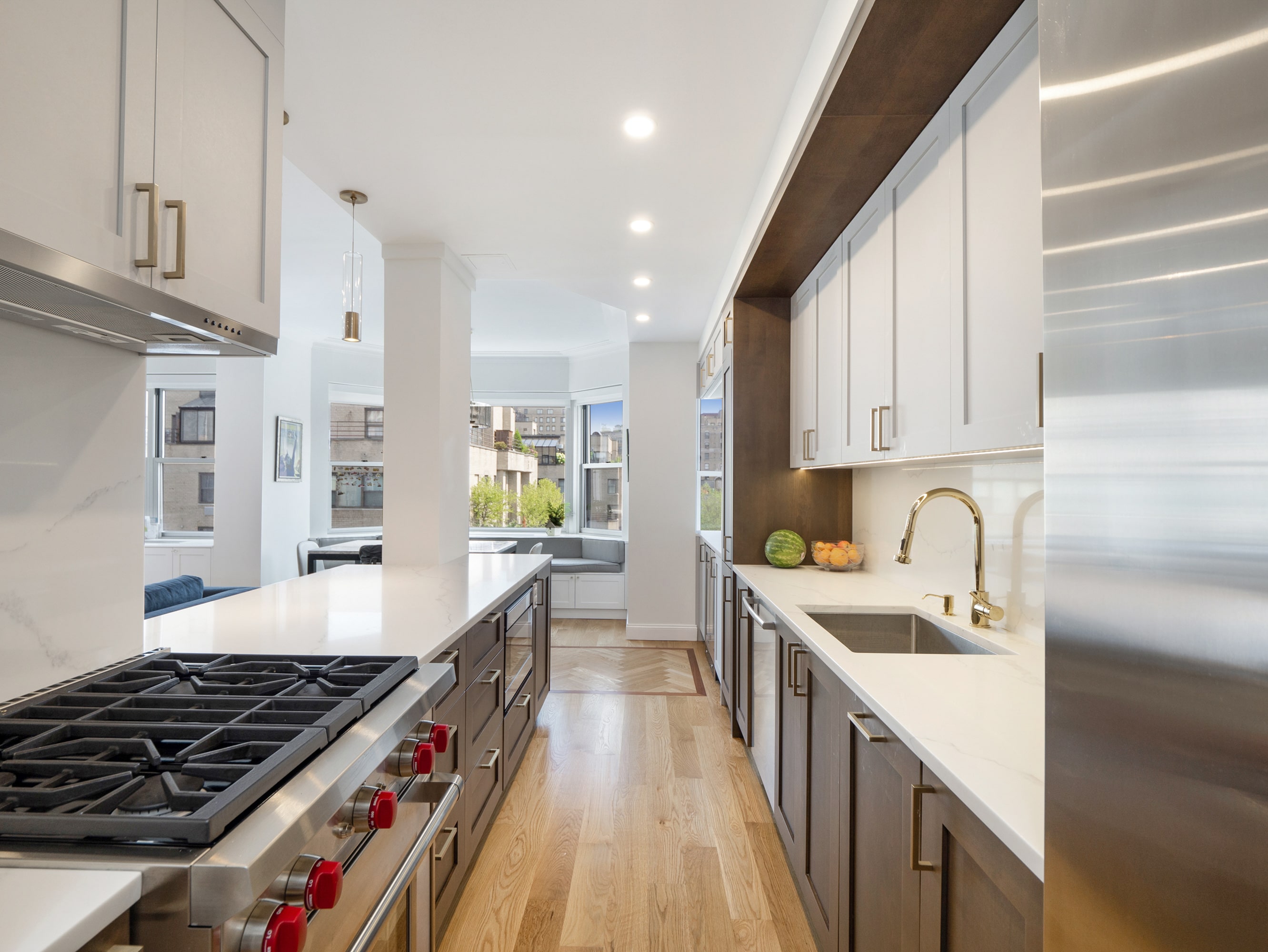
Full Condo Renovation | 8 East 83rd Street, Carnegie Hill
An 1,800 square foot post-war condo transformed from an estate-condition sponsor unit into a warm, modern family home. Custom entertainment wall with integrated storage, built-in banquette seating, bespoke kitchen with herringbone-to-straight-plank flooring transition, two fully redesigned bathrooms, and recessed lighting throughout. Completed in four months. View the full Carnegie Hill renovation before and after.
Pre-War Co-Op Restoration | 1035 Fifth Avenue
A 4,000 square foot Italian Renaissance Palazzo co-op that hadn’t been updated in over fifty years. Complete design overhaul preserving original architectural elements and elegant marble accents, with the addition of a new bathroom and powder room. Custom trims and millwork blended seamlessly with pre-war finishes. Full electrical rewiring completed without compromising historic character. Ten-month project completed to the client’s exacting standards. View the full Fifth Avenue renovation before and after.
.jpg)
West Village Condo Gut Renovation | 17 Cornelia St
A Greenwich Village duplex at 17 Cornelia Street, transformed from two disconnected levels into a cohesive family home. What began as a staircase replacement evolved into a full design-build renovation of both floors, opening up circulation, integrating the cellar into everyday living, and creating a residence built for a growing family. View the full Tribeca renovation before and after.
Gallery KBNY is a full-service design-build firm featured in The New York Times, specializing in the architecture, interior design, and renovation of apartments, co-ops, condominiums, townhomes, and lofts across Manhattan and Brooklyn. Our integrated team of architects, designers, contractors, and project managers manages every phase from board approvals and DOB permitting through design and construction. A founding partner is involved in every project, start to finish. Because architecture, design, permitting, and construction are coordinated under one roof, the process remains streamlined, accountable, and transparent from start to finish. Our work has also appeared in Forbes, Architectural Digest, and Inc., and is backed by 100+ five-star client reviews.
[#8]Frequently Asked Questions About Renovating Before Buying in Manhattan[#8]
While we get many FAQs, below are the most common questions we receive from NYC buyers considering a renovation.
When should I start planning my renovation if I’m buying an NYC apartment?
Ideally, renovation planning should begin during the contract period, before closing. Engaging a design-build firm like Gallery KBNY before you close allows architectural plans, design decisions, and board submission preparation to happen in parallel with your purchase, saving two to three months of post-closing dead time. At minimum, buyers should begin conversations with renovation contractors during the due diligence period.
How much does it cost to renovate a newly purchased apartment in NYC?
Full apartment renovations in NYC typically range from $250 to $500 per square foot, depending on scope and finish level. For a 1,200 square foot apartment, you should expect to invest $300,000 to $600,000 for a mid-range to high-end full renovation. Ultra-luxury and fully custom renovations can reach $600 to $800+ per square foot. Gallery KBNY provides all-inclusive pricing that covers architecture, design, materials, labor, permits, and project management in a single estimate.
How long does a full apartment renovation take after closing in NYC?
From closing to move-in, a full apartment renovation in NYC typically takes 6 to 12 months. This includes 12–16 weeks for design and pre-construction, 4–12 weeks for board approvals and DOB permits (varies significantly by building and runs concurrently to design process), and 4–6 months for construction on an average two-bedroom apartment. Gallery KBNY’s process is designed to compress this timeline by beginning design work before closing.
What is a pre-purchase renovation assessment?
A pre-purchase renovation assessment is an evaluation conducted before a buyer closes on a property. Gallery KBNY’s founding principal walks the prospective apartment with the buyer, evaluates the scope of renovation required, identifies potential red flags (outdated electrical, plumbing issues, structural limitations), and provides an honest budget range. This helps buyers make informed purchase decisions and avoid costly surprises after closing.
Should I hire a general contractor or a design-build firm for my NYC apartment renovation?
For apartment buyers planning a renovation, a full-service design-build firm offers significant advantages over hiring a general contractor separately from an architect or designer. A design-build firm like Gallery KBNY manages architecture, design, permitting, and construction under a single contract with one point of accountability. The traditional approach of hiring an architect and general contractor separately requires the buyer to coordinate between parties, which frequently leads to miscommunication, timeline delays, and budget overruns.
What is the difference between renovating a co-op and a condo in NYC?
Co-op renovations typically require a more extensive approval process, including a signed alteration agreement, board approval of architectural plans, a security deposit ($5,000-$10,000), and review by the building’s architect. Condo renovations generally have a lighter approval process but still require management company sign-off, proof of insurance, and adherence to building rules. Gallery KBNY handles all board approvals, alteration agreements, and DOB permits in-house for both co-ops and condos.
Can I start renovation planning before I’ve closed on the apartment?
Yes, and it’s strongly recommended. Gallery KBNY works with buyers during the contract period to begin pre-purchase assessments, conceptual design, and board submission preparation. While certain steps (like filing DOB permits) require ownership, the majority of planning and design work can be completed before closing, significantly reducing the time between closing day and the start of construction.
What should I look for when evaluating a fixer-upper in NYC?
Key areas to evaluate include the electrical system (pre-war buildings often have outdated wiring), plumbing (galvanized pipes corrode over time), ceiling and wall conditions (which can indicate structural or moisture issues), floor plan flexibility (load-bearing walls limit layout changes), and building-specific restrictions (some co-ops prohibit certain types of work). Gallery KBNY’s pre-purchase feasibility assessment covers all of these areas, giving buyers a clear picture of scope, budget, and timeline before making an offer.
Conclusion
Considering an apartment renovation in New York City and leaning towards a full-service design-build approach? Explore Our Full NYC Renovation Portfolio, learn more about Gallery, or schedule a pre-purchase renovation consultation with our team and make your decision fully informed.
We are a New York Times-featured design-build firm in New York City with a full-service approach to renovations in Manhattan and Brooklyn that includes everything from interior design and architecture services to filing permits and construction management. We’re experts in pre-war apartment renovations, apartment combinations, room creations, full gut renovations and all that falls in between. Let us bring your dream home to life.
let’s
Design-Build
together

.avif)