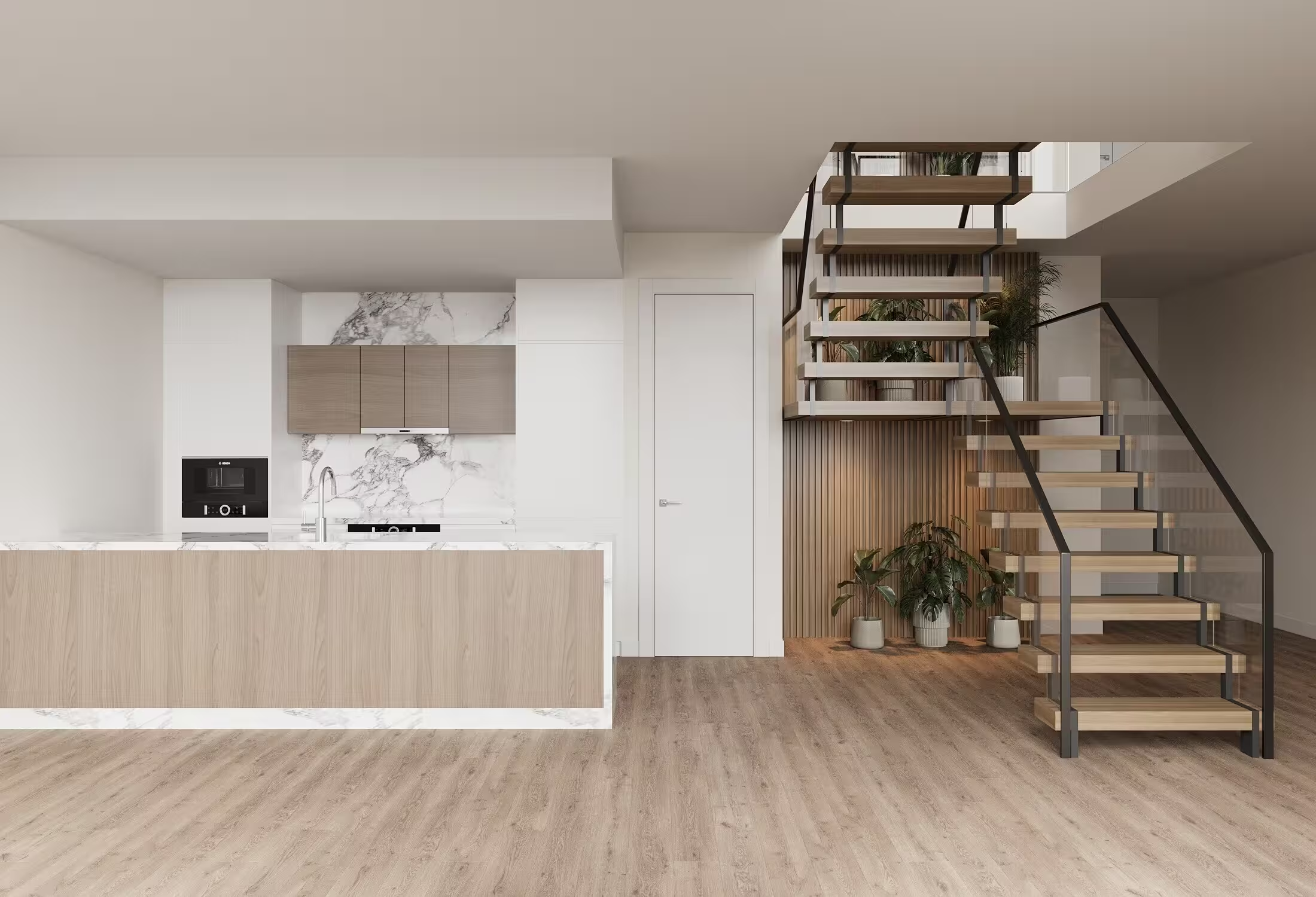
.avif)


.png)
.png)


The Exhale Moment: How Home Design Shapes Well-Being in NYC Renovations
Gallery KBNY explains how light, material, silence, and spatial sequence make a home feel restorative across the full arc of an NYC renovation.
June 3, 2026
|
The Exhale Moment: How Home Design Shapes Well-Being in NYC Renovations
Your apartment can be finished and still not feel like home. Gallery KBNY on the design principles that close that gap
TABLE OF CONTENTS
- From Function to Feeling
- The Role of Light, Material, and Silence
- Flow as a Meditative Principle
- The Architecture of Awe
- Wholeness as the Goal
- What This Looks Like in Practice
- FAQs About Renovating In NYC With Client Well-Being In Mind
Most renovations succeed. The layouts work, the finishes are right, the systems run cleanly. Clients move in and find everything they asked for.
And then, sometimes, they notice something harder to name. The apartment is finished, but it doesn't feel like home yet. The space is correct. It just doesn't restore them.
What closes that gap is intention. Decisions made for the specific person who has to live inside the home every day, rather than for the space in the abstract.
We call the result the exhale moment. A client walks through the door of a finished apartment and something in the body releases. The space communicates that every decision was made with them in mind. That quality has a name in research literature, transcendent well-being, but the label matters less than the experience. The feeling is designable. It can be planned, specified, and built. And it starts at the beginning of the process.
At Gallery KBNY, the interior designer's role isn't a downstream step in the renovation process. Design happens alongside architecture and precedes construction, which means those principles get built into the project before a single wall comes down. That integration is what makes these qualities achievable in practice.
Below is how we think about each of these principles and how they live inside the renovation decisions that produce them.
[#1]From Function to Feeling[#1]
Why Renovation Planning Alone Does Not Produce a Restorative Home
Renovation planning tends to move toward resolution. Decisions get made, drawings get issued, trades get scheduled. The process has its own momentum, pointed at one thing: getting the project built correctly and on time.
Design works against that momentum, in the best possible way. Before the drawings are finalized and the contractors mobilize, the design phase is where the most important question gets considered - is the space right for the person who lives there?
The conditions that determine how a space feels, including proportion, material, light, sequence, and acoustic quality, are each as specific and consequential as any structural calculation. They are also recoverable before construction and nearly impossible to recover after. A wall built in the wrong place can be moved for a price. A home that was never designed to feel like anything particular is much harder to fix. This is one of the many reasons we walk through our floor plans with clients during the process. By getting them to actually feel out proportions in reality, rather than just see them on a blueprint, we can make any last minute adjustments to their needs on the fly.
The Question Behind Every Renovation Decision
Our process relies on one key question for our clients: does this space work for you? Here's how we accommodate:
Where Interior Design Fits in the Design-Build Renovation Process
In a conventional renovation, design and construction are separated by a handoff. The designer produces drawings, the contractor takes them, and the designer's presence in the project diminishes as construction begins. Personalized principles are particularly vulnerable to this gap: a material substitution could get made without considering its acoustic effect, or a lighting position may shift to accommodate the electrician's convenience and throw off the intended experience.
In a design-build process, that gap doesn't exist. The interior designer and the construction team operate within the same organization, share the same accountability, and remain in active communication through every phase of the project. The design intent for well-being is something our team carries together.
.webp)
[#2]The Role of Light, Material, and Silence[#2]
The design elements that most consistently produce peace of mind for clients are light, material, and silence, key variables that are easily an afterthought in the hands of the wrong contractor. Each is the product of a specific set of renovation decisions made during the design phase.
Natural Light and Circadian Design in Apartment Renovation
Light is among the first things the interior designer and architect address together, because light touches every other decision. Partition placement accommodates what light can illuminate. Ceiling heights shape how light distributes across a space. The specification of lighting fixtures determines the emotional temperature of every room.
A lighting plan that creates a genuine temporal dimension in a home, one that shifts with the day and supports the body's circadian rhythms, requires coordination between the design intent and the electrical rough-in.
"Indirect northern light produces calm evenness that supports focus and reflection. Direct southern and western light brings warmth and energy."
A home that layers natural and artificial sources intelligently produces an environment that works with the body's daily patterns rather than against them. In our design-build process, that coordination happens without a gap.
Material Selection as a Physiological Decision
Material selection is where the interior designer's role is most direct. They guide clients through options like raw or lightly finished wood, unsealed plaster, honed stone, and matte-finish metals. These decisions determine how the design registers in the body, alongside how it looks.
"Tactile surfaces that invite touch ground people in the sensory present. They also carry acoustic properties that polished or synthetic surfaces don't. Plaster walls absorb and diffuse sound rather than reflecting it. Solid-core millwork reduces transmission."
These are part of why material specification carries physiological consequences. As our designer Neeraja said, "The designer can interpret your feelings and desires for you, the way you actually move, and how you work with your space."
A material spec sheet is, in the right hands, an acoustic plan and a sensory program for the home.
| Material | Tactile Quality | Acoustic Performance | Ages With Integrity | Well-Being Rating |
|---|---|---|---|---|
| Hand-Applied PlasterWall + ceiling finish | Highly Recommended | |||
| Raw / Lightly Finished WoodFlooring, millwork, casework | Highly Recommended | |||
| Honed StoneCountertops, floors, bath | Recommended | |||
| Woven Linen / WoolTextiles, upholstery, window treatments | Highly Recommended | |||
| Matte-Finish MetalHardware, fixtures, accents | Recommended | |||
| Polished Stone / MarbleCountertops, floors | Use Selectively | |||
| High-Gloss LacquerCabinetry, millwork | Use Selectively |
Acoustic Calm and the Design Decisions That Produce It
Acoustic calm is the quality most frequently overlooked in renovation planning and most consistently undervalued by clients until they live without it. The design decisions that produce a quiet home are solid-core doors, plaster ceilings, textile layering, and acoustic underlayment beneath finished floors. These same decisions give a home its quality of hush. Specifying those core soundproofing elements is a design-phase decision. Once the walls are closed, the opportunity to change them is expensive at best and often gone entirely.
“A quiet room feels safe. Quietness and safety aren't metaphorically related. Neurologically, they're nearly the same state.”
[#3]Flow As A Meditative Principle[#3]
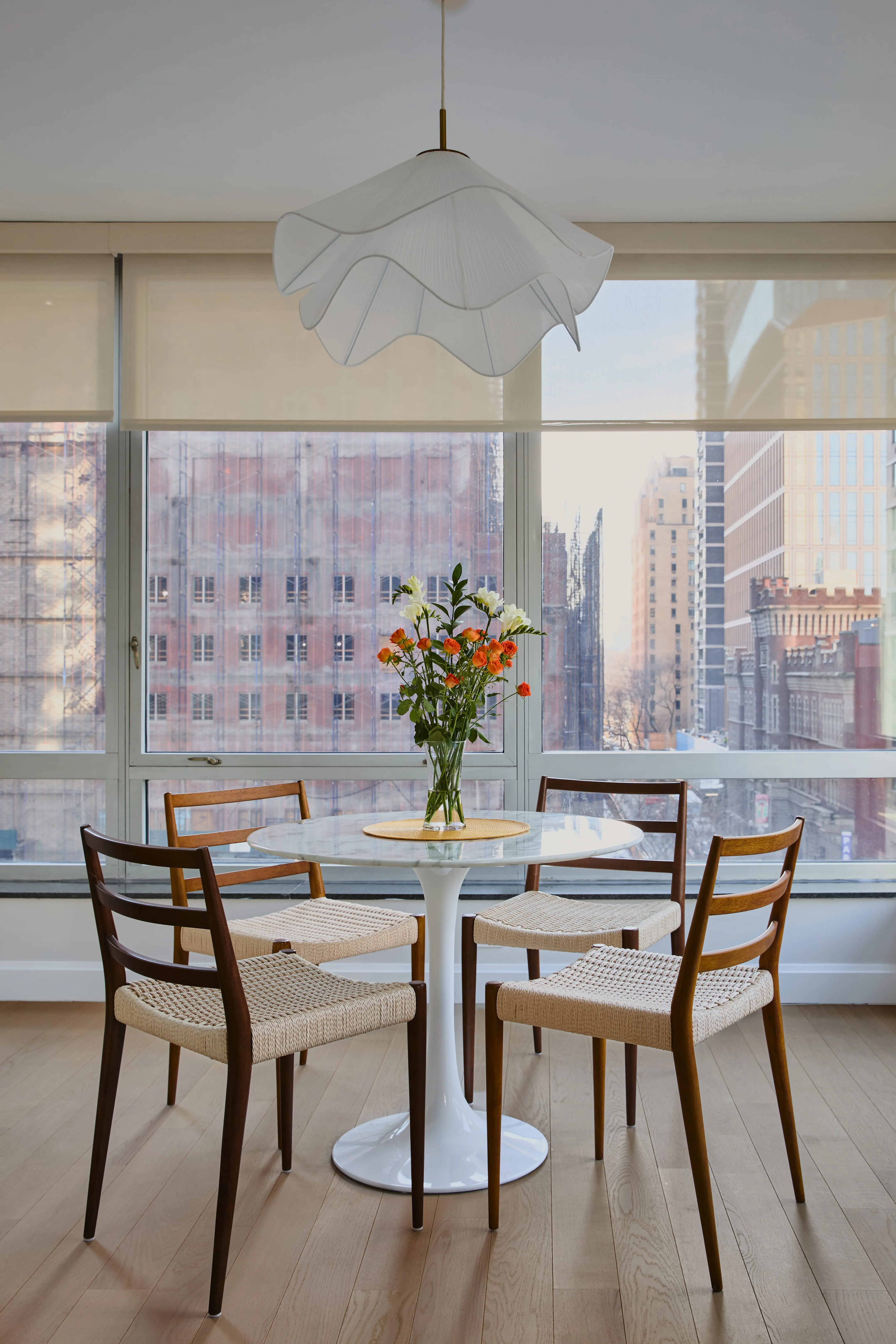
Flow describes how experience unfolds and how each room prepares the occupant for the next one. This scenic sequence creates a rhythm the body registers as design coherence.
What Renovation Clients Mean by Flow, And What They Are Really Asking For
Flow is one of the words renovation clients use early and often. Usually they mean traffic patterns, such as the path from entry to kitchen, the relationship between living and dining, or whether the bedrooms feel accessible without feeling exposed. These are real concerns that belong in the programming conversation.
In the most considered floor plans, though, flow operates at a deeper level.
Compression and Release: Spatial Sequence as Design Principle
That rhythm comes from the relationship between compression and release. A narrow entry gallery that opens into a generously proportioned living room. A lower ceiling in a corridor that gives way to height in the primary space. An intimate reading area adjacent to an expansive view. These are design drivers configured during initial architectural drawings, decisions about where walls go, what ceiling heights get preserved or introduced, and how the floor plan sequences the occupant through the apartment. In a design-build process, the designer and architect make these decisions together, with a shared understanding of how they will be executed in the field.
Entry Through Primary Living
How Spatial Design Transforms Daily Rituals
What this rhythm produces is the experience of ceremony in daily life. Making coffee in a kitchen with genuine proportion and considered light is a different experience from making coffee in a dreary space assembled around the nearest plumbing connection. The space either has a quality of intention or it doesn't. That quality is established during design.
Considering a Renovation in NYC?
Click to schedule a consultation with one of the principle partners at Gallery, who will hear out your renovation plans and let you know the best way to proceed - whether we end up working together or not.
Schedule Your Consultation
[#4]The Architecture of Awe[#4]
What Awe Is And Why It Belongs In Residential Design
Awe is a specific psychological state, offering the experience of something that expands the apparent boundaries of the self. Researchers find that awe reduces self-focused rumination, increases a sense of connection, alters the perception of time, and measurably lowers stress markers (Editor's Note: Sign me up!). Despite public perception, awe is producible in a 1,200-square-foot apartment, and the design conditions that trigger it are specific enough to be planned and built.
The Design Triggers of Awe: Sightlines, Scale, and Perceptual Surprise
The primary triggers in residential spaces are sightlines, scale contrast, and perceptual surprise. A long sightline toward a window flooded with afternoon light, 25 feet across a living room and out through an undivided pane, produces a genuine expansion of perception. A ceiling that rises to 11 feet in a room you entered through a door at standard height does the same. A skylight that throws a column of light across an otherwise quiet wall. An entry condition that compresses before opening up. These aren't decorative choices. They're architectural ones, and they're determined in the rendering process.
.webp)
Where These Decisions Get Made in a Gut Renovation
In most gut renovations, there are decision points where these moves are either made or foreclosed. Whether to restore original ceiling height by removing a dropped grid. Whether to open a sightline by consolidating two smaller rooms. Whether to locate a primary window to frame the sky rather than the building across the street. Each decision has a cost and a trade-off. The designer's role is to identify those moments and make the case for them before the layout is locked.
The goal is what we call emotional proportion, meaning; the specific relationship between height, area, sightline, and entry condition that produces the feeling of expansion in daily use. A room doesn't need to be large to feel expansive. It needs to be exactly right.
%20copy.webp)
[#5]Wholeness As The Goal[#5]
At Gallery, what your interior designer holds throughout the renovation process is the coherence of the whole. The question behind every individual decision is whether it supports the eventual experience of the person who will live there, alongside the functional program.
Coherence Across Thousands of Individual Renovation Decisions
The renovation process produces a lot of individual decisions. Thousands of them, across design, architecture, construction, and specification. That’s why we have project coordinators assigned to every one of our jobs, in addition to a dedicated designer, architect and project manager. Decisions are aplenty, and they all matter.
What Wholeness Feels Like in a Finished Home
The word we use internally at Gallery is wholeness.
"A home that feels whole doesn't announce itself. You walk in and something in the quality of the space communicates that every decision was made with the same set of values."
The space isn't an escape from the world, but instead a home where the world settles into place.
Why Design-Build Integration Protects Well-Being Intent Through Construction
Achieving that quality in practice requires design intent to stay intact through the full arc of the renovation. In a traditional, more separated process, where the designer hands off drawings to a general contractor who manages subcontractors independently, the intent has potential to degrade at every translation point. A lighting position shifts for convenience. A material substitution gets approved without considering its acoustic effect. A ceiling detail gets simplified in the field.
In an integrated design-build process, those translation points are resolved differently. The designer and the construction team share the same project and the same accountability. When a decision in the field touches the design intent, it gets resolved with the designer present rather than around them.
[#6]What This Looks Like in Practice[#6]
These principles are the decisions that define every project Gallery KBNY builds.
1035 Fifth Avenue, Carnegie Hill: Entry Sequence and Spatial Compression
At 1035 Fifth Avenue, a 4,000-square-foot estate-condition pre-war co-op in Carnegie Hill, the design phase established an entry sequence that moves from a compressed, carefully detailed vestibule through a short gallery passage and into a living room with 10.5-foot ceilings and a long sightline toward Central Park. That sequence was a design decision, resolved in drawings before demolition began. It required preserving specific elements of the existing architecture, coordinating ceiling heights across trades, and maintaining the proportional logic through construction. The first time a client walks from that entry into that living room produces exactly the response we design for. Hear that client feedback directly from the source above, then view the full renovation before and after.
MIN.webp)
425 East 58th Street: Layered Light and Material Richness in a Postwar Gut
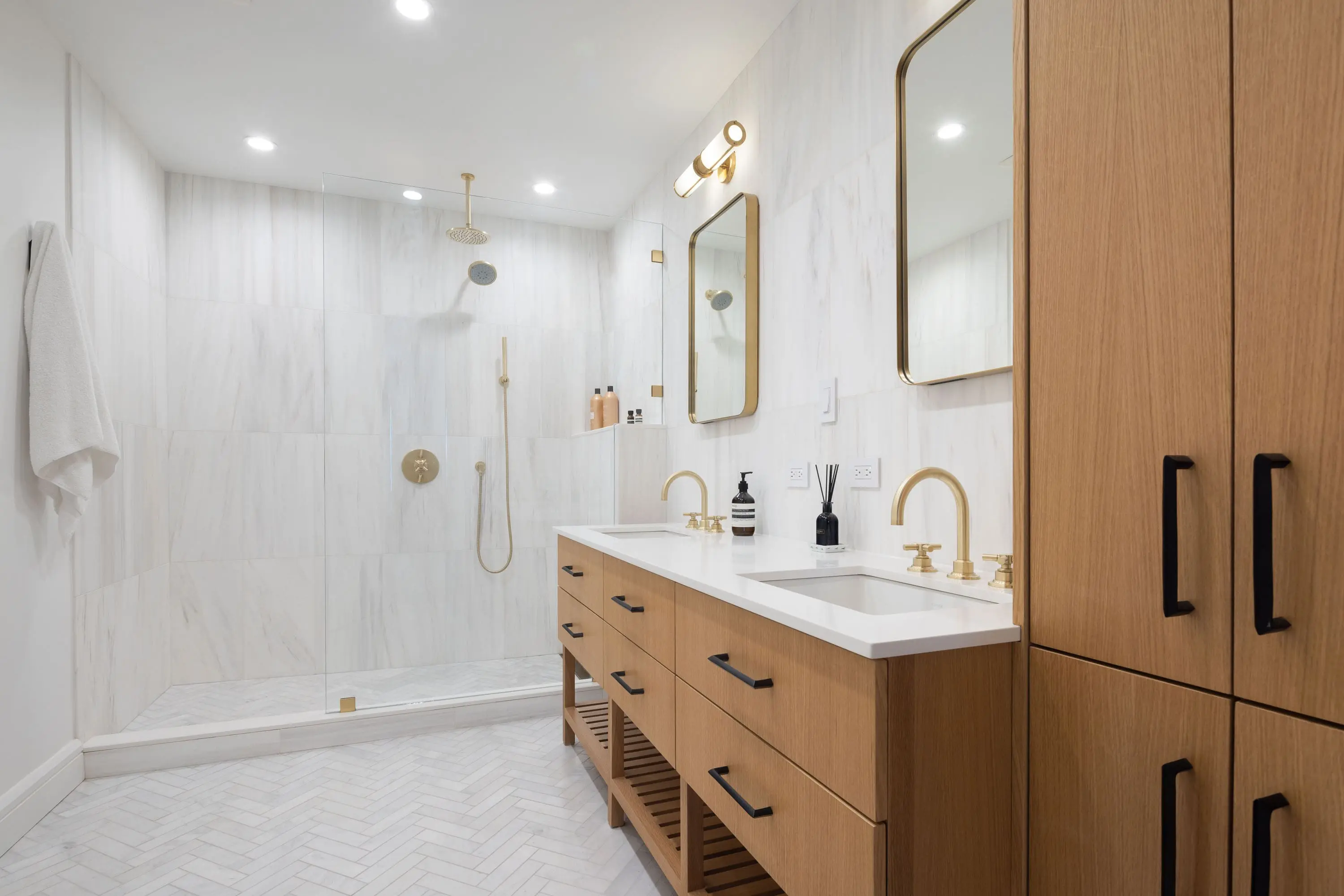
At 425 East 58th Street, a postwar gut renovation, the design work centered on light. The kitchen was reconfigured to open toward southern exposure. The lighting plan layered sources across every room: bright and functional during working hours, warm and low in the evening. The primary bathroom was designed around a single moment of material richness, a specific stone, a specific fixture, a specific proportion that makes a daily ritual feel considered. Each of those decisions required the designer and the construction team to be working from the same set of intentions at the same time. View the full renovation before and after.
MIN.webp)
In each case, the renovation was technically complete and carefully executed. But the design went further, to the question of what the person living in this home would feel, every day, in the spaces they inhabit most.
Considering an apartment renovation in New York City? View our portfolio of NYC renovation before and afters, learn more about Gallery, or contact us to discuss your project.
We are a New York Times-featured design-build firm in New York City with a full-service approach to renovations in Manhattan and Brooklyn that includes everything from interior design and architecture services to filing permits and construction management. We specialize in pre-war apartment renovations, apartment combinations, full gut renovations, and all that falls in between.
Gallery KBNY is a full-service design-build firm featured in The New York Times, specializing in the architecture, interior design, and renovation of apartments, co-ops, condominiums, townhomes, and lofts across Manhattan and Brooklyn. Our integrated team of architects, designers, contractors, and project managers manages every phase from board approvals and DOB permitting through design and construction. A founding partner is involved in every project, start to finish. Because architecture, design, permitting, and construction are coordinated under one roof, the process remains streamlined, accountable, and transparent from start to finish. Our work has also appeared in Forbes, Architectural Digest, and Inc., and is backed by 100+ five-star client reviews.
[#7]Frequently Asked Questions About Designing & Renovating In NYC With Client Well-Being In Mind[#7]
What Is Transcendent Well-Being in Home Design?
A restorative home is the product of specific, designable conditions: natural light calibrated to the body's daily rhythms, tactile materials that ground attention in the physical environment, acoustic calm that reduces ambient stress, spatial sequences that create coherence through compression and release, and moments of perceptual expansion that researchers describe as awe. Together these constitute what the research literature calls transcendent well-being. They are physiological outcomes, ideally established during the design phase before construction locks them in.
How Does Interior Design Affect Well-Being in a Renovation?
Interior design shapes well-being through decisions made before construction begins: where partitions fall, how light is layered, which materials are specified, how acoustic performance is addressed in the drawing set. These decisions determine whether a finished home simply meets its functional brief or actively supports the experience of the person living in it. In a design-build renovation, the interior designer works alongside the architect and contractor, which means the design intent for well-being is present through the full arc of construction.
What Role Does the Interior Designer Play in a Design-Build Renovation?
In a design-build renovation, the interior designer is part of the integrated project team from the beginning. Rather than working in a separate phase and handing off drawings to a general contractor, the designer collaborates directly with the architect on layout, proportion, and spatial sequence, and then remains engaged through construction to ensure that material specifications, lighting plans, and finish details are executed as designed. This integration matters for well-being in particular: the design conditions that produce calm, awe, acoustic quality, and material richness require coordination between design intent and construction execution that a separated process cannot reliably provide.
Can You Design for Well-Being in a Small NYC Apartment?
Small apartments often require more design precision to achieve it. The principles that produce well-being are scale-independent: sightlines, acoustic calm, considered light, honest materials, spatial rhythm. A 700-square-foot apartment can have a long sightline if the layout is open and the windows are positioned correctly. It can have acoustic quality if the materials are specified with that in mind during design. It can produce awe if one architectural moment (a ceiling condition, a framed view, or an entry that opens into an unexpectedly generous space) is designed with that objective and built correctly. The limitation isn't square footage. It's the ambition of the design.
What Is the Role of Natural Light in Home Well-Being?
Natural light is the most consequential single element in residential well-being design. It regulates the body's circadian rhythm, affects mood and alertness, and determines the emotional temperature of a room across the day. The quality and direction of natural light matter as much as its quantity. Indirect northern light produces calm evenness; direct southern and western light brings warmth and energy. A lighting plan that layers natural and artificial sources to support the body's daily rhythms is developed during the design phase and coordinated with the electrical rough-in during construction. In a design-build process, that coordination is built into the workflow.
What Design Elements Create a Sense of Awe in an Apartment?
Awe in residential spaces is triggered by sightlines, scale contrast, and perceptual surprise. Sightlines exceeding 25 feet across a living space toward a window or void produce a genuine expansion of perception. Ceiling heights above 10 feet, particularly when preceded by lower entry conditions, do the same. Framed views of sky or significant outdoor elements, skylights that introduce unexpected natural light, and spatial sequences that move from compression to release are all reliable triggers. Each is an architectural decision made during design and executed in construction.
Why Is Acoustic Design Important in NYC Apartment Renovations?
Ambient noise is a chronic stressor in dense urban environments, and the health consequences of chronic noise exposure are well-documented: elevated cortisol, disrupted sleep, impaired concentration. The design interventions that address it are material and architectural: solid-core millwork, plaster walls and ceilings, textile layering, acoustic underlayment beneath flooring. These are specified during the design phase and executed during construction. Once the walls are closed, the opportunity to change them is expensive or gone. In a design-build renovation, acoustic performance is part of the design brief from the start.
How Do Gallery KBNY Renovations Incorporate Well-Being Principles?
Every Gallery KBNY renovation treats well-being as a design brief. Lighting systems are designed around how each space is actually used across the day. Materials are selected for tactile and acoustic performance alongside aesthetics (plaster, solid-core millwork, and textile layering) because those choices determine the sensory quality of the finished home. Spatial sequences are resolved in the drawings. And because Gallery KBNY is a design-build firm, every one of these decisions is made by the design team and executed by the same organization, without translation loss at the handoff.
What Materials Best Support Well-Being in Home Design?
Materials that support well-being share two qualities: they engage the senses honestly and they age with integrity. Raw or lightly finished wood, unsealed or honed stone, hand-applied plaster, woven linen and wool, and matte-finish metals produce tactile and visual experiences that orient attention toward the physical environment. They also carry acoustic properties that polished or synthetic surfaces lack: plaster absorbs and diffuses sound; soft textiles reduce reverberation. High-gloss lacquer, polished stone, and hard synthetic surfaces are visually stimulating and acoustically live: appropriate in specific applications, but used throughout a home they produce environments that are difficult to rest in. Material selection in a well-designed renovation is a performance decision as much as an aesthetic one.
Is Designing for Well-Being Only Relevant to High-Budget Renovations?
The principles that produce well-being in residential spaces are available across a wide range of renovation budgets: light quality, material honesty, acoustic calm, spatial proportion, and moments of perceptual expansion. Some of the most restorative spaces are among the simplest: well-proportioned rooms with good natural light, honest materials, and acoustic quiet. These qualities follow from design intelligence applied early in the process. What changes with budget is the precision of execution, the quality of specific materials, and the complexity of technical systems.
Designing a Home That Goes Beyond Function?
Evaluate Your Manhattan Apartment
Before You Buy
Buying an apartment you plan to renovate? A founding partner walks it with you during the contract period and maps the scope, cost, and timeline, so you know exactly what you're taking on before you sign.
As seen in
Pre-Purchase Assessment
Walk the apartment with us first and understand the full scope, cost, and timeline before you close.
or call us directly
let’s
Design-Build
together

.avif)