.avif)


.png)
.png)


The Power of Real-Time Floor Plan Walk-Throughs In NYC Renovations
See how real-time floor plan walk-throughs elevate our NYC renovations, giving clients a dynamic way to visualize layouts, make informed decisions, and ensure a seamless path to completion.
June 22, 2026
|
The Power of Real-Time Floor Plan Walk-Throughs In NYC Renovations
Floor plan walk-throughs can transform NYC renovations, helping homeowners visualize spaces and make confident decisions before build.
TABLE OF CONTENTS
- Laying The Foundation For Flexibility
- From Floor Plan To Reality: Seeing & Feeling The Space
- Minimizing Trade-Offs, Maximizing Satisfaction
- Why Proper Planning & The Right Partner Matter
- Frequently Asked Questions About Planning NYC Renovations
A successful NYC renovation rests on more than a strong set of drawings. Refining a home down to the finest detail calls for a process that welcomes adjustments as the space takes shape. These adjustments respond to spatial nuances that come into focus once the layout can be experienced in person. The right renovation partner builds that flexibility into the process, and those well-timed updates often make the decisive difference.
In this article, we explore the importance of real-time floor plan walk-throughs during your NYC renovation and how the right contractor ensures your project stays on track while accommodating key adjustments based on client feedback.
.avif)
[#1]Laying The Foundation For Flexibility[#1]
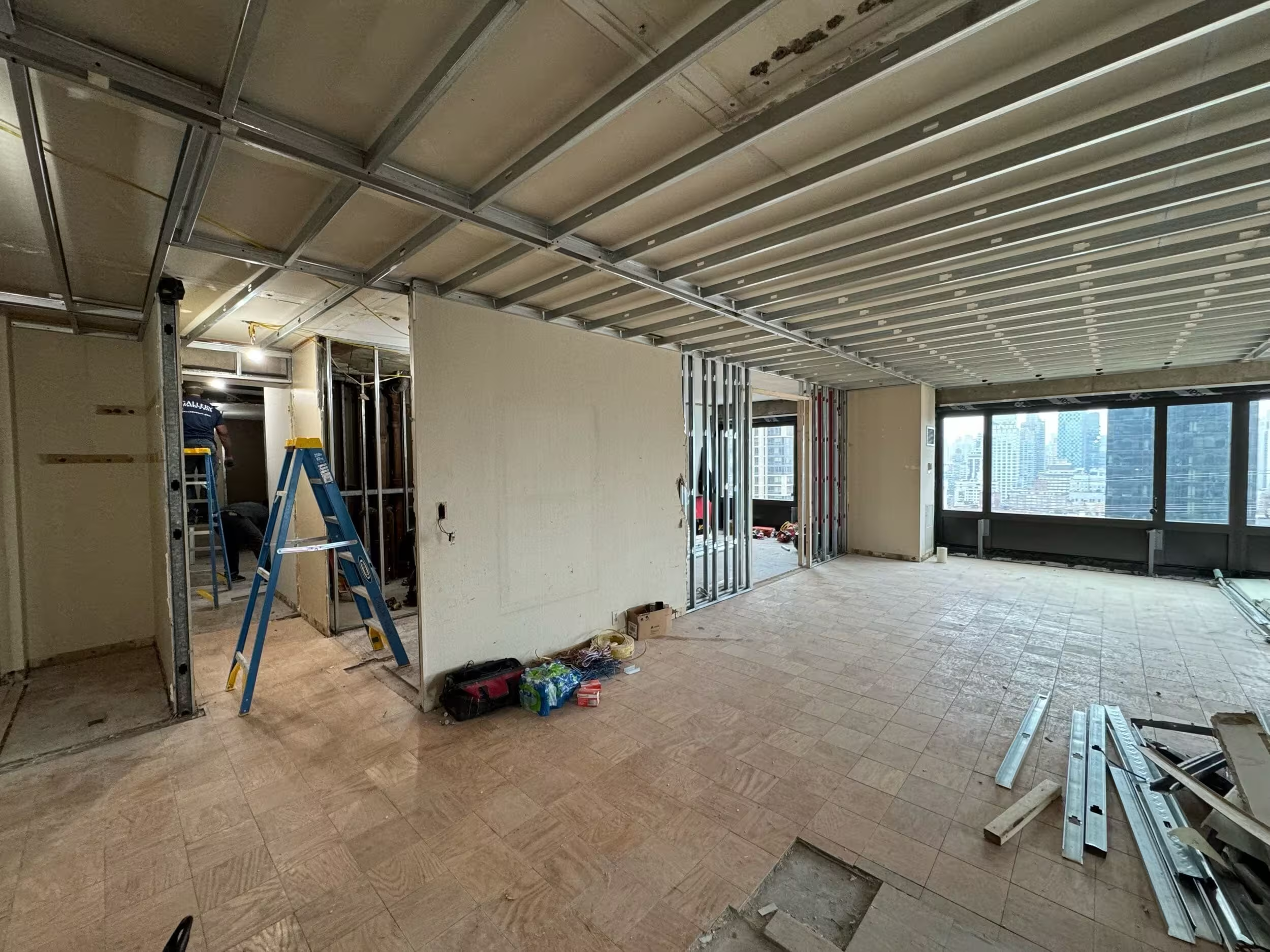
A recent project at 225 Central Park West shows the approach in practice. We installed a new subfloor across the entire apartment before finalizing wall placements, which gave us a smooth, level surface to mark the layout in real space with a temporary track. From there, clients could walk through their future home and read the space firsthand, weighing adjustments while the walls were still lines on the floor.
[#2]From Floor Plan To Reality: Reading The Space In Person[#2]
Floor plans offer a precise vision, and experiencing that layout in person adds a layer of insight that only standing in the space provides. A hallway that reads well on paper can feel tight underfoot, while a bedroom might want a few extra inches for easier flow. Reviewing the plan on-site keeps small changes, such as shifting a wall or widening a turn, straightforward and cost-effective at this stage.
The video below shows how these adjustments unfolded at 225 Central Park West, with Avi walking the Gallery team through the Central Park West renovation.
[#3]Weighing Trade-Offs Before The Build[#3]
Every adjustment carries a ripple effect. Widening one wall by a few inches looks simple on its own, yet the same move can trim closet depth or shift another part of the layout. Addressing these trade-offs before the walls go up keeps decisions proactive and collaborative, so the finished space matches what the client pictured while later costs stay contained.
| The Adjustment | What It Affects | Resolved At The Track Stage |
|---|---|---|
| Widen A Wall A Few Inches | Reduces the depth of the adjacent closet | Rebalanced with the client before framing begins |
| Shift A Doorway | Changes a furniture wall and the entry sightline | Confirmed against the furniture plan on-site |
| Enlarge A Bathroom | Borrows area from a neighboring room or hall | Weighed against how each adjacent space is used |
| Square Off An Angled Corner | Trims usable floor area elsewhere | Compared for net livable space before walls rise |
| Relocate A Closet | Affects circulation and nearby wall runs | Walked and approved within the marked layout |
[#4]Why Proper Planning And The Right Partner Matter[#4]
A successful NYC renovation pairs a strong design with a full-service contractor who blends precise planning and the ability to adapt as the work progresses. See below as our CEO and lead partner discusses the opportunity this proactive procedue procides:
With a design-build firm like Gallery handling every phase from start to finish, clients can trust the renovation to evolve alongside their vision while functionality and aesthetics stay intact.
Considering an apartment renovation in New York City? Learn more about our full design-build renovation process, then review our portfolio of NYC apartment renovation before and afters. Once you’ve learned more about Gallery, please contact us for a consultation.
We are a New York Times-featured design-build firm in New York City with a full-service approach to renovations in Manhattan and Brooklyn that includes everything from interior design, renderings, and architecture services to board approvals plus permits and construction management. We’re experts in pre-war apartment renovations, apartment combinations, room creations, full gut renovations and all that falls in between. Let us bring your dream home to life.
Gallery KBNY is a full-service design-build firm featured in The New York Times, specializing in the architecture, interior design, and renovation of apartments, co-ops, condominiums, townhomes, and lofts across Manhattan and Brooklyn. Our integrated team of architects, designers, contractors, and project managers manages every phase from board approvals and DOB permitting through design and construction. A founding partner is involved in every project, start to finish. Because architecture, design, permitting, and construction are coordinated under one roof, the process remains streamlined, accountable, and transparent from start to finish. Our work has also appeared in Forbes, Architectural Digest, and Inc., and is backed by 100+ five-star client reviews.
[#faq]Frequently Asked Questions About Planning NYC Renovations[#faq]
What does the subfloor-and-track walk-through method involve, and does it add time or cost?
A level subfloor is installed across the apartment, then the approved layout is marked out in a temporary track so the walls exist as physical lines before framing. The step fits within the normal pre-construction sequence and adds little to the schedule, since the subfloor is part of the work regardless. The clarity it provides tends to reduce mid-build changes, which protects the budget over the life of the project.
How late can a layout change be made before it becomes a change order?
The track stage is the last point where a wall can move at minimal cost, since nothing has been framed and no systems have been run. Once framing and MEP rough-in begin, the same change reaches structure, plumbing, and electrical, and it moves into change-order territory. Resolving layout questions during the walk-through keeps the work inside the original contract.
Do co-op board or DOB filings limit the adjustments made during a walk-through?
They set the boundaries. Minor moves that stay within the approved scope, such as nudging a partition a few inches, generally proceed without refiling. Changes that affect egress, wet-over-dry locations, or the filed plans call for coordination with the architect and, where needed, an amended DOB filing and notice to the board. The walk-through is used to settle the in-scope refinements and to flag anything that warrants a filing.
How are walk-through adjustments documented so the filed drawings stay accurate?
Each approved change is recorded and reflected back into the construction set, so the drawings the crew builds from match what was walked. Keeping the filed plans aligned with field conditions matters for inspections, for the building's records, and for any future sale or alteration.
How does a physical walk-through compare with a rendering or 3D model?
A rendering communicates finish, color, and proportion before construction, and a physical walk-through adds true scale along with the sense of moving through the rooms. The two work together, with the rendering setting the visual intent and the marked layout confirming how that intent reads at full size.
Can the method work in an occupied apartment, or does it require a vacant one?
It is most effective once the apartment is vacant and demolition is complete, since the subfloor and track need clear, open floor area. For a combination or a gut renovation, that condition is already part of the timeline, so the walk-through slots in naturally before framing.
Manhattan Design-Build
Evaluate Your Manhattan Apartment
Before You Buy
Buying an apartment you plan to renovate? A founding partner walks it with you during the contract period and maps the scope, cost, and timeline, so you know exactly what you're taking on before you sign.
As seen in
Pre-Purchase Assessment
Walk the apartment with us first and understand the full scope, cost, and timeline before you close.
or call us directly
let’s
Design-Build
together