.avif)


.png)
.png)


NYC Apartment Renovation Costs and Planning Considerations for 2026
Renovation costs in NYC are driven by your building—not your square footage—and our guide explains exactly why.
February 27, 2026
|
.avif)
NYC Apartment Renovation Costs and Planning Considerations for 2026
Renovation costs in NYC are shaped by your building, not just your square footage. Gallery KBNY breaks down what actually drives budgets—and why it matters before you buy.
Table of contents
- Why Renovation Costs in NYC Are Rarely About Square Footage Alone
- Renovation Cost Ranges: A Starting Point
- What Actually Drives Renovation Costs in NYC
- Real-World Cost Scenarios
- Evaluating a Fixer-Upper in Manhattan
- Why Early Feasibility Matters
- Setting Realistic Expectations
- Frequently Asked Questions About NYC Renovation Costs & Planning
Most buyers weighing a fixer-upper in Manhattan focus on what the apartment could become and underestimate what the building will allow.
This guide covers what actually drives renovation costs in NYC, what to look for before you make an offer, and why the planning decisions made before closing are often the most consequential ones.
[#1]Why Renovation Costs in NYC Are Rarely About Square Footage Alone[#1]
After years of renovating apartments across Manhattan, we can say with confidence that renovation costs here are rarely driven by square footage alone. They are shaped by the building itself, its age, infrastructure, rules, and quirks.
Pre-war co-ops and post-war condos bring their own challenges, and newer developments add others. Electrical capacity, plumbing stack locations, work-hour restrictions, approval processes, and existing site conditions all help determine both the cost and what is achievable within your design goals. Understanding these variables early matters, especially for buyers considering a fixer-upper.
[#2]Renovation Cost Ranges: A Starting Point[#2]
As a general planning benchmark, full apartment renovations in Manhattan most commonly fall within a range of $400 to $850+ per square foot. That spread is intentional. A cosmetic renovation consisting of new finishes, minimal layout changes and limited mechanical work looks very different from a full gut renovation involving new plumbing, electrical upgrades, HVAC, and structural reconfiguration. Lumping those together under a single number almost always leads to unrealistic expectations.
For a deeper breakdown of what drives those numbers, including 2026 market trends, hidden costs to budget for, and specific per-room ranges, see our full guide: NYC Apartment Renovation Costs Per Square Foot.
%20(1).avif)
[#3]What Actually Drives Renovation Costs In NYC[#3]
Per-square-foot ballparks are a useful starting point, but the factors below are ultimately what determine where project costs land.
Building Age & Type
Pre-war buildings often require additional work simply to bring systems up to modern standards. Limited electrical capacity, outdated plumbing, asbestos, plaster construction, and decades of piecemeal modifications all add complexity. Floors may need to be leveled. Newer buildings may start with better infrastructure, but they often impose strict rules around HVAC systems, penetrations, and approvals that can be just as limiting in different ways.
Scope And Level Of Intervention
Light renovations tend to sit toward the lower end of the cost spectrum. Once a project involves relocating kitchens or bathrooms, installing new HVAC systems, or significantly altering layouts, costs rise quickly. These projects require more engineering, more coordination, and more board oversight, all of which affect both budget and timeline.
Mechanical & Infrastructure Constraints
In Manhattan, the biggest cost drivers are often hidden. Electrical service limitations, plumbing stack locations, venting restrictions, HVAC feasibility, and window replacement requirements often dictate what can be done before design preferences ever come into play. These constraints vary by building and frequently shape the project more than aesthetic decisions. This is why working with a team like Gallery that is proactive and experienced in your specific building type matters as much as the design itself.
Building Rules & Logistics
Co-op and condo rules directly affect labor efficiency. Limited work hours, restricted elevator access, protection requirements, and lengthy approval processes all add time and cost. Two identical apartments in different buildings can have meaningfully different renovation budgets simply because of how work is allowed to proceed. Learn about our In-Depth Co-Op Board Approval Process For Complex NYC Renovations & What to Expect.
Finishes & Custom Work
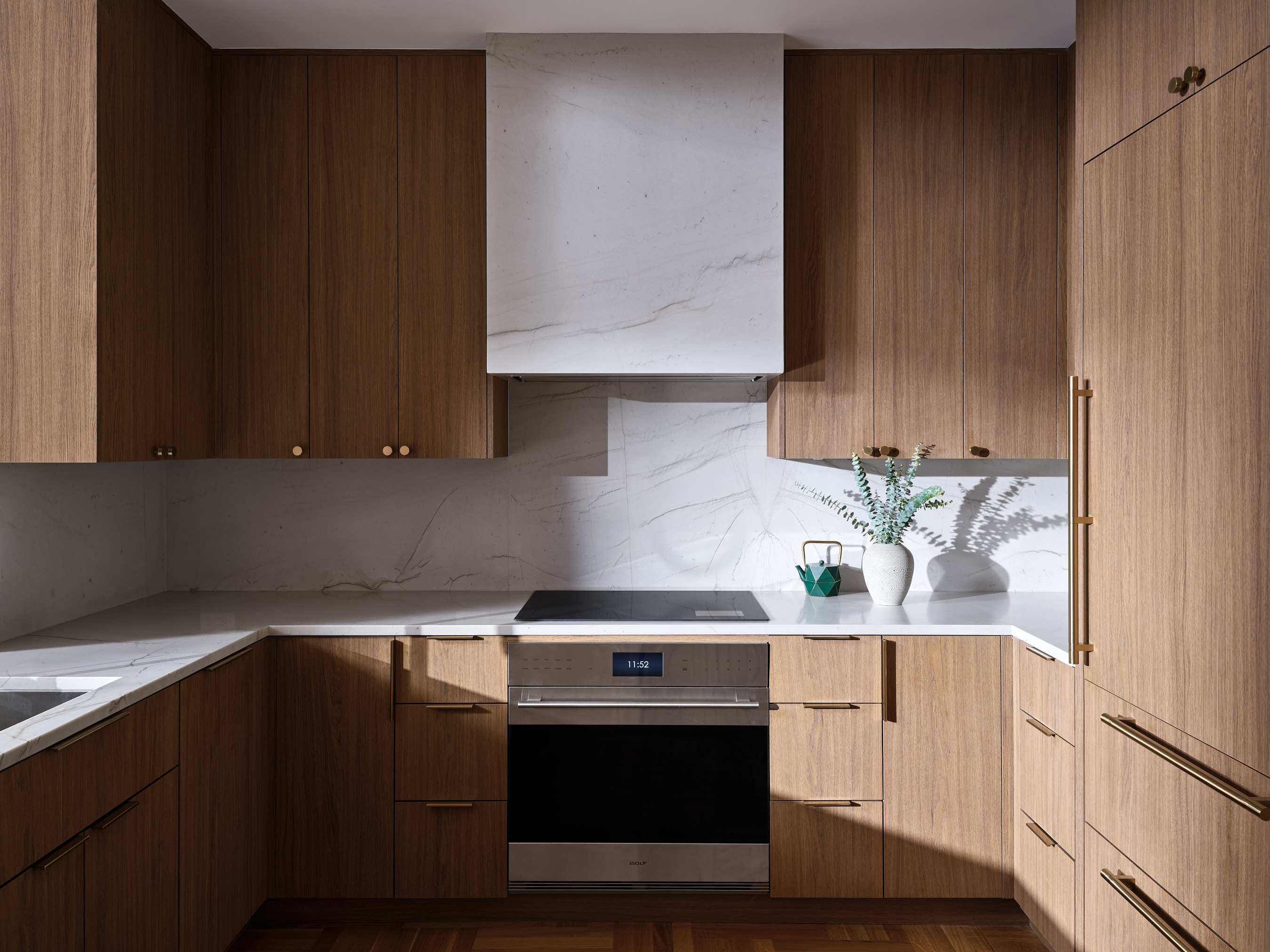
Finish level matters, but customization matters more. Custom millwork, premium stone, integrated lighting, and specialty fabrication all increase coordination and complexity. High-end work isn't just about materials—it's about detailing, sequencing, and execution at every phase.
Existing Conditions
Apartments in estate condition often conceal issues that don't surface during showings, such as asbestos, lead paint, failing plumbing, or outdated electrical work. Identifying these conditions early is one of the most important steps in avoiding budget overruns and schedule disruptions.
-min.jpg)
[#4]Real-World Cost Scenarios[#4]
The ranges below show how scope and building type translate into real budgets for a roughly 1,800-square-foot apartment.
Pre-War Apartment | Full Gut Renovation, Upper–Mid-Level Finishes
For a roughly 1,800-square-foot pre-war apartment in estate condition, including HVAC work and upper–mid-level finishes, renovation costs commonly fall in the range of:
$500–$650 per square foot , approximately $850,000 to $1,000,000+ total
Pre-War Apartment | High-End / Luxury Renovation
When a project moves into higher-end or luxury territory (IE: extensive custom millwork, advanced lighting systems, significant HVAC upgrades, and potential window replacements) costs often increase to:
$650–$850 per square foot, approximately $1,000,000 to $1,500,000+ total for a similar-sized apartment
These projects require more coordination, longer lead times, and a higher level of detailing, reflected in both budget and schedule.
Newer Building Apartment | Comprehensive Renovation
In a newer building with solid infrastructure, where scope focuses on layout refinement and cosmetic upgrades rather than major mechanical work, costs for a similar-sized apartment more typically land around:
$400–$500 per square foot, approximately $650,000 to $900,000 total
[#5]Evaluating a Fixer-Upper in Manhattan[#5]
When clients are considering a fixer-upper, we look beyond finishes and focus on the constraints that materially affect feasibility and cost:
- Plumbing riser locations and limits on relocating fixtures, particularly gas
- Electrical service capacity and upgrade requirements
- HVAC feasibility and building-specific rules
- Window replacement restrictions and landmark considerations
- Structural limitations, including load-bearing walls
- Board approval processes and alteration agreement requirements
- Permitted work hours and renovation duration limits
- Presence of asbestos or lead-based materials
Many of these factors aren't visible during a walkthrough but can significantly influence the renovation once planning begins. This is precisely why early feasibility work, conducted before an offer is made, changes the conversation entirely.
MIN.jpg)
[#6]Why Early Feasibility Matters[#6]
Reviewing an apartment's renovation potential before making an offer often reframes the entire purchase decision. Early feasibility work clarifies what's realistic within a specific building, where compromises may be required, and how scope, budget, and timeline are likely to align.
At Gallery KBNY, we routinely conduct these evaluations during pre-purchase and pre-construction phases for Manhattan co-ops, condos, and pre-war buildings. Our founding principal walks the property with you - before you make an offer or during the contract period - and provides a clear-eyed assessment of scope feasibility, budget range, and any red flags. The goal isn't to sell a scope. The goal is to identify issues early, define renovation scenarios that are actually achievable, and give you the info needed to make a confident purchase decision.
[#7]Setting Realistic Expectations[#7]
Never forget, building-specific limitations and scope complexity ultimately determine real budgets and timelines. In Manhattan, disciplined planning grounded in experience is what reduces uncertainty, limits scope changes, and leads to predictable outcomes. This is especially the case in pre-war buildings, where anything is on the table.
The difference between a renovation that goes sideways and one that delivers on every expectation comes down to how well potential issues were diagnosed prior to planning.
Gallery KBNY is a full-service design-build firm featured in The New York Times, specializing in the architecture, interior design, and renovation of apartments, co-ops, condominiums, townhomes, and lofts across Manhattan and Brooklyn. Our integrated team of architects, designers, contractors, and project managers manages every phase from board approvals and DOB permitting through design and construction. A founding partner is involved in every project, start to finish. Because architecture, design, permitting, and construction are coordinated under one roof, the process remains streamlined, accountable, and transparent from start to finish. Our work has also appeared in Forbes, Architectural Digest, and Inc., and is backed by 100+ five-star client reviews.
[#8]Frequently Asked Questions About NYC Renovation Costs & Planning[#8]
What Drives Renovation Costs In NYC Apartments Beyond Square Footage?
In NYC, renovation costs are primarily shaped by building age and type, the condition of existing mechanical systems, building-specific rules and logistics, scope of work, and finish level. Pre-war buildings often require electrical upgrades, plumbing remediation, and asbestos abatement that post-war or newer buildings don't. Two apartments of identical size in different buildings can have significantly different renovation budgets based on these factors alone.
How Much Does It Cost To Renovate A Pre-War Apartment In Manhattan?
A full gut renovation of a pre-war apartment in Manhattan typically ranges from $500 to $650 per square foot for upper–mid-level finishes, and $650 to $850+ per square foot for high-end or luxury scope. For a 1,800-square-foot apartment, that translates to approximately $850,000 to $1,500,000+ depending on conditions and finish level. For a full breakdown by renovation type and scope, see Gallery KBNY's NYC renovation cost per square foot guide.
What Should I Look For When Evaluating A Fixer-Upper In NYC?
Key factors to evaluate include electrical service capacity, plumbing configuration and riser locations, HVAC feasibility, floor plan flexibility given load-bearing walls, building-specific restrictions on permitted work, and whether asbestos or lead-based materials are present. Many of these aren't visible during a standard walkthrough, which is why a pre-purchase feasibility assessment with an experienced renovation firm is strongly recommended before making an offer.
What Is A Pre-Purchase Renovation Assessment And Do I Need One?
A pre-purchase renovation assessment is an evaluation conducted before closing on a property. Gallery KBNY's founding principal walks the prospective apartment with the buyer, assesses scope feasibility, identifies infrastructure constraints and red flags, and provides a realistic budget and timeline range. For anyone considering a fixer-upper in Manhattan or Brooklyn, this assessment is one of the most valuable steps in the buying process, because it surfaces the issues that cause budget overruns before they become your problem.
When Should Renovation Planning Begin For An NYC Apartment Purchase?
Renovation planning should begin during the contract period, before closing. Engaging a design-build firm before you take possession allows architectural plans, design decisions, and board submission preparation to run in parallel with due diligence and financing. This approach can compress the time between closing and move-in by two to three months, reducing carrying costs and dead time significantly.
Does Building Type Affect How Much A Renovation Costs In NYC?
Yes, significantly. Pre-war buildings carry higher baseline renovation costs due to aging infrastructure, plaster construction, and code compliance requirements. Post-war and newer buildings generally start with better mechanical infrastructure but often impose their own restrictions on HVAC systems, penetrations, and approved scopes of work. The building's rules and logistics (work hours, elevator access, approval processes) also directly affect labor efficiency and total cost.
Ready To See The Difference?
At Gallery KBNY, we’re a New York Times-featured design-build firm in New York City with a full-service approach to residential renovations in Manhattan and Brooklyn that includes everything from interior design and architecture services to filing permits and construction management.
Whether you are planning a full gut renovation, considering a fixer-upper purchase, or evaluating renovation firms for the first time, Gallery KBNY's principal-led team is ready to walk you through what your project would actually involve - honestly, specifically, and no pressure.
Considering an apartment renovation in NYC? View our full portfolio of New York City renovation before and afters, learn more about Gallery KBNY, or simply contact us today.
Manhattan Design-Build
Evaluate Your Manhattan Apartment
Before You Buy
Buying an apartment you plan to renovate? A founding partner walks it with you during the contract period and maps the scope, cost, and timeline, so you know exactly what you're taking on before you sign.
As seen in
Pre-Purchase Assessment
Walk the apartment with us first and understand the full scope, cost, and timeline before you close.
or call us directly
let’s
Design-Build
together