.avif)


.png)
.png)


Home Remodeling Glossary: Key Design & Architecture Terms
What's the difference between modern, minimalist & mid-century modern? Gallery KBNY breaks down the meaning of the top design and architecture terms.
November 8, 2025
|

Home Remodeling Glossary: Key Design & Architecture Terms
The words behind a renovation should mean something specific. The Gallery KBNY team defines the fifteen design and architecture terms we use most, from modern to pre-war.
Table of contents
- Chic
- European
- Farmhouse
- Mid-Century
- Mid-Century Modern
- Minimalist
- Minimalist
- Modern
- Pre-War
- Post-War
- Scandinavian
- Transitional
- Design-Build
Modern, mid-century modern, transitional, pre-war: the words behind a renovation get used loosely. Here is what each one means, defined by the Gallery KBNY team.
Design language gets slippery fast. Modern, mid-century, and mid-century modern often get used as if they mean the same thing, and a term like transitional can stretch to cover almost anything. Naming the look you want is the first real step in a renovation, since it gives your design team a clear target before a single wall moves.
This glossary defines the fifteen design and architecture terms that come up most in NYC homes, written by the Gallery KBNY team. As a full-service design-build firm, the same people who define these styles also design and build them, across whole-home renovations in Manhattan and Brooklyn. Each definition reflects how the term actually shows up in a finished apartment, loft, or townhouse.
The terms also sort into a few families, and the pre-war and post-war labels point to building eras rather than looks. The charts ahead map both before the A-to-Z begins.
.webp)
[#Chic]Chic[#Chic]
As an adjective, it means elegant, often effortlessly so. In the home renovation world, it’s often used, as the second part of a noun, to modify or specify a broader design term. So, “farmhouse chic” would mean a kitchen or bath whose rustic, natural feel is executed in a way that’s simple and refined.
[#Country]Country[#Country]
Country style is warm and traditional, rooted in rural design. It favors natural materials such as hickory and oak, inset cabinetry, and soft earth tones that make a room feel settled and homey. The result reads relaxed and timeless. Country shares a family resemblance with farmhouse, which carries that same warmth into more utilitarian, industrial-edged territory.
.webp)
[#European]European[#European]
When used with other descriptors, this word can describe design with any Continental influence, but when it’s used on its own in home remodel settings, it typically refers to a modern, often Scandinavian-tinted design. (We’ll get to Scandinavian design in a bit.)
.webp)
[#Farmhouse]Farmhouse[#Farmhouse]
Similar to country, but with a hint of industry and function-first priorities.
-min.webp)
[#Century]Mid-century Modern[#Century]
A subset of mid-century style with a clear set of signatures. Think Eames chairs, tapered legs, organic curves, and large windows that pull the outdoors in.
[#Minimalist]Minimalist[#Minimalist]
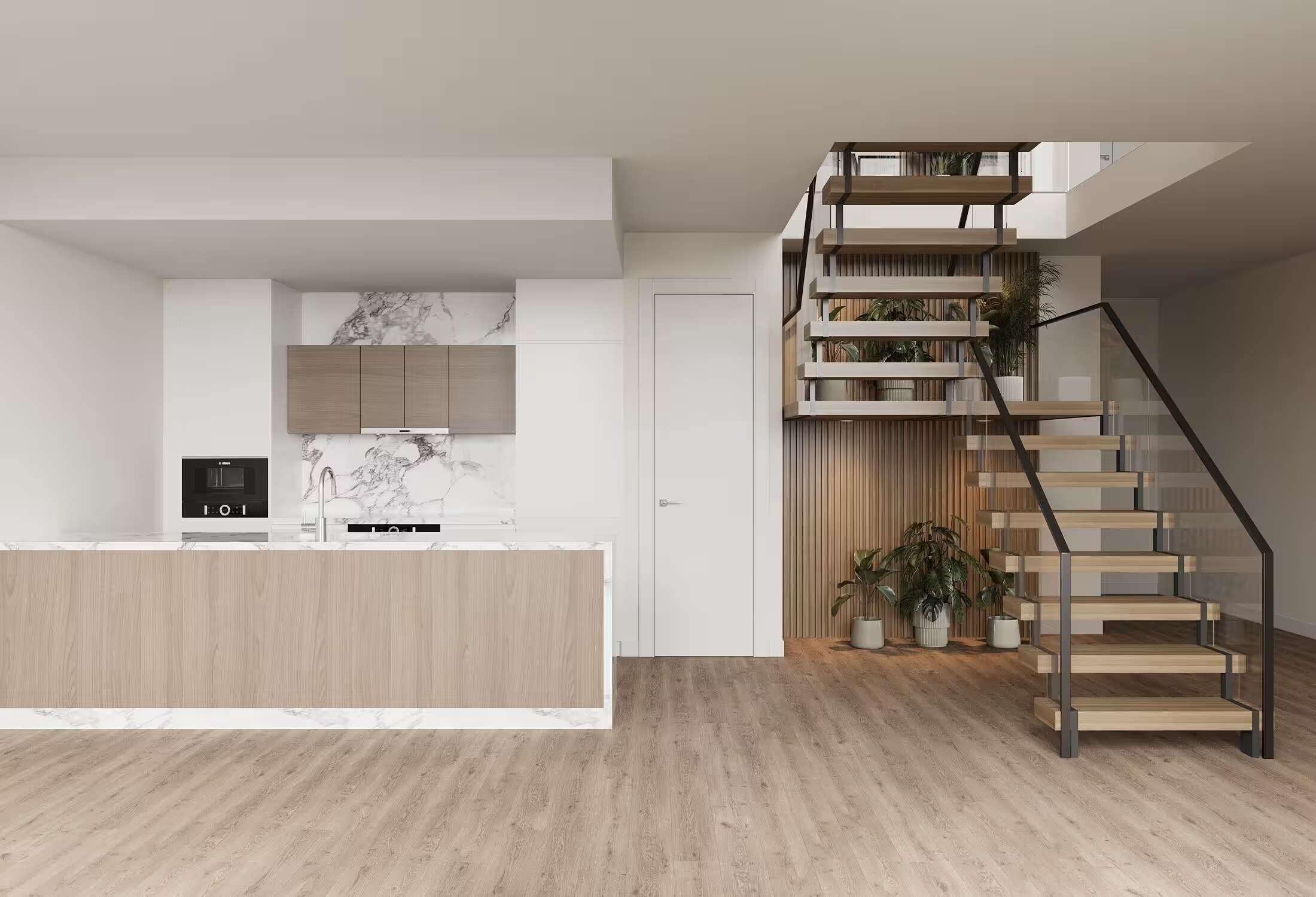
A clean, unadorned look that eschews loud patterns and baroque extras for a function-forward feel.

[#Modern]Modern[#Modern]
Modern design grew out of the early-to-mid 20th-century Modernist movement, favoring clean lines, open space, and minimal ornament. It works as an umbrella that covers mid-century, mid-century modern, Scandinavian, European, and many minimalist looks.

[#Pre]Pre-war[#Pre]
Pre-war apartments were generally built between the 1890s and 1939, and they carry architectural detail that is hard to find in newer buildings. Expect solid oak floors, high ceilings, decorative wood molding, and original fireplaces. See examples via our pre-war renovation before and afters.
MIN.webp)
[#War]Post-war[#War]
Post-war refers to American buildings and design from roughly 1945 to the 1970s. The era overlaps with mid-century modern in furniture and finishes, though the term points more to the building stock of the period than to one decorating style. In NYC, post-war apartments tend toward simpler layouts, larger windows, and ceilings around eight feet.
[#Scandinavian]Scandinavian[#Scandinavian]
This typically describes design that is functional, modern, and minimalist, along with structures and angles that feel homey yet innovative and clean.
%20Gallery%20KBNY.webp)
[#Transitional]Transitional[#Transitional]
This is a design style whose name refers to the transition between classic and modern. That, in itself, is a broad concept (what is classic? What is modern?), but it typically means mixing ornamental elements, like crown molding, with modern elements, like sleek flat panel kitchen cabinets.
[#Design-Build]BONUS: Design-Build Firm[#Design-Build]
Ready to start your own NYC apartment renovation? As a full-service design-build firm in New York City, Gallery handles home renovations from start to finish, driving all aspects of a client's project from interior design and architectural planning to building board management and demolition plus construction. Learn more about how our all-inclusive design-build process differs from a traditional design-bid-build approach. Ready to renovate? Contact us for a consultation.
Gallery KBNY is a full-service design-build firm featured in The New York Times, specializing in the architecture, interior design, and renovation of apartments, co-ops, condominiums, townhomes, and lofts across Manhattan and Brooklyn. Our integrated team of architects, designers, contractors, and project managers manages every phase from board approvals and DOB permitting through design and construction. A founding partner is involved in every project, start to finish. Because architecture, design, permitting, and construction are coordinated under one roof, the process remains streamlined, accountable, and transparent from start to finish. Our work has also appeared in Forbes, Architectural Digest, and Inc., and is backed by 100+ five-star client reviews.
[#Transitional]Frequently Asked Questions About How Design & Architecture In NYC Renovations [#Transitional]
How do I figure out which design style fits my home?
Start with the spaces you keep returning to in photos, then look for the through-line. Saved images of pale wood, white walls, and uncluttered rooms point toward Scandinavian, while tapered-leg furniture and warm walnut lean mid-century modern. Your apartment gives the second cue, since its era, light, and proportions all favor certain looks. A design team can read both inputs and translate them into a clear direction before any plan is drawn.
Can I combine more than one design style in the same home?
Yes, and most finished homes do. The key is a shared thread that ties the choices together, usually a consistent palette, a repeated material, or a level of formality held steady from room to room. Transitional and eclectic are two named ways of doing this well. A blend reads as intentional when one style leads and the others support it, instead of competing for attention.
Can a pre-war apartment be renovated in a modern style?
Absolutely, and the contrast often becomes the most striking part of the home. The usual approach keeps the character details worth saving, such as moldings, hardwood, and ceiling height, then sets clean contemporary elements against them. The building's structure guides where walls and systems can move, so the design works with the pre-war framework rather than against it.
Do I have to commit to one style for the whole home?
No. A whole-home renovation usually carries one overall direction for cohesion, with individual rooms free to shift in mood. A calmer, minimal feel in the bedrooms can sit comfortably beside a livelier living room, as long as the materials and palette stay in conversation across the spaces. A loose through-line keeps the home reading as one place while giving each room its own character.
How do I communicate the style I want to a design team
Bring examples rather than adjectives. A folder of saved images, a few rooms you love, and notes on what specifically draws you tells a designer far more than a single style label. Flagging what you want to avoid helps too, since it narrows the direction quickly. From there, the team can put a name to the direction and show it back to you, tested against your actual space.
Should I choose a style that is trending right now?
Treat trends as inspiration, and build on a style with staying power. A look chosen for its quality and fit tends to satisfy far longer than one picked because it is current. The useful question is which style suits how you live and the home you are in, since that is what keeps a renovation feeling right years after the work wraps. Trend-driven choices are easiest to enjoy in elements that refresh easily later, such as textiles, paint, and decor.
Manhattan Design-Build
Evaluate Your Manhattan Apartment
Before You Buy
Buying an apartment you plan to renovate? A founding partner walks it with you during the contract period and maps the scope, cost, and timeline, so you know exactly what you're taking on before you sign.
As seen in
Pre-Purchase Assessment
Walk the apartment with us first and understand the full scope, cost, and timeline before you close.
or call us directly
let’s
Design-Build
together