.avif)


.png)
.png)


How Much Does It Cost to Renovate an Estate-Condition Pre-War Apartment on the Upper East Side?
Buying an estate-condition UES pre-war? Read this first.
April 1, 2026
|
How Much Does It Cost to Renovate an Estate-Condition Pre-War Apartment on the Upper East Side?
Gallery KBNY explains 2026 costs, timelines, hidden variables, and what buyers should know before they renovate.
Renovating an estate-condition pre-war apartment on the Upper East Side typically costs $500–$850+ per square foot in 2026, depending on apartment size, infrastructure condition, finish level, layout changes, and building requirements. For a 1,800-square-foot classic six or classic seven, that often translates to approximately $900,000 to $1,400,000+ before contingency.
That is the direct answer. But for Upper East Side buyers, the more important question is usually not just what the renovation will cost on paper. It is why these projects cost what they do, what hidden variables shape the budget, and whether an estate-condition apartment is actually a better all-in value than a unit that simply looks more updated.
Estate-Condition Pre-War Renovation on the UES: Key Cost & Planning Insights (2026)
- Full Gut Renovation, Upper Mid-Tier Finishes: $500–$650 per square foot
- Full Gut Renovation, Luxury Finishes: $650–$850+ per square foot
- 1,800 Sq Ft Estate-Condition Renovation: Approximately $900,000–$1,400,000+
- 2,000 sq ft estate-condition renovation: approximately $1,000,000–$1,700,000+
- Asbestos And Lead Abatement: $15,000–$40,000+
- Full Electrical Rewiring: Typically $30,000–$60,000+
- Central HVAC Installation: Typically $80,000–$150,000+
- Plaster Wall Restoration / Reconstruction: Often $15,000–$35,000+ Depending On Extent
- Upper East Side Co-Op Board Approval: Typically 8–12 weeks
- Typical Full Project Timeline: 10–14 months
Most important insight: “Somewhat dated” pre-war apartments often cost nearly the same to renovate as estate-condition units because the underlying infrastructure and building requirements are often identical
Table of contents
- What Makes Estate-Condition Pre-War Apartments Different
- Cost Breakdown by Scope and Finish Level
- The Infrastructure Variables That Drive Cost
- Board Approvals, Permits, and Upper East Side Building Culture
- 2026 Market Factors Affecting UES Renovation Costs
- Case Study: 1035 Fifth Avenue
- Why “Somewhat Dated” Often Costs the Same as Estate-Condition
- Why Design-Build Is the Right Model
- Frequently Asked Questions
[#1]What Makes Estate-Condition Pre-War Apartments Different[#1]
An estate-condition apartment is not simply an older apartment. It is usually a unit that has gone largely untouched for decades, often 30, 40, or 50+ years, without ever being brought through a modern renovation cycle.
On the Upper East Side, these apartments are often found in pre-war co-ops built between the early 1900s and the 1940s along Fifth Avenue, Park Avenue, Madison Avenue, and throughout Carnegie Hill and Lenox Hill. They often come with extraordinary architectural character, but they also come with infrastructure realities that are easy to underestimate during a showing.
What makes these units fundamentally different is that the largest cost drivers are often invisible at first glance. A buyer may notice dated finishes, but not aging or inadequate wiring, deteriorated plumbing, asbestos-containing materials, lead-based paint, plaster-and-lath wall conditions, or the absence of any central HVAC infrastructure.
That is why these apartments are almost always best understood as gut renovations in NYC, not light updates. And for a deeper look at the unseen scope, see our guide to hidden costs of renovating estate-condition pre-war apartments.
[#2]Cost Breakdown By Scope & Finish Level[#2]
For most estate-condition Upper East Side apartments, a full gut renovation is the practical baseline. Once you are addressing electrical, plumbing, wall conditions, HVAC, kitchens, baths, and board requirements, there is usually little advantage in trying to renovate only selectively. For broader market context, see our guide to NYC apartment renovation costs per square foot.
NYC Renovation Pricing Guide
2026 Renovation Cost Ranges
Typical costs for Manhattan and Brooklyn residential renovations.
All figures reflect current labor, material, and regulatory conditions in New York City.
| Renovation Scope | Typical Cost Range (2026) | Key Variables |
|---|---|---|
| Upper mid-tier gut renovation | $450–$550 / sq ft | Building age, infrastructure condition, scope complexity |
| Luxury gut renovation | $550–$650+ / sq ft | Custom millwork, premium stone, integrated HVAC, design density |
| Co-op soft costs (board fees, deposits, permits) |
$25,000–$75,000+ | Building-specific; varies by alteration agreement |
| Electrical service upgrade (if needed) |
$10,000–$12,000 / floor | Distance from basement to unit; building infrastructure |
| Asbestos abatement (if found) |
$8,000–$40,000+ | Extent and location; required by NYC law |
* Cost ranges are estimates based on 2026 NYC market conditions and Gallery KBNY project data. Final scope and pricing are determined through a formal pre-construction assessment. Figures do not include furniture, fixtures, or appliances unless otherwise specified.
These ranges assume a true full-gut scope: full electrical replacement, plumbing replacement, HVAC work, wall reconstruction where needed, new kitchen and baths, flooring, millwork, permits, board submissions, and full project management.
What Separates Upper Mid-Tier from Luxury
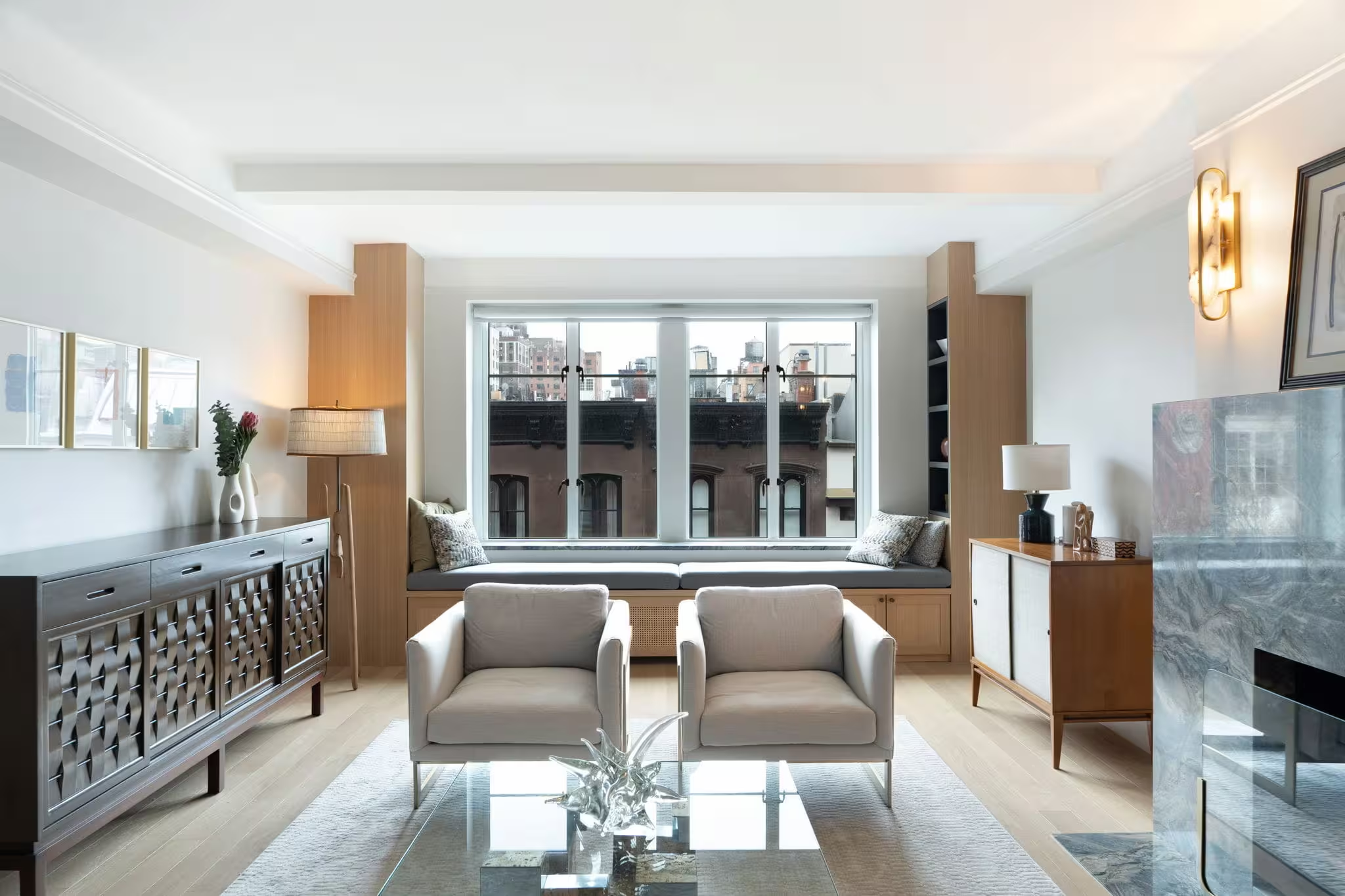
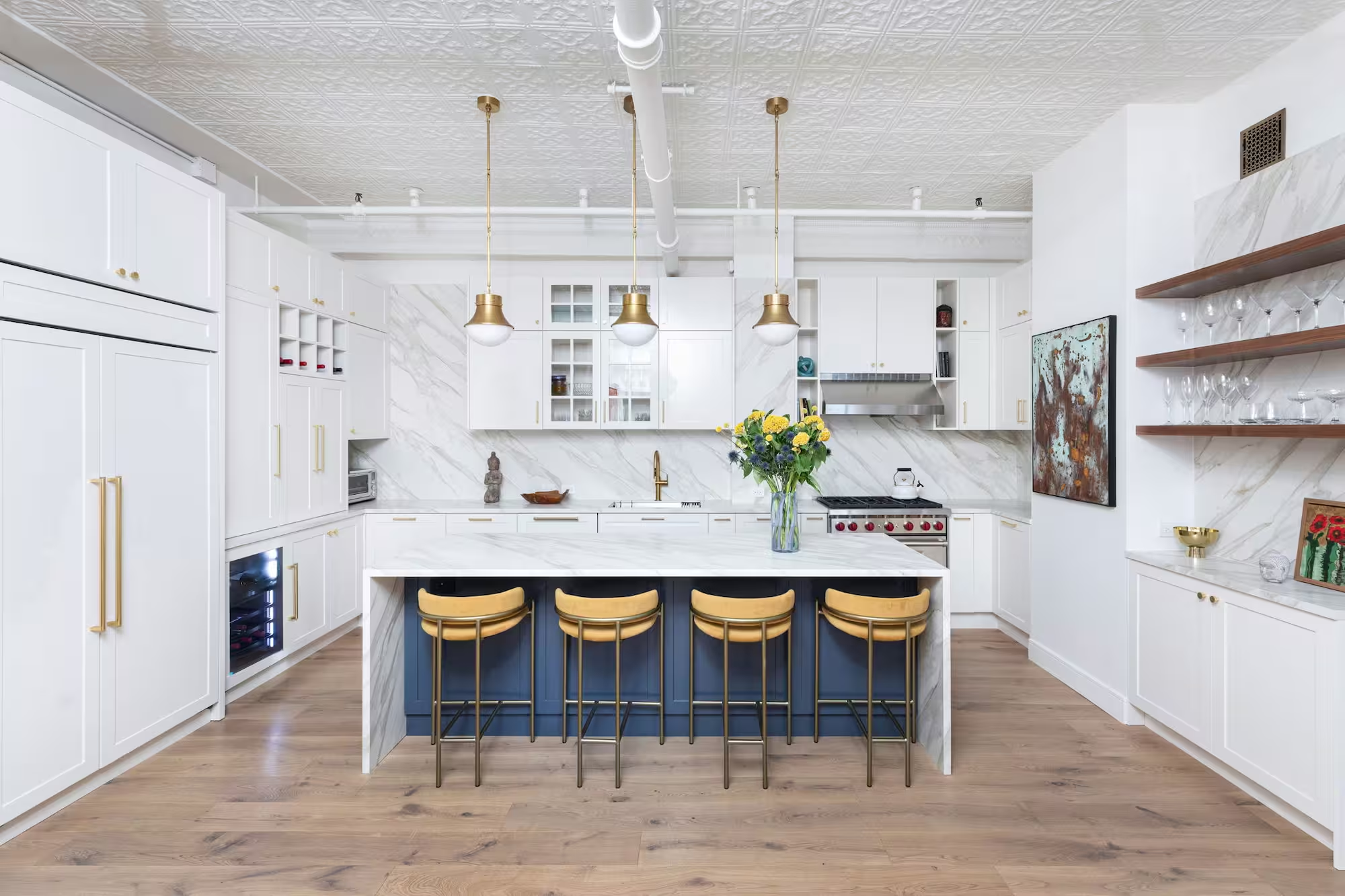
At the $500–$650/sf level, expect very strong quality, but generally not ultra-custom at every touchpoint. That may include high-quality hardwood flooring, custom or semi-custom cabinetry, quartz or select natural stone, quality plumbing fixtures, thoughtful lighting, and restoration or replication of pre-war trim details.
At the $650–$850+/sf level, the scope often expands to more complex layout reconfiguration, premium stone and custom fabrication, high-end appliances, substantial custom millwork, zoned HVAC, integrated lighting, smart home features, and more extensive restoration of original architectural elements.
[#3]The Infrastructure Variables That Drive Cost[#3]
In estate-condition pre-war renovations, infrastructure is often the real budget engine. In many cases, it represents 25–40% of the total project cost before finish selections meaningfully come into play.
Asbestos and Lead Abatement
Pre-war buildings on the Upper East Side frequently contain asbestos in some form, whether in old floor tiles, pipe insulation, joint compound, or other concealed materials. Lead paint is also common in virtually every pre-1978 apartment.
- Typical Cost Range: $15,000–$40,000+, depending on scope and where hazardous materials are found.
Electrical Rewiring
Many estate-condition apartments still contain outdated wiring that cannot support contemporary electrical demand and may not satisfy modern code expectations.
- Typical Cost Range: $30,000–$60,000+
This is one of the most common hidden issues and one of the most expensive surprises for buyers who have never renovated a pre-war apartment. It also frequently appears alongside the broader category of common surprises when renovating in Manhattan buildings.
Plumbing Replacement
Older galvanized pipes corrode internally over time, which can affect pressure, performance, and reliability. Full replacement costs vary, but in larger apartments with multiple wet rooms, this becomes a major line item.
- Typical Cost Range: $30,000–$50,000+, and higher depending on complexity.
HVAC Installation
Adding central air to a pre-war apartment that was never designed for it is one of the most technically demanding parts of the renovation.
- Typical Cost Range: $80,000–$150,000+
Routing constraints, soffits, mechanical locations, refrigerant requirements, and building conditions all matter. For more, see custom HVAC solutions for pre-war renovations.
Walls, Structure, and Existing Conditions
Plaster-and-lath wall systems require different demolition and rebuilding methods than drywall construction. Structural conditions may also limit what can be opened, reframed, or combined.
- Typical Cost Range: $15,000–$35,000+ for wall-related scope depending on extent.
[#4]Board Approvals, Permits, and Upper East Side Building Culture[#4]
Upper East Side co-op buildings are often among the most administratively demanding in Manhattan.
The renovation budget is not shaped only by construction scope. It is also shaped by alteration agreement requirements, insurance minimums, approved trade rules, construction hour limits, deposits, completion deadlines, and board review timelines.
Many Upper East Side alteration agreements require stricter terms than buyers expect, including elevated insurance coverage, labor law or action-over requirements, building-approved plumbers for certain work, narrow work windows, significant refundable deposits, and meaningful penalties for delay.
That is why understanding co-op alteration agreements and the full process of board approvals and permitting is essential well before construction begins.
Typical Timeframes
- Board Approval: 8–12 weeks
- DOB Permit Processing: Often 6–8 weeks depending on scope
- Pre-Construction Process Overall: Often 4–6 months before work begins on site
For Upper East Side projects, this timeline discipline matters as much as the construction budget itself.
NYC Renovation Planning Guide
Renovation Timeline: Phase by Phase
What to expect from first consultation to move-in day,
based on a full gut renovation of a Manhattan co-op or condo.
| Phase | Typical Duration | Notes |
|---|---|---|
1Design + architectural plans |
12–16 weeks | Must be detailed enough for board architect review |
2Board approval + alteration agreement |
8–12 weeks | Dependent on board meeting schedule |
3DOB permits |
6–8 weeks | Concurrent with or following board approval |
4Construction |
16–30 weeks | Scope-dependent; restricted hours extend timeline in co-ops |
| Total: Consultation to Move-In | 10–16 months | Full gut renovation; shorter for limited scopes |
* Timelines are estimates based on Gallery KBNY project data and current NYC regulatory conditions. Board schedules, DOB backlog, and building-specific requirements can affect actual durations. A founding partner is involved at every phase to keep projects on track.
[#5]2026 Market Factors Affecting UES Renovation Costs[#5]
Upper East Side renovation costs in 2026 are also being shaped by broader market conditions. Compared with recent years, costs remain affected by higher material pricing, labor cost growth, code and compliance demands, and procurement volatility in certain categories. For background, see our article on how tariffs impact NYC renovation costs.
What matters specifically on the Upper East Side is that these pressures land on top of older housing stock. Estate-condition pre-war apartments are more labor-intensive than recently renovated or post-war units. So when labor costs rise, these projects tend to feel that increase more acutely.

[#6]Case Study: 1035 Fifth Avenue: A 4,000 SF Estate-Condition Transformation[#6]
Our renovation at 1035 Fifth Avenue is a strong example of what a true estate-condition pre-war renovation on the Upper East Side looks like in practice.
The Apartment
Located in an Italian Renaissance Palazzo co-op at the corner of Fifth Avenue and 85th Street, the apartment overlooked Central Park and had not been materially updated in more than 50 years when the client purchased it.
It was a textbook estate-condition unit: original infrastructure, dated interiors, no modern systems, and no realistic path to a partial renovation.
The Scope
The renovation involved full gut renovation, electrical rewiring, plumbing replacement, HVAC installation, new kitchen and baths, additional bathroom creation, and the preservation and reinterpretation of original architectural character.
The project also required careful handling of building restrictions, including wet-over-dry limitations and board expectations typical of high-standard Upper East Side co-ops.
The Design Approach
Rather than imposing a design language that fought the apartment’s original architecture, the project respected its heritage while modernizing its functionality. Existing marble accents and architectural details were integrated into a new design that felt resolved, not imposed.
Client Perspective
The project also reflects something especially important for prospective buyers: the value of experienced decision-making early. The greatest risks were not visible in the finishes. They were hidden in infrastructure, layout feasibility, building coordination, and how all of those factors affected cost and scope.
See the full 1035 5th Ave renovation before and after.
[#7]Why “Somewhat Dated” Often Costs the Same as Estate-Condition[#7]
This is one of the most important conversations we have with buyers considering renovation on the Upper East Side.
Many people assume that a “somewhat dated” apartment (for example, one last updated in the 1990s or early 2000s) should be significantly cheaper to renovate than a true estate-condition unit. That seems logical at first. But in practice, the difference is often far smaller than expected, and in many cases, the total renovation cost converges.
Why the Cost Often Converges
Because in pre-war co-ops, the real drivers are usually not cosmetic.
Even if an apartment looks more updated on the surface, it often still has underlying infrastructure that needs replacement, no central HVAC, wall systems with the same limitations, plumbing constraints, and exactly the same board, permitting, and building requirements.
Once the renovation includes layout changes, kitchen and bathroom replacement, electrical upgrades, plumbing work, HVAC installation, or code-related updates, the project often triggers the same level of systemic work whether the apartment looks untouched since 1975 or superficially refreshed in 2002.
The Partial Renovation Trap
Buyers of somewhat dated apartments often hope to do less. In theory, that sounds cost-efficient. In practice, it often creates a mismatch: older systems remain in place, soft costs remain largely the same, board process remains the same, and newly renovated rooms may make the rest of the apartment feel even more unfinished.
This is one reason many buyers ultimately end up doing more work than they initially intended.
Why This Can Make Estate-Condition a Better Buy
If renovation cost converges regardless of cosmetic condition, then the lower acquisition price of an estate-condition apartment can produce stronger all-in value. That is why buyers evaluating Upper East Side apartments should not just compare purchase prices. They should compare purchase price plus realistic renovation cost. For related context, see renovating a fixer-upper in NYC.
This is also exactly where a pre-purchase renovation assessment becomes valuable: understanding the all-in number before you commit.
How We Can Help
If you are evaluating an Upper East Side apartment and want clarity on likely renovation cost, scope, and timeline before signing, Gallery KBNY is happy to be a resource.
Considering an Estate-Condition Apartment
on the Upper East Side?
Schedule a pre-purchase renovation assessment.
Schedule Your Consultation
[#8]Why Design-Build Is the Right Model for Estate-Condition Renovations[#8]
Estate-condition Upper East Side renovations involve overlapping technical, regulatory, and logistical variables from the very beginning.
These projects require coordination across abatement, demolition, architecture, MEP planning, board approvals, DOB permitting, procurement, and construction sequencing.
That is exactly where fragmentation becomes expensive.
A design-build structure does not remove complexity. It manages complexity more effectively by keeping architecture, design, pricing, approvals, and construction aligned earlier in the process.
At Gallery KBNY, our in-house team works from one integrated process rather than a handoff model. That means infrastructure realities are evaluated earlier, pricing is aligned earlier, board and permit planning are built into the process, and scope is less likely to drift after design is already advanced. You can learn more about our design-build process or explore how a full-service design-build firm compares to a more fragmented route.
Gallery KBNY is a full-service design-build firm featured in The New York Times, specializing in the architecture, interior design, and renovation of apartments, co-ops, condominiums, townhomes, and lofts across Manhattan and Brooklyn. Our integrated team of architects, designers, contractors, and project managers manages every phase from board approvals and DOB permitting through design and construction. A founding partner is involved in every project, start to finish. Because architecture, design, permitting, and construction are coordinated under one roof, the process remains streamlined, accountable, and transparent from start to finish. Our work has also appeared in Forbes, Architectural Digest, and Inc., and is backed by 100+ five-star client reviews.
[#9]Frequently Asked Questions[#9]
How much does it cost to gut renovate an estate-condition pre-war apartment on the Upper East Side?
In 2026, a full gut renovation of an estate-condition pre-war apartment on the Upper East Side typically costs $500–$650 per square foot for upper mid-tier finishes and $650–$850+ per square foot for luxury scope. For a 1,500-square-foot apartment, that usually translates to roughly $750,000–$1,275,000+, depending on infrastructure condition, layout changes, and building requirements.
What is an estate-condition apartment?
An estate-condition apartment is a unit that has not been materially renovated in decades, often 30 to 50+ years. These apartments typically retain older infrastructure such as outdated wiring, older plumbing, plaster wall systems, and may also contain hazardous materials such as asbestos and lead paint.
Is it cheaper to renovate a somewhat dated pre-war apartment than an estate-condition one?
Often, not by as much as buyers expect. In many Upper East Side pre-war apartments, the underlying infrastructure, building requirements, and board constraints are the same regardless of whether the unit looks untouched or was cosmetically updated 20–25 years ago. Once a renovation includes major systems and layout work, total costs often converge.
How long does it take to renovate an estate-condition pre-war apartment on the Upper East Side?
A realistic total timeline is usually 10–14 months from early planning through completed construction. Pre-construction, design, approvals, and permitting often take 4–6 months, while construction commonly takes 6–8 months depending on apartment size, building rules, and scope complexity.
Do I need asbestos testing before renovating a pre-war apartment?
Yes. Asbestos testing is generally required before filing renovation plans with the NYC Department of Buildings, and it is also commonly required under co-op alteration agreements. Because asbestos is prevalent in many pre-war buildings, it should be identified early so cost and abatement scope are understood before construction begins.
Can I add central air to a pre-war apartment on the Upper East Side?
Yes, but it is usually one of the more complex and expensive components of the renovation. Most pre-war buildings were not designed for central air, so routing, mechanical strategy, soffits, and building conditions all need to be carefully evaluated. Typical costs often fall in the $80,000–$150,000+ range.
What are the biggest hidden costs in estate-condition pre-war renovations?
The biggest hidden costs are usually not cosmetic. They are infrastructure-related: asbestos abatement, lead remediation, electrical rewiring, plumbing replacement, HVAC installation, plaster wall reconstruction, and building-specific compliance requirements such as insurance, deposits, and approved-trade restrictions.
How long do Upper East Side co-op approvals usually take?
Board approvals commonly take 8–12 weeks, though some buildings may take longer depending on their review process and submission requirements. DOB permits can add additional time depending on scope.
Should I get a renovation assessment before buying an estate-condition apartment?
Yes, especially if you are comparing multiple apartments or trying to understand all-in cost before signing a contract. A pre-purchase renovation assessment can help identify likely infrastructure issues, board-related constraints, and realistic budget and timeline expectations before you commit.
Why are Upper East Side pre-war renovations so demanding?
Because they combine three layers of complexity at once: older infrastructure, high architectural expectations, and rigorous co-op building oversight. That combination makes them some of the most nuanced renovation projects in Manhattan.
.avif)
[#10]The Bottom Line on Estate-Condition Pre-War Renovation Costs on the Upper East Side[#10]
Estate-condition pre-war apartments on the Upper East Side offer something that is increasingly rare: the opportunity to create a highly personal home inside a building with architectural quality and character that modern construction often cannot replicate.
But the budget is driven by infrastructure reality, not by surface appearance.
That is why the smartest buyers and homeowners approach these projects with a full understanding of what the building will allow, what the apartment actually requires, how long the process will take, and why “dated” and “estate-condition” often end up much closer in cost than expected.
The goal is not simply to renovate beautifully, but make decisions with clarity before renovation begins.
let’s
Design-Build
together