.avif)


.png)
.png)


The Pre-Closing Renovation Step That Changes Everything
A pre-purchase renovation consultation shows NYC buyers what an apartment can become before closing. Gallery KBNY explains the hidden costs it uncovers and how to use them in negotiation.
May 20, 2026
|
.avif)
The Pre-Closing Renovation Step That Changes Everything
Wondering if your NYC renovation needs an architect? Learn when plans are required, who to hire, and how a design-build firm can simplify the process.
TABLE OF CONTENTS
- Why Most NYC Property Buyers Miss This Critical Step
- Hidden Costs That Surface After Closing
- What A Pre-Purchase Renovation Consultation Reveals
- Real-World Impact: Before And After Stories
- When To Walk Away Vs. When To Negotiate
- Frequently Asked Questions About Planning For NYC Renovations
The difference between a smooth NYC renovation and a six-figure surprise often comes down to a step taken before closing. At Gallery, we are brought in by buyers every week, and many of the deal-breaking challenges that emerge after purchase could have been spotted earlier through a single move: a pre-purchase renovation consultation.
Picture two buyers eyeing the same apartment. The first skips the consultation and learns after closing that an open kitchen runs into structural walls and plumbing stacks, or that the electrical service cannot carry the washer-dryer that was central to the plan, which adds months of delay and a stack of unplanned cost. The second brings us in beforehand for a pre-purchase walk-through, where we usually identify the limitations and map a realistic path to the goal within that first visit. The second buyer moves forward with full clarity about what lies ahead.
This article carries the same intent as those walk-throughs: helping a prospective buyer set clear expectations about whether a purchase can meet their renovation goals before the contract is signed.
[#1]Why Most NYC Property Buyers Miss This Critical Step[#1]
From our experience, here’s where most buyers go wrong and and what they often overlook:
Where An Inspection Stops
Most buyers assume a traditional inspection covers the ground that matters. An inspection focuses on safety and structural integrity, confirming that the apartment is sound to live in, and it stops short of whether the property can become the home a buyer has in mind. A broker helps set expectations while working toward a sale, so renovation feasibility and the building's restrictions sit outside that role. An inspector is trained to flag what needs repair, and the question of what can be transformed, and at what price, falls to a different kind of assessment.

Where Renovation Consultations Come In
A renovation consultation fills that gap. We are brought in by prospective buyers every week to assess whether a property's condition and restrictions align with their design goals. In a pre-war building, we flag unlevel floors early and explain what leveling costs, along with how to adapt the design where leveling is impractical. A co-op with a strict board or limited heating and cooling often needs HVAC adjustments, which we identify and guide clients through to approval. When a buyer hopes to replace windows, we explain at the outset how Landmarks Preservation Commission review may shape the process and outline the path to approval.
The Benefit of Taking This Step Early
Taking this step before closing means the layout and the systems you envision are priced and understood early, while the information can still guide your decision and your offer.
| The Question | Standard Inspection | Renovation Consultation |
|---|---|---|
| Is the apartment safe and structurally sound? | Covered | Covered |
| Can this wall come down for an open kitchen? | Not assessed | Assessed with engineering input |
| Will the electrical support central air or a washer-dryer? | Not assessed | Evaluated against your plans |
| Can the plumbing stacks be relocated? | Not assessed | Mapped on-site |
| Will the board and DOB permit the plan? | Not assessed | Reviewed from the start |
| What will the renovation cost and how long will it take? | Not assessed | Estimated in real ranges |
[#2]Hidden Costs That Surface After Closing[#2]
While every property has unique nuances that may add limitations, below are the most common post-purchase renovation surprises we see in NYC properties.
Structural Modifications
Open-concept kitchens and expanded living space are common goals, and the walls in the way are sometimes load-bearing or home to critical infrastructure. Removing or altering a structural wall calls for engineering oversight and Department of Buildings approval, along with meaningful reinforcement. Anticipating that work before purchase keeps an ideal layout within reach and within budget.
Electrical & Plumbing Upgrades
Older NYC apartments, pre-war co-ops in particular, often run on systems built for lighter demand. A plan to add central air, upgrade to smart appliances, or relocate a bathroom can run past what the existing electrical service or plumbing stacks support. Bringing systems up to code may involve rewiring lines, a ConEd service upgrade, or replacing corroded pipe, each of which adds time and calls for coordination with building management.
Permit Complications
What looks like a straightforward kitchen renovation can trigger several DOB filings. Moving plumbing, modifying structural elements, or adding mechanical systems each calls for specific permits, and the review can run from weeks into months with city agencies. Buyers who treat permitting as a formality tend to be surprised by the expense and the timeline of multi-stage approvals, and by the cases where an approval does not come through.
Building-Specific Restrictions
Every NYC building carries its own rules. A co-op board can limit work hours, restrict certain renovations, and enforce alteration agreements that carry penalties when breached. A landmark-designated property adds Landmarks Preservation Commission review for any exterior-facing change, including window replacements. For a buyer new to these constraints, the rules can shape flexibility, timeline, and budget in ways that are far easier to plan for when known in advance.
Access Restrictions
Renovation costs in NYC can climb for reasons few buyers expect, and one of the most surprising is simply moving materials in and out of the building. A walk-up means everything arrives by hand, while a building with a small service elevator can require large pieces to be fabricated to fit. Access can also shape design, such as sizing a countertop slab to clear an elevator. A partner who anticipates these constraints plans around them from the start. In our Chelsea Co-Op Renovation at 107 W 25th St, we met that exact slab challenge, and through extensive coordination and building approvals we opened the elevator shaft on the second floor, set the slab on top of the elevator car within the shaft, and had the crew ride the elevator roof to the fourth floor to receive and install it with every detail intact.
Hidden Environmental Hazards
Pre-war and estate-condition apartments frequently hold asbestos, lead paint, or mold behind walls and ceilings. Identifying and remediating these hazards calls for specialized contractors and adds both cost and time for safe removal and compliance. Standard inspections rarely surface them, and intrusive testing during renovation planning is what brings them to light.
- Dig Deeper: Common Surprises When Renovating A NYC Apartment
.jpg)
[#3]What A Pre-Purchase Renovation Consultation Reveals[#3]
A pre-purchase renovation consultation does more than point out risk. It lays out what a property can support and what reaching your goal will take. Where an inspection flags safety concerns, our process evaluates renovation potential in real-world terms.
Comprehensive Assessment
We look well past finishes. Our team evaluates the structure, the building systems, and the compliance requirements that determine what kind of renovation is achievable. Load-bearing walls, plumbing stack locations, and HVAC feasibility are assessed on-site, with board rules and DOB code factored in from the start.
Cost Clarity
We provide realistic, all-inclusive cost ranges for the renovation you have in mind, usually within our first two engagements. That can mean explaining the premium on leveling floors in a pre-war or pricing the electrical upgrades that central air requires. A clear view of the numbers makes the process easier to weigh and to plan around.
- Get More Specific: NYC Apartment Renovation Costs In 2025: Costs Per Square Foot
Timeline Expectations
A renovation spends time as much as money. A pre-purchase consultation outlines how building access rules, permit timelines, and board approvals can extend a project. For some clients, that clarity shapes whether to move forward now or wait for a property that better fits their timing.
Realistic Design Feasibility
A consultation also clarifies what the design can realistically achieve and what it will take. That can mean a creative alternative, such as opening a galley kitchen with an island in place of removing a structural wall, or a candid read on where a vision meets the building's limits. Either way, buyers gain the clarity to move forward with confidence.
- Consider The Difference: Our Interior Design Process
.jpg)
[#4]Real-World Impact: Before And After Stories[#4]
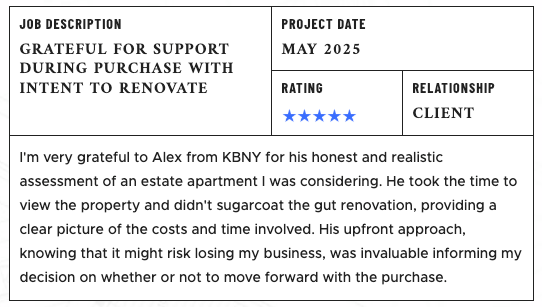
A recent example shows the value of a pre-closing consultation. One prospective client came to us while weighing an estate-condition apartment intended for a full renovation, and wanted to know whether the vision was achievable before committing. Our team ran a pre-purchase walk-through and gave a transparent assessment of the work involved, including the reality of a gut renovation, the costs attached, and the timeline to expect. The client described the experience in their own words on the published page. Further reviews are on our Testimonials page.
[#5]When To Walk Away Vs. When To Negotiate[#5]
Part of the value of a pre-purchase consultation is clarity on where a given property sits. When the scope to reach a vision runs deep, with moves like major structural walls, relocated plumbing stacks, or hazards buried behind the walls, the investment may not pencil out. A more contained set of challenges, such as leveling floors, upgrading electrical service, or working within co-op rules, tends to respond well to the right plan.
The findings themselves often guide the decision. They can give leverage at the negotiating table, refine a purchase offer, or secure credits that offset future construction costs. And when the numbers point the other way, the same clarity spares a buyer from a property that cannot deliver what they are after.
Wrapping Up
If you’re weighing a purchase right now and wondering where it falls on that spectrum, now may be the right time for a consultation. An in-person walkthrough with Team Gallery can help you evaluate the property with clarity, understand the true renovation potential, and decide whether to move forward, renegotiate, or keep looking.
Considering purchasing in NYC with intent to renovate and want a renovation consultation to confirm your design goals are feasible - without being caught off guard post-purchase? Feel free to contact us and find out why our full-service approach makes most sense when choosing a contractor in NYC.
We are a New York Times-featured design-build firm in New York City with a full-service approach to residential renovations in Manhattan and Brooklyn that includes everything from interior design and architecture services to filing permits and construction. We’re experts in renovating pre-war homes, kitchens, bathrooms, flooring, sourcing custom pieces, building entirely new rooms, millwork, and all that falls in between. Let Gallery bring your dream home to life.
Gallery KBNY is a full-service design-build firm featured in The New York Times, specializing in the architecture, interior design, and renovation of apartments, co-ops, condominiums, townhomes, and lofts across Manhattan and Brooklyn. Our integrated team of architects, designers, contractors, and project managers manages every phase from board approvals and DOB permitting through design and construction. A founding partner is involved in every project, start to finish. Because architecture, design, permitting, and construction are coordinated under one roof, the process remains streamlined, accountable, and transparent from start to finish. Our work has also appeared in Forbes, Architectural Digest, and Inc., and is backed by 100+ five-star client reviews.
[#faq]Frequently Asked Questions About Planning For NYC Renovations[#faq]
When in the buying process should a pre-purchase renovation consultation happen?
The most useful window is before signing, or during the contract's due-diligence period where one applies. Assessing the apartment while there is still room to renegotiate or withdraw lets the findings inform the offer itself. For an all-cash or fast-moving deal, a walk-through scheduled ahead of signing serves the same purpose.
Can a consultation be conducted before you own the apartment, given access limits?
Yes. Access is arranged through the listing agent or seller for a walk-through, which is enough to assess the structure, the systems, and the building's constraints visually and against the offering plan. Anything that needs intrusive testing, such as suspected asbestos behind a wall, is flagged as a known unknown and carried as a priced contingency, with confirmation reserved for the planning phase.
How do pre-purchase findings translate into negotiating leverage?
Documented renovation constraints and their costs support a specific, defensible case for a price adjustment or a closing credit. A figure tied to leveling floors or upgrading electrical service carries more weight with a seller than a general concern, and it gives a buyer a clear walk-away number when the gap cannot be closed.
Can the consultation tell whether two apartments can be combined?
It can assess the physical feasibility, such as shared walls, floor levels, and stack alignment, and it identifies the approvals a combination requires, including board consent and a DOB filing for the combined certificate of occupancy. The board's willingness to allow a combination is confirmed separately, since some buildings restrict them outright.
How are board and DOB constraints evaluated before purchase?
We review the building's alteration agreement and house rules where available, weigh the intended scope against what those documents permit, and identify which elements would need DOB filings or landmark review. That picture sets realistic expectations for the timeline and the approvals path before a buyer is committed.
What does a consultation cost relative to what it can save?
A consultation is a modest fee against the scale of a Manhattan purchase and renovation, and its value lies in avoiding a six-figure misjudgment, whether that is an unbuildable layout, an unanticipated system upgrade, or an abatement no one priced. For buyers comparing several apartments, it also sharpens which property is the stronger investment.
Manhattan Design-Build
Evaluate Your Manhattan Apartment
Before You Buy
Buying an apartment you plan to renovate? A founding partner walks it with you during the contract period and maps the scope, cost, and timeline, so you know exactly what you're taking on before you sign.
As seen in
Pre-Purchase Assessment
Walk the apartment with us first and understand the full scope, cost, and timeline before you close.
or call us directly
let’s
Design-Build
together