.avif)


.png)
.png)


NYC Smart Home Renovation Guide: 10 Upgrades, Costs, and Infrastructure Specs
Ten smart home upgrades to integrate during a NYC apartment renovation, with cost ranges, platform comparisons, and electrical and low-voltage specs.
February 9, 2026
|

NYC Smart Home Renovation Guide: 10 Upgrades, Costs, and Infrastructure Specs
Consider These Smart Home Remodeling Options For Your New York City Home
Table of contents
- Home Network
- Smart Home Interface
- Smart Thermostats and HVAC
- Smart Water Heaters
- Smart Lighting
- Home Security and Locks
- Smart Windows and Blinds
- Connected Appliances
- Advanced Home Audio
- What to Spec Before Walls Close
- Implement Smart Home Upgrades During A Full Home Renovation
- FAQs About Smart Home Installations Within NYC Renovations
Smart home technology is often perceived as complex, but the implementation is actually straightforward when integrated during a renovation. Including smart home technology during a NYC renovation makes the installation significantly easier than retrofitting later. The walls are already open, the trades are already on site, and the infrastructure can be coordinated as part of the broader project rather than tacked on after.
While there are various smart home options to choose from, each with their own benefits, below are the smart home technology options most applicable to residential renovations in NYC.
[#Home]Home Network[#Home]
The backbone of any smart home is the network. Every connected device, from thermostats to motorized shades to audio systems, runs through this. A NYC apartment renovation is the right time to plan the network architecture: a dedicated network closet, hardwired Cat6 drops to every TV and office location, and ceiling-mounted access points centered in each main room. Mesh WiFi works in small apartments, but professional access points outperform consumer mesh in dense NYC buildings where signal interference from neighbors is constant.
[#Smart]Smart Home Interface[#Smart]
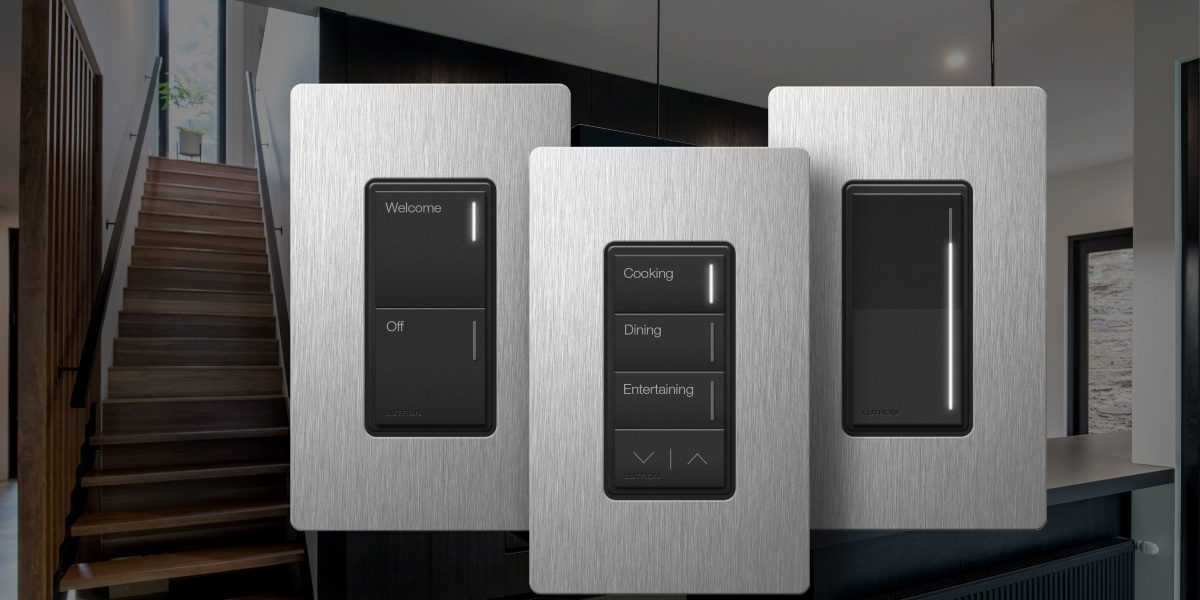
The choice of platform shapes how every device in the home gets used. One of the more sophisticated options on the market is RadioRa by Lutron. This completely-customizable smart home system is extremely sleek and customizable, offering advanced technology that allows for custom multi-room configurations that are accessible via single buttons (rather than cycling through a dial). Apple Home, Google Home, and Amazon Alexa each offer comprehensive functionality at lower price points than custom systems, and the Matter protocol now allows newer devices to work across all three ecosystems with minimal vendor lock-in.
Match the platform to the household's existing device ecosystem. iPhone households generally benefit from Apple Home; Android households from Google Home; mixed-device households from Alexa for breadth or Lutron for depth in lighting control.
[#HVAC]Smart Thermostats and HVAC[#HVAC]
Smart thermostats allow users to change the temperature of their home directly from their device, whether they’re bundled up in the living room or laying on a beach abroad. We often set-up these thermostats in tandem with HVAC installations, then place sensors throughout the home to monitor temperature plus humidity and dynamically adjust the thermostat accordingly - even during the middle of the night. Beyond convenience, smart thermostats are environmentally friendly, keeping energy usage down and reducing your carbon footprint. Read more on Why Custom HVAC Solutions Are Essential For Pre-War Renovations In NYC.
[#Water]Smart Water Heaters[#Water]
Smart water heaters are one of the more practical smart home installations. These state-of-the-art core plumbing features help reduce energy and offer built-in safety features like leak-protection and temperature regulation to prevent bacteria build-up.

[#Lighting]Smart Lighting[#Lighting]
As a design-build firm specializing in custom lighting installations, we’re big proponents of smart lighting. Smart lighting integrates with the broader architecture rather than sitting on top of it. Scene control lets the same room shift from morning task lighting to evening ambient, and programmed schedules support security routines while traveling. Hardwired systems like Lutron RadioRA 3 deliver more reliable performance than bulb-based systems in apartments where dimming and scene control are central to the design. A smart home system like RadioRa 3 features various smart lighting options.
[#Security]Home Security and Locks[#Security]
At Gallery, we create peace of mind for our clients by installing fully-connected security cameras, smart locks, and doorbells, which are all becoming fairly standard in smart home installations. Smart security cameras are easily connected to your phone, delivering on-demand eyes watching your door and more.
[#Windows]Smart Windows and Blinds[#Windows]
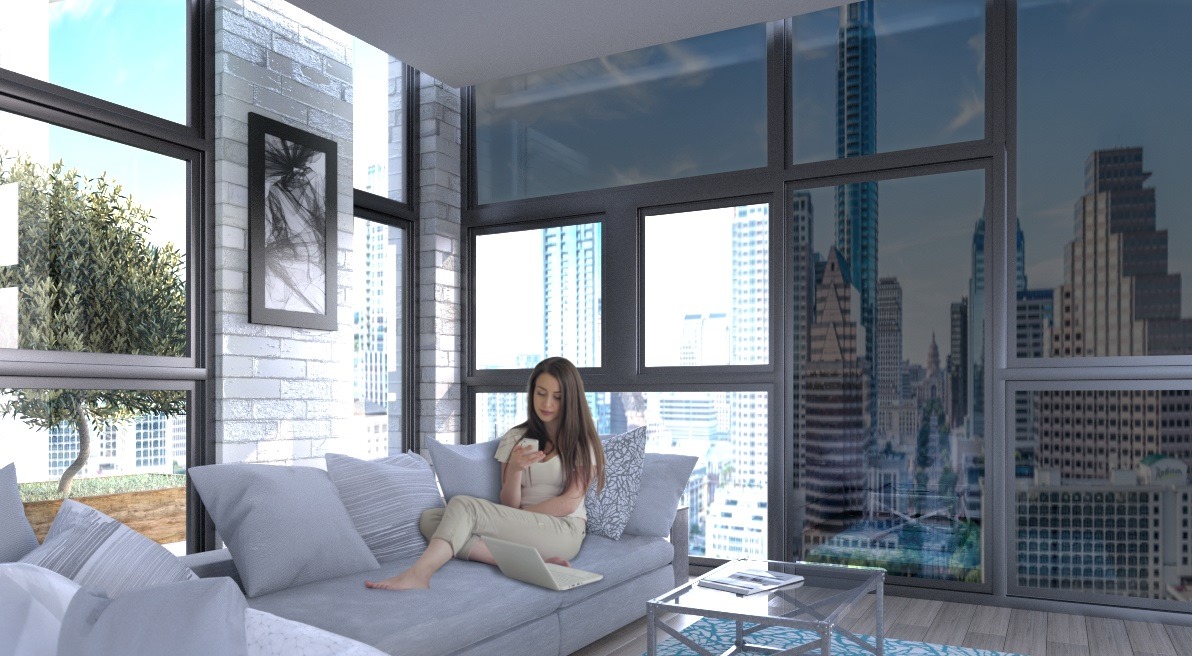
Smart shades and smart glass address the same problem from different angles. Motorized shades offer reliable, well-established technology that retrofits onto any window. Smart glass replaces the window itself with electrically tintable or passively activated glazing. Both work well in NYC high-rises, where heat load and glare from full-height glazing can be significant.
Smart Window Glass: Three Technologies Compared
| Glass Type | How It Activates | Best For | Typical Cost Per Sq Ft |
|---|---|---|---|
| Electrochromic | Low-voltage electrical signal triggers tint change in 3 to 10 minutes | User-controlled tint via app, voice, or scene; precise privacy and glare control | $75 to $200+ |
| Photochromic | UV light exposure triggers tint passively; no electrical infrastructure required | Set-it-and-forget-it sun control; lower cost than electrochromic | $50 to $120 |
| Thermochromic | Temperature change triggers tint; activates when glass reaches set threshold | Heat-load management for south-facing or floor-to-ceiling glass | $60 to $140 |
NYC building consideration: Smart glass installations in co-ops and condos typically require board approval because they alter the building facade and affect the visual uniformity of windows from the street. Electrochromic systems also require low-voltage wiring runs to each window, which should be planned during the renovation.
[#Connected]Connected Appliances[#Connected]
Smart-connected appliances handle energy monitoring, diagnostics, and remote adjustments. Most major appliance brands now ship with WiFi connectivity as a standard feature rather than a premium add-on. The value is less about voice control and more about predictive maintenance and integration with energy and water leak detection systems. For more kitchen inspiration, check out the Kitchen Renovation section of our Design & Reno blog.

[#Audio]Advanced Home Audio[#Audio]
Whole-home audio has matured into a standard renovation upgrade. Sonos remains the most accessible option, with WiFi-connected speakers that link into a unified system. For more refined installations, in-ceiling and in-wall speakers from Sonance, Bowers and Wilkins, or KEF deliver concealed audio that integrates with the architecture. The pre-wire happens during framing; the speaker selection happens later. Rock on, just easier.
[#spec]What to Spec Before Walls Close[#spec]
The single biggest determinant of smart home outcomes is what gets specified during framing and rough electrical, not what gets selected at the device level. Devices can be upgraded later; wiring cannot, at least not without opening walls. A NYC apartment renovation is the one window where infrastructure decisions can be made cleanly. Below is what every smart home renovation should include in pre-construction scope.
What to Spec Before Walls Close: Smart Home Infrastructure
The single biggest determinant of smart home outcomes is what gets specified during framing and rough electrical, not what gets selected at the device level. Retrofitting wiring after drywall closes is significantly more expensive and disruptive.
| Infrastructure | Spec to Request | Why It Matters |
|---|---|---|
| Network rack or closet | Dedicated location with power, ventilation, and Ethernet patch panel | Centralizes router, switch, modem, and smart home hubs; eliminates visible equipment |
| Cat6 or Cat6a wiring | Hardwired drops to every TV location, office, smart hub, and access point | Wired is more reliable than mesh WiFi for high-bandwidth devices |
| WiFi access point pre-wire | Ceiling-mounted Cat6 drops centered in each main room | Professional access points outperform consumer mesh in dense NYC buildings |
| Neutral wires at all switch locations | Neutral conductor pulled to every switch box, not just hot and ground | Required by most smart dimmers and smart switches; common gap in older buildings |
| Motorized shade wiring | Power and low-voltage drops above every window | Hardwired motorized shades outperform battery-powered shades on longevity |
| Smart lock infrastructure | Low-voltage to entry door for hardwired smart lock or video doorbell | Avoids battery-powered locks that fail unpredictably |
| In-ceiling and in-wall speakers | 16-gauge speaker wire to all planned audio locations | Concealed audio is the single biggest visual upgrade over visible speakers |
| HVAC zoning capability | Independent zones with dampers or mini-splits per zone | Smart thermostats can only manage what the HVAC system supports |
| Leak detection at wet zones | Power and low-voltage runs under bathrooms, kitchen, laundry | Most NYC alteration agreements require leak protection; smart sensors prevent damage to neighbors |
| Future cabling conduit | 1 inch flexible conduit from network rack to main TV and AV locations | Allows pulling fiber, additional Ethernet, or future protocols without opening walls |
Each of these items is straightforward to install while the walls are open and significantly more expensive to add after the renovation is complete. For instance, the cost of running an extra Cat6 drop during construction is under $200. The cost of retrofitting the same drop two years later, including drywall repair and paint, often exceeds $1,500.
[#Implement]Implement Smart Home Upgrades During A Full Home Renovation[#Implement]
A NYC renovation is the optimal window for smart home integration. Open walls, active electrical work, and a coordinated trades schedule make installation significantly cheaper and cleaner than retrofitting afterwards.
Choosing a Smart Home Platform: Side-by-Side
| Platform | Best for | Strengths | Considerations |
|---|---|---|---|
| Lutron RadioRA 3 | Whole-home installations where lighting is the priority | Professional-grade reliability, physical keypads, deep lighting control, integrates with HomeKit and Alexa | Higher initial cost, requires professional installation, no native voice assistant |
| Apple Home | iPhone-first households prioritizing privacy and simple setup | End-to-end encryption, Matter protocol support, clean UI, strong HomePod audio | Narrower third-party device support than Google or Amazon |
| Google Home | Android households or anyone using Google Workspace | Strong voice recognition, wide device compatibility, Nest cameras and thermostats | Privacy concerns for data-sensitive households; ongoing product line changes |
| Amazon Alexa | Mixed-device households wanting maximum third-party compatibility | Largest third-party device ecosystem, lowest-cost entry point, Ring integration | Less refined UI than Apple, occasional voice recognition issues |
| Crestron or Control4 | Large or luxury homes requiring multi-zone AV, lighting, and HVAC integration | Custom-programmed reliability, professional support, deep integration depth | Substantially higher cost; requires certified dealer for installation and updates |
Gallery is a design-build firm in New York City that specializes in tech-heavy residential renovations. All of our home renovations include every aspect of the project, from interior design and architectural services to facilitating building management and board approval, to construction and construction management. Ready to renovate? Contact us for a consultation.
Gallery KBNY is a full-service design-build firm featured in The New York Times, specializing in the architecture, interior design, and renovation of apartments, co-ops, condominiums, townhomes, and lofts across Manhattan and Brooklyn. Our integrated team of architects, designers, contractors, and project managers manages every phase from board approvals and DOB permitting through design and construction. A founding partner is involved in every project, start to finish. Because architecture, design, permitting, and construction are coordinated under one roof, the process remains streamlined, accountable, and transparent from start to finish. Our work has also appeared in Forbes, Architectural Digest, and Inc., and is backed by 100+ five-star client reviews.
[#FAQ]Frequently Asked Questions About Smart Home Installations Within NYC Renovations[#FAQ]
Why is a renovation the best time to add smart home technology?
A renovation is the one window when smart home infrastructure can be installed cleanly. The walls are already open, the trades are already on site, and the wiring can be coordinated as part of the broader project. The single biggest determinant of a smart home's success is what gets specified during framing and rough electrical, because devices can be upgraded later while wiring cannot without reopening walls. The cost difference is significant: running an extra Cat6 drop during construction is under $200, while retrofitting the same drop two years later, including drywall repair and paint, often exceeds $1,500. Integrating during the renovation captures that advantage.
What network infrastructure should a smart home renovation include?
The network is the backbone that every connected device runs through, from thermostats to motorized shades to audio. A NYC renovation is the right time to plan its architecture: a dedicated network closet, hardwired Cat6 drops to every television and office location, and ceiling-mounted access points centered in each main room. Mesh WiFi can work in a small apartment, though professional access points outperform consumer mesh in dense NYC buildings where signal interference from neighboring units is constant. Getting the network wiring in during construction is what allows every later device to perform reliably.
Which smart home platform should I choose?
The platform shapes how every device in the home is used, so it is worth matching to the household. RadioRA by Lutron is among the most sophisticated options, fully customizable and strong on multi-room configurations accessible from single buttons, which makes it well suited to depth in lighting control. Apple Home, Google Home, and Amazon Alexa each offer comprehensive functionality at lower price points, and the Matter protocol now lets newer devices work across all three with minimal vendor lock-in. iPhone households generally fit Apple Home, Android households Google Home, and mixed-device households either Alexa for breadth or Lutron for depth. The right choice follows the existing device ecosystem.
Which smart home upgrades are most relevant to a NYC apartment?
A NYC renovation supports a full range of smart upgrades. The core categories are the home network, the control platform, smart thermostats paired with HVAC and sensors, smart water heaters with leak protection and temperature regulation, smart lighting with scene and schedule control, connected security cameras, locks, and doorbells, motorized shades or smart glass, connected appliances, and whole-home audio. Each integrates most cleanly when planned into the renovation rather than added afterward. Prioritizing which of these matters most to the household is what keeps the infrastructure scope focused on what will actually be used.
What should I know about smart glass or motorized shades in a co-op or condo?
The two address the same glare and heat-load problem from different angles. Motorized shades are a well-established technology that retrofits onto any window. Smart glass replaces the window itself with electrically tintable or passively activated glazing, and both perform well in NYC high-rises where full-height glazing brings significant heat and glare. There is a building consideration worth noting: smart glass in a co-op or condo typically requires board approval, because it alters the facade and affects the visual uniformity of the windows from the street. Electrochromic systems also need low-voltage wiring to each window, which should be planned during the renovation.
What smart home infrastructure must be specced before walls close?
The items that must go in before drywall are the ones tied to wiring, since devices can be swapped later while cabling cannot without opening walls. That scope includes the dedicated network closet, hardwired Cat6 drops to televisions and office locations, ceiling access-point locations, low-voltage runs for lighting control and audio, and dedicated circuits for higher-draw systems. Each is straightforward to install while the walls are open and considerably more expensive and disruptive to add afterward. Treating framing and rough electrical as the moment to lock the infrastructure is what prevents costly retrofits down the line.
How should whole-home audio be planned in a renovation?
Whole-home audio has become a standard renovation upgrade, and the key is to handle the wiring during framing. Sonos remains the most accessible option, with WiFi-connected speakers that link into one system. For more refined, concealed installations, in-ceiling and in-wall speakers from Sonance, Bowers and Wilkins, or KEF integrate into the architecture and disappear from view. The pre-wire happens while the walls are open, and the speaker selection can follow later. Running the audio cabling as part of the rough-in is what allows a clean, built-in result rather than surface-mounted speakers added after the fact.
Manhattan Design-Build
Evaluate Your Manhattan Apartment
Before You Buy
Buying an apartment you plan to renovate? A founding partner walks it with you during the contract period and maps the scope, cost, and timeline, so you know exactly what you're taking on before you sign.
As seen in
Pre-Purchase Assessment
Walk the apartment with us first and understand the full scope, cost, and timeline before you close.
or call us directly
let’s
Design-Build
together