.avif)


.png)
.png)


Don’t Overlook The Details: The Mundane Mistakes That Derail Pre-War Renovations In NYC
In New York City renovations, especially in pre-war buildings, the smallest details often have the biggest impact on whether a home feels complete or unfinished.
September 4, 2025
|
Don’t Overlook The Details: The Mundane Mistakes That Derail Pre-War Renovations In NYC
It’s not the bold mistakes that sink NYC pre-war renovations, but background details no one talks about until it’s too late.
TABLE OF CONTENTS
- The Subtle Design Elements That Derail Renovations
- Why The “In-Between” Details Matter
- Design Cohesion Without Going Full Gut?
- The Case For A Full-Service, Design-Build Approach
- True Cohesion Starts Behind the Scenes
- Frequently Asked Questions About Mistakes That Derail Pre-War Renovations in NYC
When homeowners set out to renovate an apartment in New York City, especially in a pre-war building, the focus almost always starts with the big-ticket items: kitchens, bathrooms, and maybe the floors. Makes sense. These are the most heavily used spaces, the ones that show their age fastest, and where updates deliver the most dramatic before-and-after impact.
But while these upgrades deserve priority, too many renovations suffer from a common blind spot: overlooking the more mundane architectural details that hold a home together. We're talking about original doors that stick or don’t latch, worn hardware, uneven walls, mismatched casings, overpainted crown moldings, elements that are often dismissed as background noise during early planning, only to stand out in stark contrast once the high-impact areas are complete.
At Gallery KBNY, we specialize in helping clients plan and execute full-scope pre-war renovations, whether a true gut renovation or more selective overhaul. In either case, one truth remains: the success of a truly cohesive renovation hinges on the little things.

[#1]The Subtle Design Elements That Derail Renovations[#1]
In many pre-war apartments—especially those in estate condition—a full gut renovation can be relatively straightforward. Everything is being replaced, and the planning process becomes a matter of smart layout, efficient design, and managing external variables like asbestos abatement, building management approvals, and electrical capacity upgrades.
But when clients opt for a partial renovation—whether to save costs or preserve certain original charm—things get complicated. Surgical precision is required to strike the right balance between old and new, and that’s where costly mistakes often sneak in.
Doors that no longer close properly. Brass knobs that clash with updated finishes. Casings that don’t align with new floor heights. These may sound like minor quirks, but they can create major friction once the renovation is underway or completed.
.jpeg)
[#2]Why The “In-Between” Details Matter[#2]
Original architectural details in pre-war apartments weren’t chosen randomly—they were designed to work together, in both proportion and material. When you update only parts of a home and leave these features untouched, the sudden contrast can become jarring.
Consider this common scenario: a client updates the kitchen and bathroom but decides to leave original interior doors in place. Once the renovation is complete, those doors—perhaps painted dozens of times over the decades—suddenly feel flimsy. A mortised lock no longer functions properly. Modern hardware doesn’t align with the existing bores or weight tolerances. What seemed like a smart place to cut costs quickly snowballs into scope creep: replacing the doors leads to replacing the casings, which leads to wall patching and repainting—turning a minor detail into a major (and expensive) change order.
We often hear versions of the same regret:
"Now that everything else looks updated, I wish I had done the doors too."
Unfortunately, by that point, the trades have moved on, pricing may have changed, and access to certain areas is restricted by installed cabinetry or finished floors. A small decision delayed becomes a big opportunity missed. Enter, anxiety.
-min.jpeg)
[#3]Design Cohesion Without Going Full Gut? [#3]
Thankfully, there’s good news. It is possible to achieve cohesive interior design without gutting your entire pre-war home—but only if the planning is intentional from the beginning. If your doors, trim, and moldings are in excellent shape and consistent throughout, they may be worth preserving. But in many NYC homes, especially pre-wars, these elements endured decades of patch jobs, paint layers, or mismatched repairs.
This is why our all-inclusive design-build firm places so much emphasis on early scoping. Our prep doesn’t just include budgeting for the big stuff—but deciding which architectural elements to preserve and which to upgrade. That evaluation shapes both the renovation’s aesthetic integrity and the long-term value of your property. When done right, truly thorough planning means your home feels thoughtful and resolved, opposed to a collection of unrelated updates.
[#4]The Case For A Full-Service, Design-Build Approach[#4]
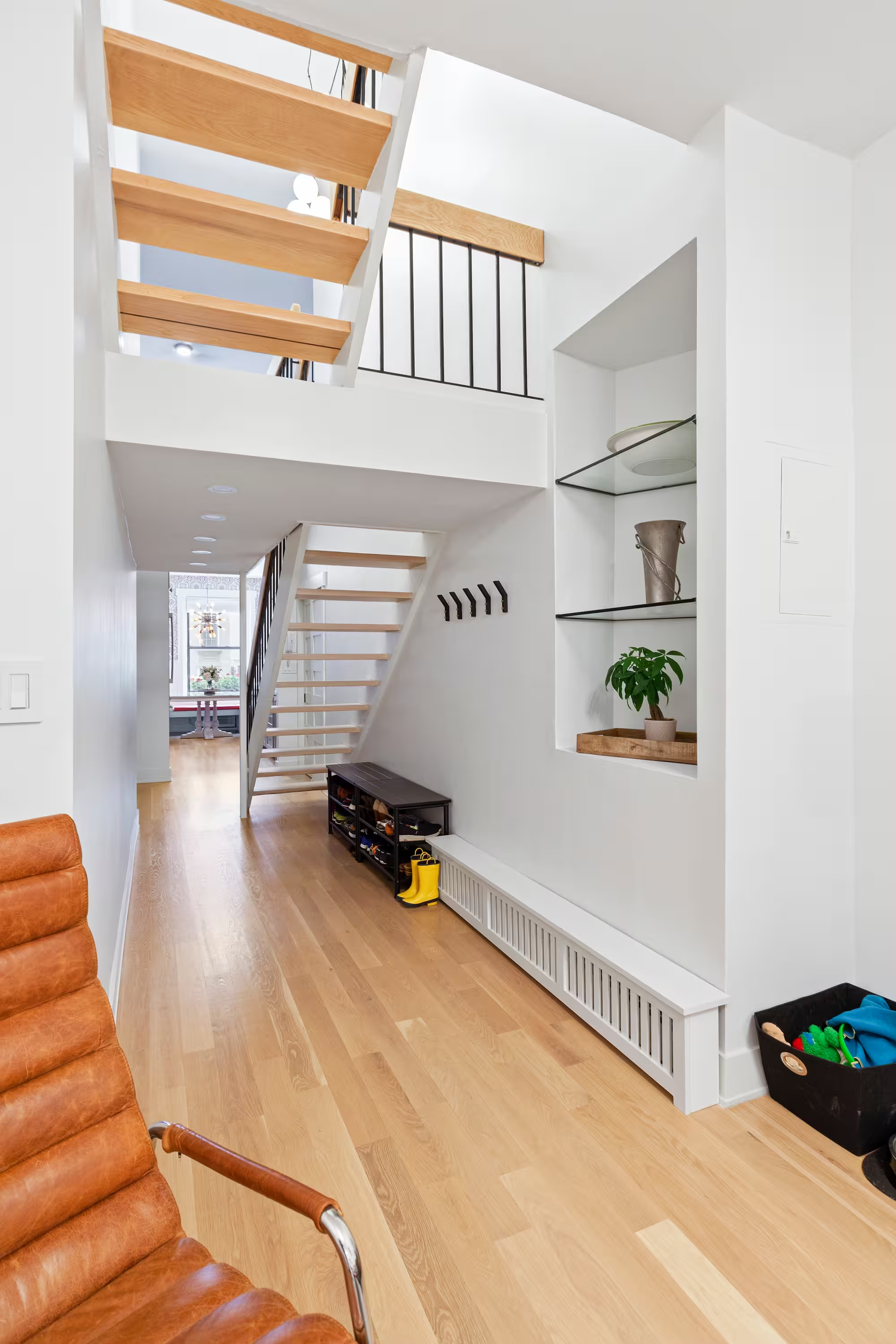
At Gallery, we’ve built our design-build process specifically to avoid these pre-war pitfalls. From the outset, we help clients consider every element (visible and not-so-visible) so nothing gets overlooked or becomes a costly afterthought.
Because everything happens in-house—interior design, architecture, permitting + board approvals, and construction management, we can coordinate across teams to make sure the small details align with the big picture. Our goal? Renovations that are not only pristine, but cohesive, functional, and built to last.
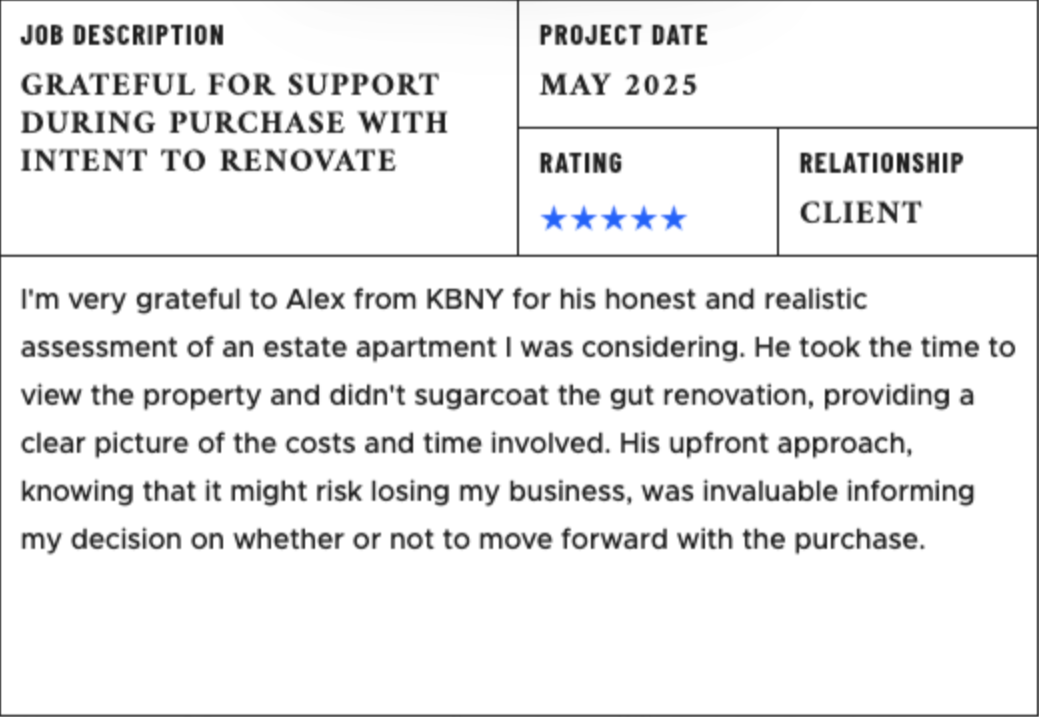
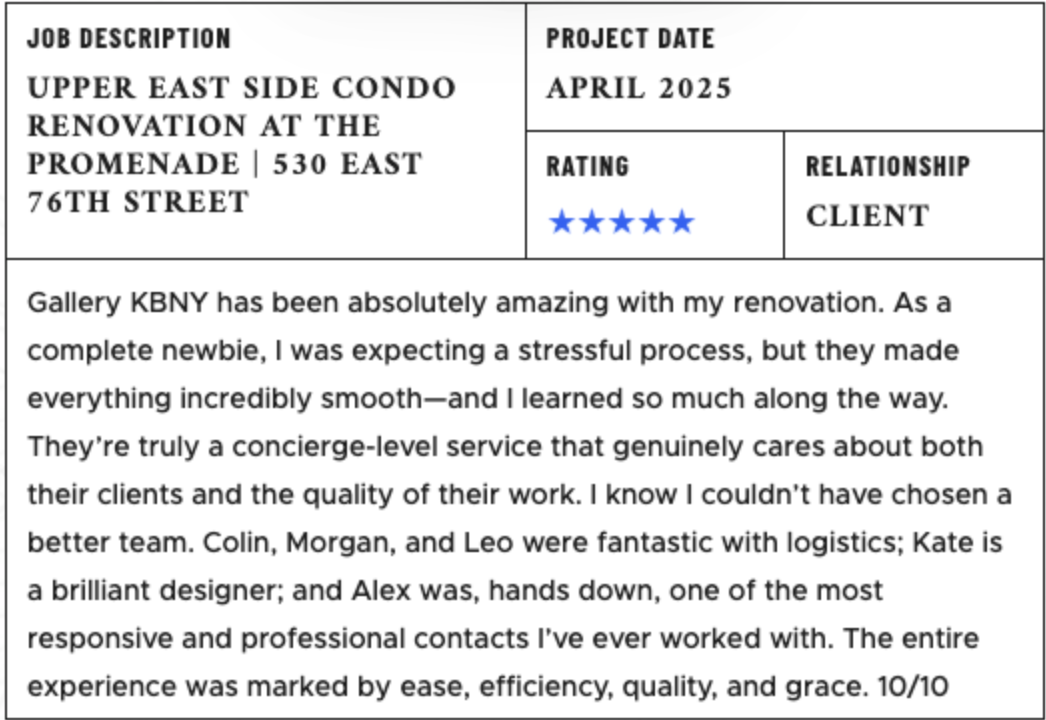
Whether our clients have already signed on with us or are still navigating the early stages of property purchase, our speciality is helping homeowners plan with clarity. View a few client testimonials below:
[#5]True Cohesion Starts Behind the Scenes[#5]
Baseboards, doorframes, moldings, picture rails are more than decorative details. They’re the connective tissue of a home’s architecture. In NYC, especially in pre-war apartments, these in-between elements carry real weight. Overlook them, and they disrupt the flow of an otherwise beautiful renovation. Approach them with care, and they elevate everything around them.
At Gallery, we help clients think beyond the kitchens and baths. Because more often than not, unassuming details like misaligned casings, overpainted doors, inconsistent trim are what make or break design cohesion. Planning for them early not only preserves aesthetic integrity but also helps avoid costly regrets later and ensures the final result feels complete, not patch-worked.
Gallery KBNY is a full-service design-build firm featured in The New York Times, specializing in the architecture, interior design, and renovation of apartments, co-ops, condominiums, townhomes, and lofts across Manhattan and Brooklyn. Our integrated team of architects, designers, contractors, and project managers manages every phase from board approvals and DOB permitting through design and construction. A founding partner is involved in every project, start to finish. Because architecture, design, permitting, and construction are coordinated under one roof, the process remains streamlined, accountable, and transparent from start to finish. Our work has also appeared in Forbes, Architectural Digest, and Inc., and is backed by 100+ five-star client reviews.
[#6]Frequently Asked Questions About Mistakes That Derail Pre-War Renovations in NYC[#6]
Q: What Is the Most Common Mistake Homeowners Make When Renovating a Pre-War Apartment in NYC?
Focusing exclusively on the high-impact spaces and treating everything else as background noise.
Kitchens, bathrooms, and floors deserve the attention they get. But the architectural details that hold a pre-war apartment together, the doors, the casings, the trim profiles, the crown mouldings, the baseboards, are what make those updated spaces feel cohesive rather than assembled. When those elements are left untouched while everything around them is renovated, the contrast becomes the most noticeable thing in the room.
The mistake is not renovating them. The mistake is not deciding early whether to renovate them.
Q: Why Do Pre-War Renovations Fail to Feel Cohesive Even When the Work Is High Quality?
Because cohesion is not about quality in individual spaces. It is about consistency across all of them.
Typical oversights include:
- Door hardware that clashes with new finishes
- Uneven wall conditions not corrected before millwork install
- Misaligned trim after floor height changes
These are often dismissed early but become highly visible once primary renovations are complete.
Q: Should You Replace or Preserve Original Doors in a Pre-War Apartment Renovation?
It depends on their condition and whether they are consistent with the rest of the scope.
If original doors are structurally sound, close and latch properly, and their finish and hardware can be updated to align with the renovation, preservation is often the right call. Pre-war doors, particularly solid wood originals, have weight and character that modern replacements rarely match.
If the doors have been painted dozens of times, no longer function correctly, or have hardware bores and tolerances that are incompatible with updated finishes, replacement is usually more cost-effective than restoration. The key is making that determination during the planning phase, not after the rest of the renovation is complete and the trades have moved on.
Q: Why are partial renovations often riskier than full gut renovations in pre-war apartments?
Partial renovations require surgical integration between old and new conditions, which introduces alignment, material, and proportion challenges. In contrast, gut renovations reset all variables, making coordination more predictable. The hybrid condition is where most execution errors occur.
Q: Is a Full Gut Renovation Always Necessary to Achieve Design Cohesion in a Pre-War Apartment?
No, but the planning has to be intentional from the beginning if it is not.
A partial renovation can produce a cohesive result when the scope is defined with genuine care for which elements to preserve, which to restore, and which to replace. Pre-war apartments where original mouldings, trim, and flooring are in excellent and consistent condition throughout are strong candidates for selective renovation. The original architecture does enough of the work that targeted updates can feel resolved rather than incomplete.
Where it falls apart is when the partial scope is defined by budget alone, without a clear-eyed assessment of which elements will create contrast once the primary work is done. That is where selective renovations become expensive in hindsight.
Q: How Do You Decide Which Original Architectural Details to Keep in a Pre-War Renovation?
By evaluating condition, consistency, and compatibility with the intended scope, before construction begins.
The questions worth asking for each element:
- Is it structurally and functionally sound, or has it been compromised by age, paint buildup, or piecemeal repairs?
- Is it consistent throughout the apartment, or does it vary room to room in ways that will read as unresolved?
- Will it remain compatible with updated finishes, hardware, and floor heights once the renovation is complete?
Elements that pass all three tend to be worth preserving. Elements that fail one or more are usually better addressed during construction than revisited as change orders or regrets after the fact.
Q: Why Do Partial Pre-War Renovations Often End Up Costing More Than Originally Planned?
Because scope creep in pre-war apartments tends to move in one direction: outward.
Replacing doors leads to replacing casings. Replacing casings exposes wall conditions that require patching. Patching requires repainting. Repainting in a room that was not part of the original scope means matching finishes to adjacent spaces that were. Each step is logical, and each step adds cost and time.
This is not a failure of execution. It is a predictable outcome of not fully scoping the connective tissue of the renovation at the outset. The cost of thorough early planning is almost always lower than the cost of sequential change orders discovered mid-construction.
Q: How Does a Design-Build Firm Help Avoid These Mistakes on Pre-War Renovations?
By keeping design and construction decisions in the same room from the beginning.
When an interior designer, architect, and construction team are working under one roof and communicating continuously, details like door function, trim alignment, hardware compatibility, and finish consistency get resolved on paper before they become problems in the field. There is no handoff between a design firm that has moved on and a contractor encountering the building for the first time.
For pre-war apartments specifically, where the margin for in-between details being overlooked is high and the cost of addressing them late is real, that integrated approach is not just convenient. It is what determines whether the finished renovation feels complete or assembled.
Manhattan Design-Build
Evaluate Your Manhattan Apartment
Before You Buy
Buying an apartment you plan to renovate? A founding partner walks it with you during the contract period and maps the scope, cost, and timeline, so you know exactly what you're taking on before you sign.
As seen in
Pre-Purchase Assessment
Walk the apartment with us first and understand the full scope, cost, and timeline before you close.
or call us directly
Considering a pre-war apartment renovation in New York City that may - or may not - require a gut renovation? View our portfolio of NYC apartment renovation before and afters, learn more about Gallery, or contact us today.
let’s
Design-Build
together