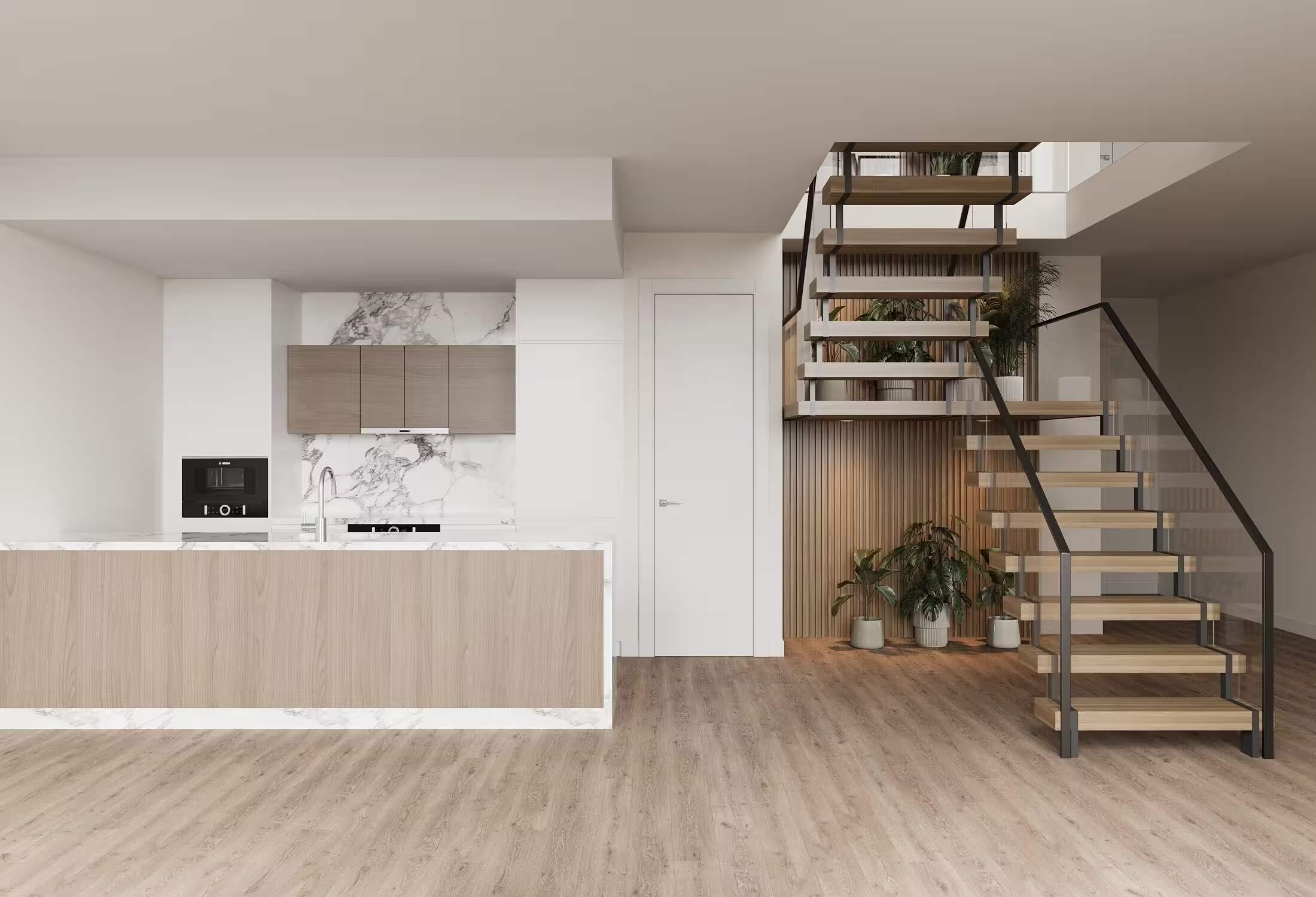
.avif)


.png)
.png)


NYC Neighborhood Spotlight: Our Favorite Midtown Renovations
Midtown Manhattan has more going on than most neighborhoods in the world. The ever-changing area finds many homes vying to modernize and maximize property value. See how we applied our full-service design-build approach to various Midtown properties and helped them meet their full potential.
February 8, 2025
|

NYC Neighborhood Spotlight: Our Favorite Midtown Renovations
Get up close and personal with some of our favorite Midtown, Manhattan renovations.
Table of Contents
- Loft Kitchen Renovation | 419 West 55th
- Pied-à-terre Apartment Renovation | 303 East 43rd
- Hit Factory Condo Renovation | 421 West 54th
Midtown Manhattan is one of the more complex residential renovation environments in New York City. The neighborhood spans several distinct residential pockets: Hell's Kitchen to the west, Turtle Bay to the east, and the condominium corridor running through the 40s and 50s. Each pocket has its own building stock, board governance structure, and renovation constraints. Property owners here typically approach renovation with a defined objective: maximum utility and design cohesion within whatever approval framework their specific building imposes.
Gallery KBNY has completed full-service design-build renovations throughout Midtown's residential sub-neighborhoods.
The three projects below represent the range of property types and client objectives the firm handles in this area: a loft kitchen build-out in Hell's Kitchen, a full pied-a-terre renovation in Turtle Bay, and a comprehensive condo modernization at the Hit Factory on West 54th.
| 01 419 West 55th | 02 303 East 43rd | 03 421 West 54th | |
|---|---|---|---|
| Sub-neighborhood | Hell's Kitchen | Turtle Bay | Hell's Kitchen |
| Property type | Loft | Co-op / Pied-à-terre | Luxury Condo |
| Client objective | Entertain at scale; expand kitchen footprint and add a dedicated bar | Create a fully functional NYC second home for bi-coastal clients; minimize remote-management friction | Modernize a legacy luxury unit with updated design language and a practical layout |
| Primary scope | Full kitchen renovation · island expansion · new bar build-out | Kitchen · master bath · powder room · new flooring · custom entertainment center | Full kitchen renovation · custom millwork throughout · fireplace restoration |
| Design anchor | Industrial concrete ceilings preserved; material palette introduced warmth and character within the loft's existing vibe | Tight upfront design sign-off process accommodated an absentee owner; every decision made once, not revised on-site | Focal-point fireplace restoration anchored the redesign; full-service scope delivered a cohesive modern interior from a previously mixed-finish shell |
| Key constraint | Original loft layout limited island expansion direction; bar placement required coordination with existing utilities | Alteration agreement work-hour restrictions; remote owner approval process required documentation-heavy design phase | Building history (converted recording studio) introduced non-standard mechanical systems requiring full assessment pre-scope |
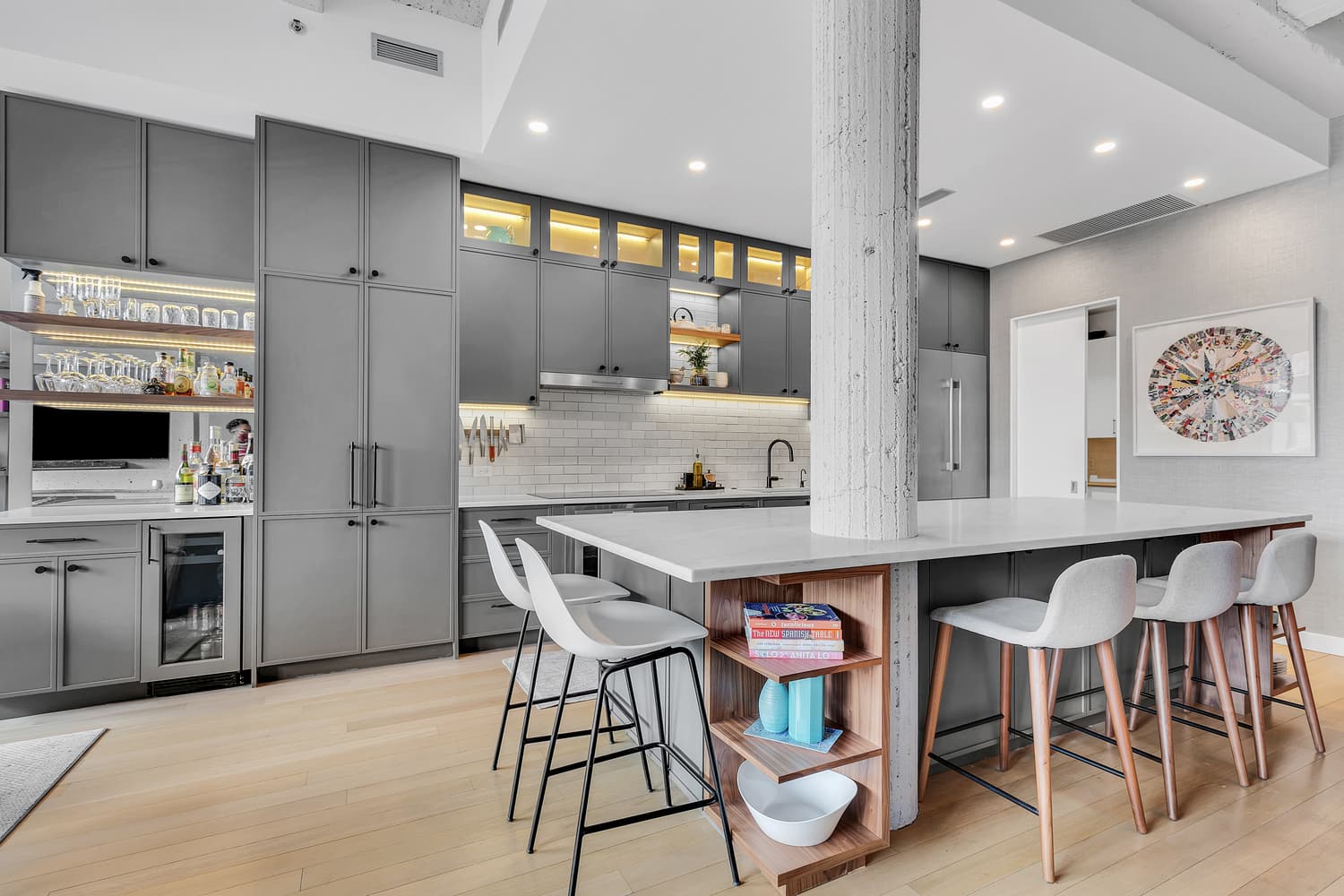
[#1]MANHATTAN LOFT KITCHEN RENOVATION | 419 WEST 55TH[#1]
The clients at 419 West 55th Street use their Hell's Kitchen loft as a primary entertaining space. The renovation brief centered on two priorities: expanding the kitchen island to accommodate large-format gatherings, and adding a dedicated bar at the opposite end of the kitchen. Both required careful utility coordination within the existing loft infrastructure.
Gallery's design approach worked with the building's character rather than against it. The exposed concrete ceiling, a defining feature of the original industrial conversion, anchored the material palette. Warmer stone selections and custom cabinetry finishes were introduced to balance the structural concrete, producing a kitchen that reads as both residential and architecturally considered.
The island expansion required rerouting plumbing and gas connections within the building's existing slab. That scope element was identified during Gallery's pre-construction assessment and incorporated into the alteration agreement submission before work began. The new bar at the room's far end was developed as a secondary focal point, with dedicated storage millwork and a distinct countertop material selection. View the full Midtown Manhattan loft kitchen renovation before and after.
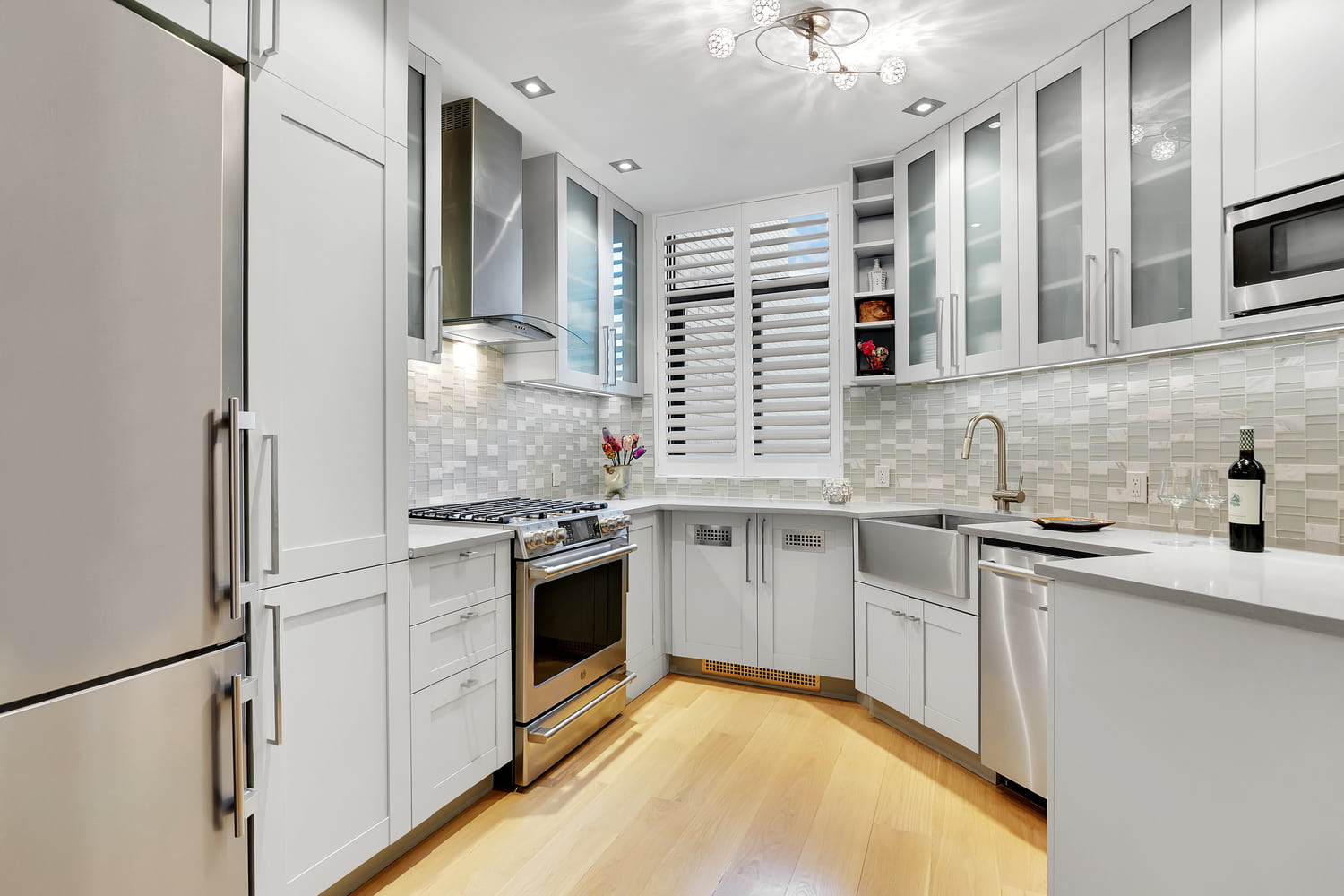
[#2]PIED-À-TERRE APARTMENT RENOVATION IN MANHATTAN | 303 EAST 43RD[#2]
The renovation at 303 East 43rd Street was structured around a specific ownership pattern: bi-coastal clients purchasing a Turtle Bay co-op as a dedicated NYC pied-a-terre. That context shaped every phase of the project. The clients required a fully finished, low-maintenance apartment that would operate without requiring active attention between stays.
Gallery's full renovation scope covered the kitchen, master bathroom, and powder room, new flooring throughout, and a custom entertainment center built into the living room. The entertainment center was designed to serve as the apartment's organizational anchor when the owners are in residence.
Remote client management protocols were established at the start of the design phase. All major decisions were documented and approved before construction commenced, eliminating on-site revision cycles that typically extend pied-a-terre renovation timelines. The Turtle Bay co-op board's alteration agreement required strict work-hour compliance and advance notice for certain scopes; Gallery managed the submission and coordination process as part of the full-service contract. View the full Midtown Manhattan apartment renovation before and after.
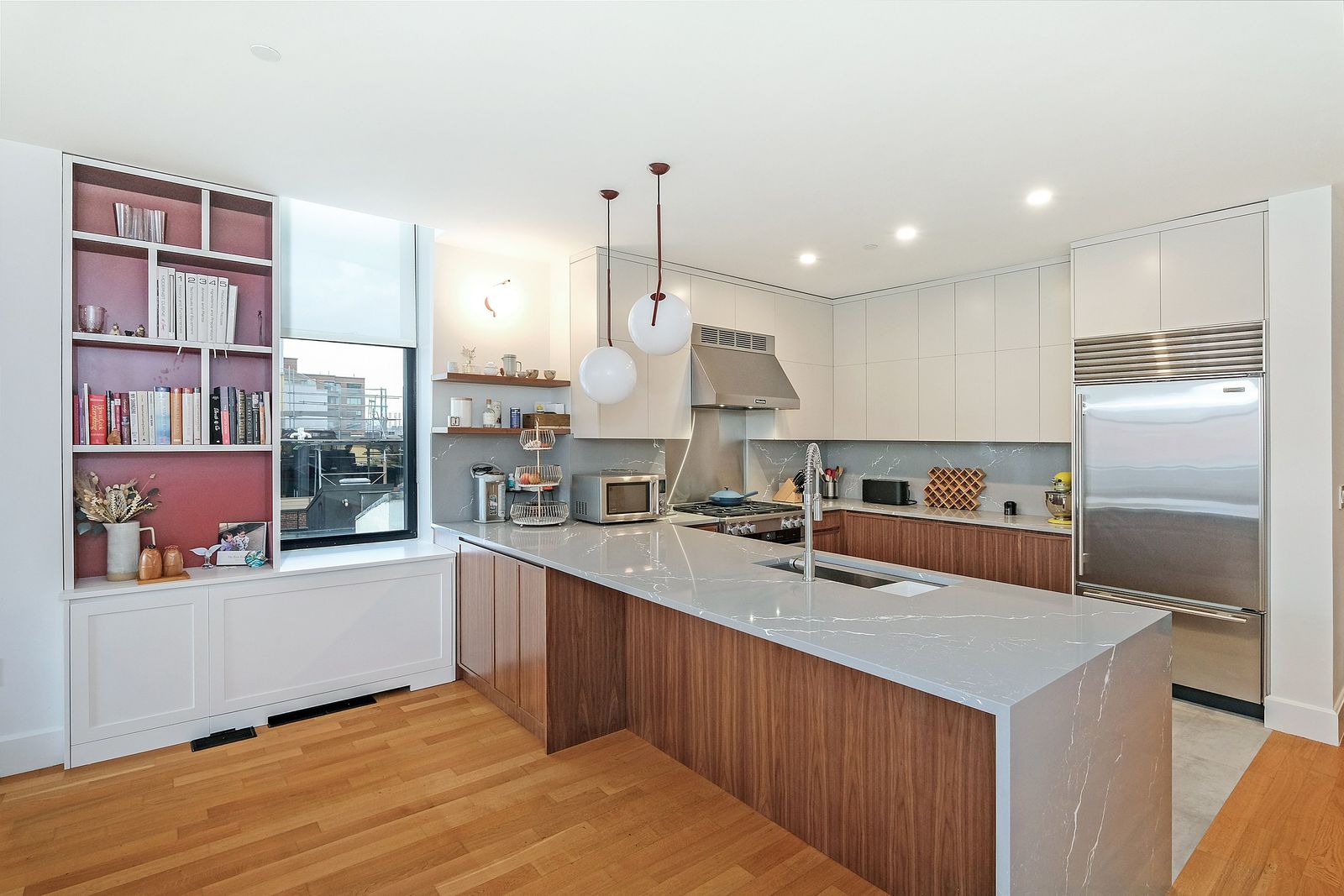
[#3]HIT FACTORY CONDO RENOVATION IN MIDTOWN | 421 WEST 54TH[#3]
421 West 54th Street is the Hit Factory, the former recording complex converted into luxury condominiums. The building's history as a professional recording facility left its residential units with non-standard mechanical systems and a spatial vocabulary that differed from conventional Manhattan condominium construction. Gallery's pre-scope assessment identified the mechanical complexity before pricing commenced, allowing for an accurate full-service scope from the outset.
The renovation delivered a full kitchen build, custom millwork throughout the unit, and a focal-point fireplace restoration. The fireplace had been part of the original conversion but had received deferred maintenance; restoring it to functioning specification became one of the project's defining design moments. The millwork was designed to integrate the fireplace wall into a cohesive living space rather than treating it as an isolated feature.
Gallery's design-build model was well-suited to this project. The unit's conversion-era quirks required real-time coordination between architectural intent and on-site execution, a dynamic the firm's integrated team handles within a single contract rather than across separate consultant relationships. View the full Midtown condo renovation before and after.
- Expediter and alteration agreement fees
- Extended pre-construction coordination
- Phased work tied to board approval windows
- Permit filing and DOB inspection costs
- Higher-finish expectations in luxury buildings
- Insurance certificate requirements for contractors
- Mechanical assessment of original industrial systems
- Custom millwork to work within non-standard layouts
- Concrete and structural work tied to open-plan changes
Considering A Renovation In Midtown, Manhattan?
Find more priority content to help guide your upcoming renovation in Midtown, Manhattan via our NYC Renovation & Design Blog, view a full portfolio of our renovations throughout NYC, or contact us to begin conversations regarding the home of your dreams.
We are a New York Times-featured design-build firm in New York City with a full-service approach to residential renovations in Manhattan and Brooklyn that includes everything from interior design and architecture services to construction and construction management. That's why we're different from other renovation and remodel firms in NYC. We’re experts in renovating full interiors, kitchens, bathrooms, flooring, millwork, and all that falls in between. Let’s design-build together.
Gallery KBNY is a full-service design-build firm featured in The New York Times, specializing in the architecture, interior design, and renovation of apartments, co-ops, condominiums, townhomes, and lofts across Manhattan and Brooklyn. Our integrated team of architects, designers, contractors, and project managers manages every phase from board approvals and DOB permitting through design and construction. A founding partner is involved in every project, start to finish. Because architecture, design, permitting, and construction are coordinated under one roof, the process remains streamlined, accountable, and transparent from start to finish. Our work has also appeared in Forbes, Architectural Digest, and Inc., and is backed by 100+ five-star client reviews.
Frequently Asked Questions About Reovations In Midtown, Manhattan
How does the co-op board process in Turtle Bay and similar Midtown buildings typically affect renovation scope and timeline?
Co-op boards in this part of Midtown operate under proprietary lease restrictions that govern work-hour windows, wet-over-dry conditions, contractor insurance minimums, and which scopes require managing agent sign-off before DOB filing can begin. A full kitchen renovation in a co-op at 303 East 43rd or comparable buildings typically requires an alteration agreement that addresses waterproofing specifications and contractor indemnification requirements before a single permit is filed. The practical effect on timeline is a three-to-eight-week pre-construction window that exists entirely in the approval and documentation phase. Owners who account for this at the time of purchase are positioned to move faster once construction begins.
What makes loft renovations in Hell's Kitchen structurally different from standard apartment renovations in the same area?
The converted industrial buildings that characterize Hell's Kitchen lofts introduce three variables that standard residential construction does not. Slab penetrations for plumbing and gas routing are more complex in poured-concrete floor plates than in wood-joist construction. Mechanical systems in former industrial spaces were often sized for commercial use and may require full replacement when the residential load profile changes. Ceiling heights in the range of 12 to 16 feet require custom millwork and lighting specifications that fall outside standard residential product lines. Each of these adds cost and coordination time that should be identified in a pre-scope assessment before any pricing is finalized.
For a pied-a-terre purchase in Midtown, what renovation approach produces the lowest ongoing maintenance burden once the project is complete?
The primary driver of maintenance burden in a pied-a-terre is finish durability relative to vacancy cycles. Surfaces that perform well under continuous occupancy often show accelerated wear in apartments that see intermittent use and periodic temperature fluctuations when HVAC is in setback mode. Gallery's recommendation for pied-a-terre renovations prioritizes sealed stone over unsupported marble in wet areas, fully integrated appliance packages with high-reliability service records, and custom millwork with closed storage configurations that protect interiors during vacancy. The mechanical scope should also include a thermostat and humidity control system capable of remote monitoring, which is a board-approvable modification in most Midtown buildings.
How does a design-build contract structure affect the board submission process compared to hiring an architect and general contractor separately?
The board submission package for a Manhattan co-op typically requires coordinated documentation from the design team, the contractor, and the owner's representative, all formatted to the managing agent's specific submission standards. When architecture and construction are contracted separately, assembling that package requires active coordination across two firms, each with its own administrative process. Under a design-build contract, a single firm is accountable for the complete submission package. That structure eliminates the most common source of submission delays: missing or inconsistent documentation from one party of a two-party team. For buildings with multiple submission rounds, the efficiency difference is material.
What is a realistic cost range for a full gut renovation in a Midtown condo like the Hit Factory?
A full gut renovation in a Midtown luxury condominium typically falls in the range of $550 to $850 per square foot at Gallery's service tier, with converted buildings adding a meaningful premium depending on the mechanical scope uncovered during pre-construction assessment. At the Hit Factory specifically, the non-standard systems from the building's prior commercial use introduced cost variables that a standard condo in the same price range would not carry. A pre-scope assessment before finalizing purchase price is the only reliable way to surface those variables. Gallery offers pre-purchase renovation assessments as a standalone engagement for buyers in exactly this situation.
Manhattan Design-Build
Evaluate Your Manhattan Apartment
Before You Buy
Buying an apartment you plan to renovate? A founding partner walks it with you during the contract period and maps the scope, cost, and timeline, so you know exactly what you're taking on before you sign.
As seen in
Pre-Purchase Assessment
Walk the apartment with us first and understand the full scope, cost, and timeline before you close.
or call us directly
let’s
Design-Build
together