.avif)


.png)
.png)


Mid-Century Modern Bathroom Renovation Guide: Tile Styles & Design Ideas
Mid-century modern is most powerful when it functions as a full-home design language rather than a bathroom tile decision, with the same walnut, marble, and brass vocabulary deploying consistently from kitchen to en-suite to powder room.
June 29, 2026
|
-min.jpeg)
Mid-Century Modern Bathroom Renovation Guide: Tile Styles & Design Ideas
How Gallery KBNY deploys mid-century modern design as a coherent language across full home NYC apartment renovations, with bathroom tile patterns and material pairings explained.
TABLE OF CONTENTS
- The Mid-Century Modern Bathroom, In Context
- MCM As A Design Language, Not A Tile Pattern
- How Does Gallery Avoid Change Orders?
- Mid-Century Modern Bathroom Design Ideas
- FAQs About Mid-Century Modern Design In NYC Renovations
The checkered tile fad of the 2000s has run its course. Mid-century modern is one of the directions we're seeing clients exploring more than ever these days, often leaning into the familiar vocabulary of walnut, marble, brass, and hexagon or subway tile in coordinated layouts.
Most Gallery clients arrive with a reference and a clear direction, and the role of our designers is to refine it, push back where execution would suffer, and dial in the choices that produce the strongest version of what they came in wanting. When MCM is the direction, the iconic design push usually lands best as a vocabulary deployed across rooms rather than confined to one bathroom, with the same walnut in the kitchen, the same brass throughout, and the same stone moving from counter to bath floor.
.webp)
[#tile]MCM As A Design Language, Not A Tile Pattern[#tile]
The most common misreading of mid-century modern design treats it as a tile pattern selection problem. The thinking goes: choose hexagon for the floor, subway for the walls, add a walnut vanity, and the bathroom is "mid-century modern." The result reads as styled rather than designed, because the room's vocabulary does not connect to anything else in the apartment.
The more rigorous approach treats MCM as a material palette deployed consistently across rooms. Walnut appears as kitchen cabinetry and as the bathroom's floating vanity. Brass shows up as kitchen hardware and as bathroom fixture finish. Marble runs from the kitchen island to the bathroom shower bench. The hexagon and subway tiles that signal MCM in the bathroom are echoed in the kitchen backsplash's subway tile, in the herringbone wood floors of the living areas, in the geometry of a custom built-in. The result is an apartment where MCM is not a bathroom feature; it is the apartment's design identity, read consistently from the entry through every room.
This is the design discipline Gallery applies to MCM-influenced renovations across Manhattan and Brooklyn. The conversation that begins with a client's reference image of an MCM bathroom typically evolves into a full-home palette discussion within the first design meetings, because the bathroom in isolation cannot deliver the visual coherence the reference image actually exhibits. The reference image was shot in a fully designed apartment; the bathroom looks compelling because the rooms around it speak the same vocabulary.
[#Endless]The Six Tile Patterns That Anchor MCM Bathrooms[#Endless]
Across hundreds of completed Manhattan and Brooklyn bathroom renovations, six tile patterns appear most consistently in MCM-aligned designs. Each pattern carries its own visual register and its own finish pairings.
Subway & Brick
The most versatile MCM wall tile. Standard 3x6 subway tile in white with tinted grout is the classic horizontal application. Vertical or stacked layouts give a more contemporary read. Pairs well with walnut floating vanities, matte black or brushed brass fixtures, and honed marble counters. A tinted grout, typically a warm gray or charcoal, adds visual depth that white grout cannot achieve. Installed cost ranges from $8 to $45 per square foot depending on tile selection and grout work.
Hexagon
The quintessential MCM floor pattern. Small hexagons (1-inch penny tile) read more vintage; larger hexagons (3 to 6 inches) read more contemporary. White hexagon with black or dark gray grout is the period-correct application. Calacatta marble hexagons in 2-inch format produce a substantially more elevated reading, particularly when paired with subway walls in the same marble. Installed cost ranges from $15 to $60 per square foot.
Herringbone
Among the most elegant MCM bathroom floor options. Marble herringbone (Calacatta or Carrara) produces a sophisticated, design-forward floor that pairs equally well with subway wall tile or with a single large-format wall material. The directional quality of herringbone makes the floor itself a focal point, which is most effective when wall tiles stay relatively quiet. Installed cost ranges from $25 to $85 per square foot.
Chevron
More directional than herringbone, chevron creates a stronger visual line and a more contemporary read. Most effective on either floor or a single accent wall, rather than both. Marble chevron is a showpiece material, particularly in larger formats. Pairs with solid wall tile, rich wood vanity, and brass or matte black fixtures. Installed cost ranges from $30 to $90 per square foot.
Basketweave
A historically authentic MCM pattern with a vintage feel. Marble basketweave (typically white marble with darker dot tiles at the corners) is the most period-correct interpretation, reading more traditional than other MCM patterns. Pairs well with marble or stone elements throughout, brass fixtures, and vintage-leaning fixtures and mirror. Installed cost ranges from $25 to $70 per square foot.
Stacked
The most contemporary MCM layout. Stacked subway tile in horizontal or vertical orientation creates a sleek, gallery-like wall, particularly with long, narrow tiles that exaggerate the stacked effect. Reads as the boldest of the six MCM patterns. Pairs well with matte black fixtures, concrete or terrazzo counter, and a sleek minimalist vanity. Installed cost ranges from $10 to $50 per square foot.
[#Ideas]Mid-century Modern Bathroom design IDEAS[#Ideas]
Below are various bathroom renovations from our Before + After portfolio, with a spotlight on mid-century modern design and a focus on tile styles.
-min.jpg)
Upper East Side Co-Op Renovation | 55 East End Ave
The primary en suite bathroom from our Upper East Side co-op renovation required an especially custom touch and came out eloquent as ever. Beyond the custom floating marble bench in the shower that was specifically designed for client (find out why), we wanted the space to really drive home the mid-century modern design. To accomplish this, we added emerald green tile up top, then paired that with Calcutta penny tile and brass finishes from Kohler, plus an extremely rich West Elm Mid Century Walnut vanity to add some earthy tones to the space and ground the design. See the full co-op renovation before and after.

Tribeca Pre-War Co-Op Renovation | 9 Murray Street
For this Tribeca bathroom renovation, we combined traditional black and white checkered tile flooring with walnut vanity and shelving, matte black fixtures, and horizontal white subway tile, delivering a highly-functional, luxe mid-century modern design. See the full bathroom renovation before and after.

Manhattan Townhouse Renovation | 529 East 87th
Between the white gloss penny tiles with black grout, wood wall treatments, the subtle floral print wallpaper and gold framed vintage mirror, this powder room delivers subtle MCM qualities. See the full townhouse renovation before and after.
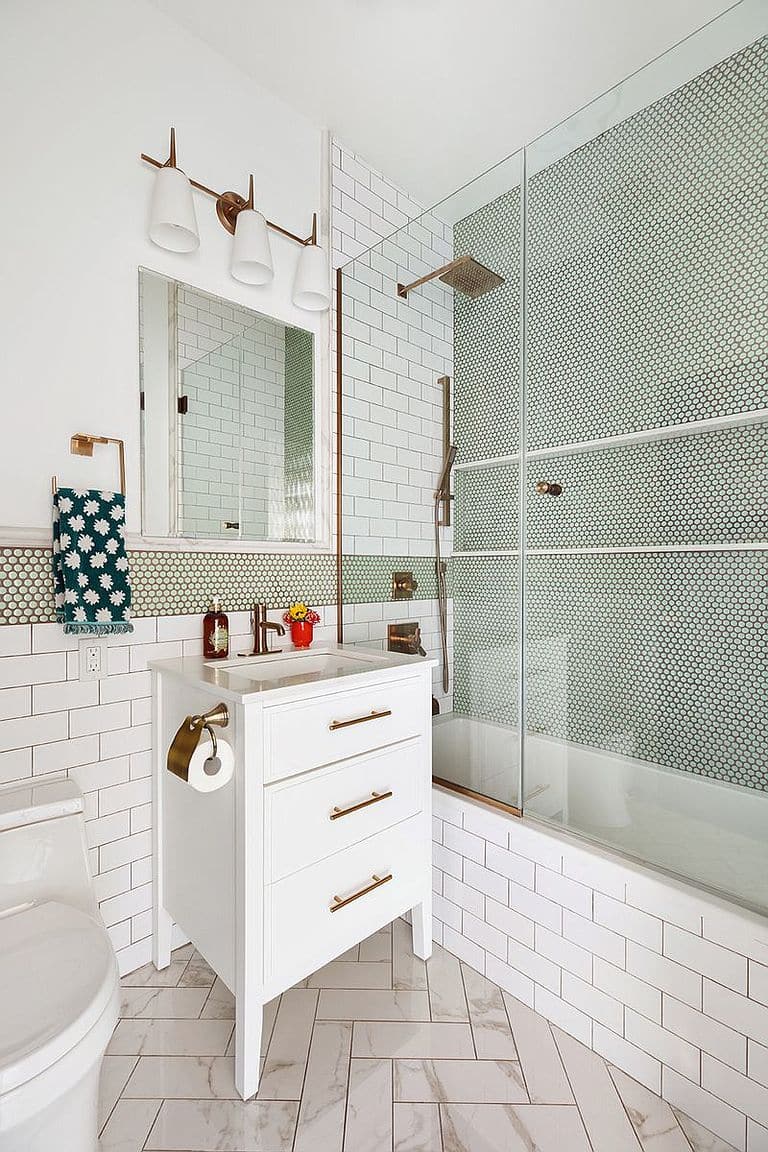
Brooklyn Co-Op Renovation | 296 Sterling Place
Between the horizontal white subway tiles on the wall, herringbone marble tiles on the floor, and white penny tile blending throughout the space, the three styles of tile blend well with the coper fixtures and white shaker cabinet for an eclectic but high-end MCM look. See the full condo renovation before and after.
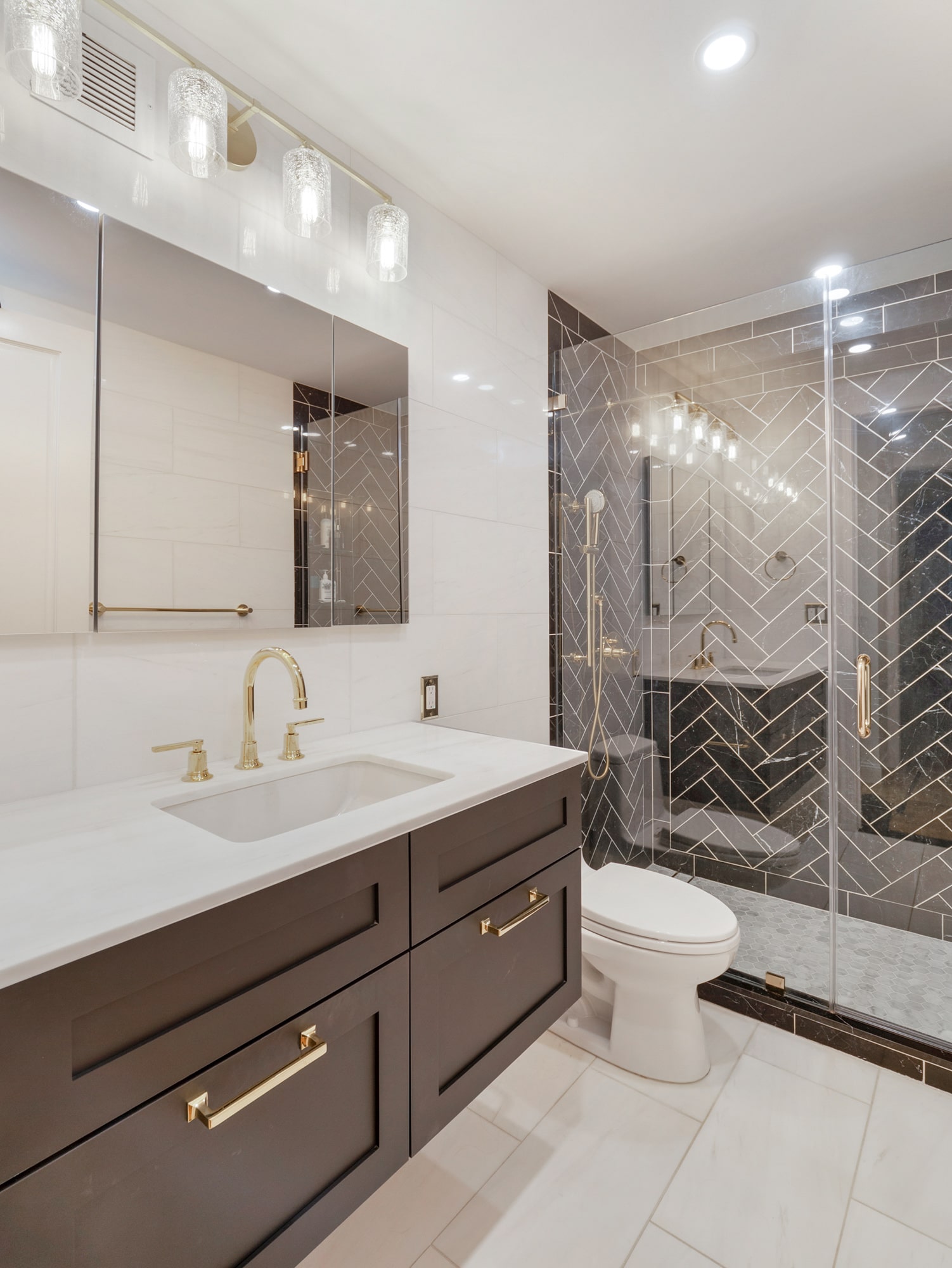
NYC Condo Renovation In Carnegie Hill | 8 EAST 83RD
Both bathrooms in this Carnegie Hill renovation near Central Park got the MCM treatment. Bathe in the blend of herringbone black subway tile on the shower walls, Portofino marble stones blending from wall to floor, modern frameless mirror, and chestnut vanity. View full condo renovation before and after.
Benefits Of Working With Gallery For Mid-Century Modern Design In Your NYCRenovation
If you have a renovation project coming up, the dedicated and experienced team at Gallery Kitchen & Bath can help you sort through all your options and find the best mid century-modern design ideas for your space. Learn more about Gallery, view a portfolio of our renovations in NYC, or contact us to begin conversations about kicking off your dream renovation.
We are a New York Times-featured design-build firm in New York City with a full-service approach to residential renovations in Manhattan and Brooklyn that includes everything from interior design and architectural services to facilitating building management and board approval, to construction and construction management. We’re experts in renovating full homes, kitchens, bathrooms, flooring, custom millwork, and all that falls in between.
Gallery KBNY is a full-service design-build firm featured in The New York Times, specializing in the architecture, interior design, and renovation of apartments, co-ops, condominiums, townhomes, and lofts across Manhattan and Brooklyn. Our integrated team of architects, designers, contractors, and project managers manages every phase from board approvals and DOB permitting through design and construction. A founding partner is involved in every project, start to finish. Because architecture, design, permitting, and construction are coordinated under one roof, the process remains streamlined, accountable, and transparent from start to finish. Our work has also appeared in Forbes, Architectural Digest, and Inc., and is backed by 100+ five-star client reviews.
[#faq]Frequently Asked Questions About Mid-Century Modern Design In NYC Renovations[#faq]
What Distinguishes A Genuinely Mid-Century Modern Bathroom From A Contemporary Bathroom That Simply Uses MCM-Adjacent Materials?
The distinction comes down to material discipline and reference. A genuinely MCM bathroom is grounded in a specific material vocabulary (walnut or rosewood vanity, marble counter and accent surfaces, brass or matte black fixtures, geometric tile in hexagon or subway formats, restrained color palette) and a specific design reference (the residential work of the 1940s to 1960s that established the language). A contemporary bathroom using MCM-adjacent materials might combine some of these elements (a walnut vanity with quartz counter and modern fixtures) without committing to the disciplined palette that defines the genuine style. The visual difference is that a true MCM bathroom reads as a coherent design moment with clear architectural lineage, while an MCM-influenced bathroom reads as contemporary with MCM accents. Neither is inherently better; they serve different design intentions. The distinction matters when an owner is making a long-term design decision and wants the bathroom's aesthetic to age into legitimate design history rather than into a dated trend.
How Should An Owner Of A Fully Renovated Pre-War Manhattan Apartment Evaluate Whether MCM Is The Appropriate Design Language For The Building?
Pre-war Manhattan apartments are particularly hospitable to MCM design language because the architectural bones of pre-war construction (high ceilings, large windows, original molding and millwork detail, generous proportions) provide the architectural context MCM design assumes. The pre-war shell anchors the MCM material vocabulary in genuine architecture rather than imposing it on a contemporary space. MCM tends to read most successfully in pre-war apartments where the original architectural detail is preserved and the MCM palette is deployed as the finish layer within that architectural frame. The combination produces an apartment with two design languages operating in productive tension: the pre-war architectural shell and the MCM material finishes. MCM tends to read less successfully in apartments with weak architectural bones (low ceilings, minimal molding, generic post-war construction) where the material vocabulary has no architectural context to anchor it. For owners evaluating MCM as a design direction, the question is whether the apartment's underlying architecture is strong enough to hold the design language without competing with it.
What Is The Practical Cost Difference Between An MCM-Styled Single Bathroom Renovation And An MCM-Coordinated Full Apartment Renovation?
A single bathroom renovated in full MCM specification (walnut floating vanity, marble counter, hexagon or marble floor, brass fixtures, subway wall tile) runs $45,000 to $120,000 installed in Manhattan or Brooklyn depending on tile selection and fixture tier. A coordinated kitchen-plus-baths-plus-millwork renovation program in the same design language runs $280,000 to $650,000, depending on apartment size and finish level. A full apartment gut at luxury tier with MCM design throughout runs $700 to $1,000 per square foot, placing a typical 1,500 square foot apartment at $1.05M to $1.5M. The cost-per-room math is similar across scopes (room-only renovations carry higher per-room overhead due to fixed costs and trade minimums), but the design outcome scales nonlinearly. The single bathroom delivers a styled moment; the full apartment delivers a designed home. For owners considering MCM as a design direction, the more compelling project is typically the coordinated scope where the design language reaches its full expression, not the single-room intervention where the MCM vocabulary is contained but the surrounding apartment does not support it.
How Does Gallery Approach The Design Phase For An MCM-influenced Apartment Renovation, And Where Should An Owner Expect The Most Consequential Decisions To Be Made?
Gallery's design process for an MCM-influenced renovation begins with a full-apartment palette conversation rather than a room-by-room finish selection process. The first design meetings establish the foundational material vocabulary: which wood tone (walnut, rosewood, chestnut), which stone family (Calacatta marble, Carrara marble, Portofino marble), which metal finish (brushed brass, matte black, or a coordinated pairing), and which tile patterns will appear in which rooms. Those foundational decisions cascade into every subsequent specification, and they are the decisions where the design outcome is genuinely determined. Subsequent design phases handle the application of the palette within each room (the bathroom's specific tile layout, the kitchen's specific cabinet configuration, the millwork's specific profile detail), but the rooms are working within an established vocabulary rather than each room making independent material decisions. The owners who get the strongest result from the process are the ones who engage fully with the foundational palette discussion early, rather than deferring those decisions to room-by-room conversations later in the project.
Is MCM A Design Choice That Holds Resale Value In The Manhattan And Brooklyn Market, Or Does It Carry The Same Dated-Trend Risk That Previous Bathroom Design Fads Did?
MCM has a structurally different position in the design market than trend-driven bathroom designs of previous decades. The 1940s through 1960s residential vocabulary that MCM draws on is genuine architectural history, not a styling fad, and the material palette (walnut, marble, brass, geometric tile) is the same material palette that has anchored serious residential design for nearly a century. The risk of MCM aging poorly is structurally lower than the risk associated with more decoratively driven trends because the materials themselves age with grace rather than with obsolescence. The resale signal in the Manhattan and Brooklyn market favors apartments with disciplined material vocabulary and coherent design execution, both of which MCM supports when properly deployed across the apartment. The risk is not that MCM will date poorly; the risk is that an MCM execution in a single bathroom within an otherwise unrenovated apartment will read as a styling intervention rather than a coherent design vision. Buyers respond more strongly to apartments with whole-home design coherence than to apartments with one renovated room in a distinctive style, regardless of how skillfully that room is executed.
Manhattan Design-Build
Evaluate Your Manhattan Apartment
Before You Buy
Buying an apartment you plan to renovate? A founding partner walks it with you during the contract period and maps the scope, cost, and timeline, so you know exactly what you're taking on before you sign.
As seen in
Pre-Purchase Assessment
Walk the apartment with us first and understand the full scope, cost, and timeline before you close.
or call us directly
let’s
Design-Build
together