.avif)


.png)
.png)


How to Maximize Space in a Small Kitchen
Knowing how to maximize space in a small kitchen is critical, especially if you're an NYC resident.
January 25, 2026
|
How to Maximize Space in a Small Kitchen
The kitchen is one of the most popular targets for renovation, but small kitchen remodel ideas can be hard to come by. Here’s how to plan a well-thought-out, space-saving kitchen design.
TABLE OF CONTENTS
- Start With A Plan
- Reclaim The Corners And Cabinets
- Build Cabinetry To The Inch
- Use The Vertical Space
- Open The Kitchen To The Home
- Small Kitchens We Have Opened Up
New York apartments ask a lot of a small footprint, and the kitchen is where that pressure shows first. Tight dimensions and hard ninety-degree corners create inefficiencies that a thoughtful plan can turn into usable space. The work is equal parts strategy and creativity, and the gains compound when the kitchen is designed as part of the larger home.
What follows are the moves we rely on, grouped from light-touch updates to the structural changes that open a kitchen to the rooms around it.
[#1]Start With A Plan[#1]
With limited room to work, a small kitchen rewards a plan that is strategic and creative in equal measure. The moves below range from light-touch updates that need no construction to structural changes that reshape the footprint, and the right mix depends on the kitchen and on the renovation around it. The chart sets them out by scope.

[#2]Reclaim The Corners And Cabinets[#2]
Corners are where small kitchens lose the most space. A rarely-used appliance pushed into a ground-level corner tends to disappear for good, so we fit corners with a Super Susan or a blind-corner pull-out that brings the back of the cabinet within reach. Inside the runs, pull-out pantry and spice racks, sliding shelves, and toe-kick drawers turn awkward gaps into working storage. On one Manhattan kitchen, we built the cabinets to the exact dimensions of the room and fitted them with a pull-out spice rack, a Super Susan, and sliding shelves, so every inch earned its place. The reference below covers the solutions we reach for most.
.webp)
[#3]Build Cabinetry To The Inch[#3]
Custom cabinetry costs more than semi-custom or stock, and in a small kitchen it pays for itself by using the space those options waste. Built to the room’s exact measurements, custom cabinets remove the filler panels and dead gaps pre-made boxes leave behind, and they let a run rise to the ceiling for a taller line and more storage. We applied this in a Brooklyn chef’s loft kitchen, where custom shelving carried the storage the cook actually needed.

[#4]Use The Vertical Space[#4]
When floor space is fixed, the walls and ceiling carry the load. Cabinets taken to the ceiling reclaim the height most kitchens leave empty, and open shelving, balanced against closed cabinetry, keeps the room feeling light while adding display and reach. Integrated lighting does double duty, since LED strips set into cabinets and under shelves light the counter without the bulk of a fixture, and they trim energy use along the way. Together these moves help a compact kitchen read as open and considered.
%20Gallery%20KBNY.webp)
[#5]Open The Kitchen To The Home[#5]
The largest gains come from the rooms next door. When the budget supports a fuller renovation, removing a wall opens a cramped kitchen into the living or dining area and creates the open plan many NYC homes want. Blending the kitchen with an adjacent dining room stretches the perceived space, and an island or peninsula can mark the transition while adding prep and seating. Each of these is a whole-home decision, since it depends on what is load-bearing and on how the surrounding rooms are meant to flow. The chart below maps the structural moves and what each one asks of the larger plan.

[#6]Small Kitchens We Have Opened Up[#6]
A few examples from our work across Manhattan and Brooklyn show these ideas in place. In a Manhattan townhouse, a narrow galley kitchen sat beside the dining room, so we built custom banquette seating with a central table that works as both connector and divider, tying the two rooms together. For a Manhattan apartment, we removed the walls enclosing a small kitchen and added an island with a waterfall quartz counter that transitions from the living area, then layered in custom cabinetry and recessed lighting so no ceiling height was lost. In a Westside apartment combination near Columbus Circle, two one-bedroom units were joined horizontally; the kitchen footage was modest, so we opened it with a wrap-around counter-seating area, a blend of custom cabinets and open shelving, and a transitional dining area across the doorway, all tied together with a mid-century Scandinavian theme.
MANHATTAN TOWNHOUSE RENOVATION
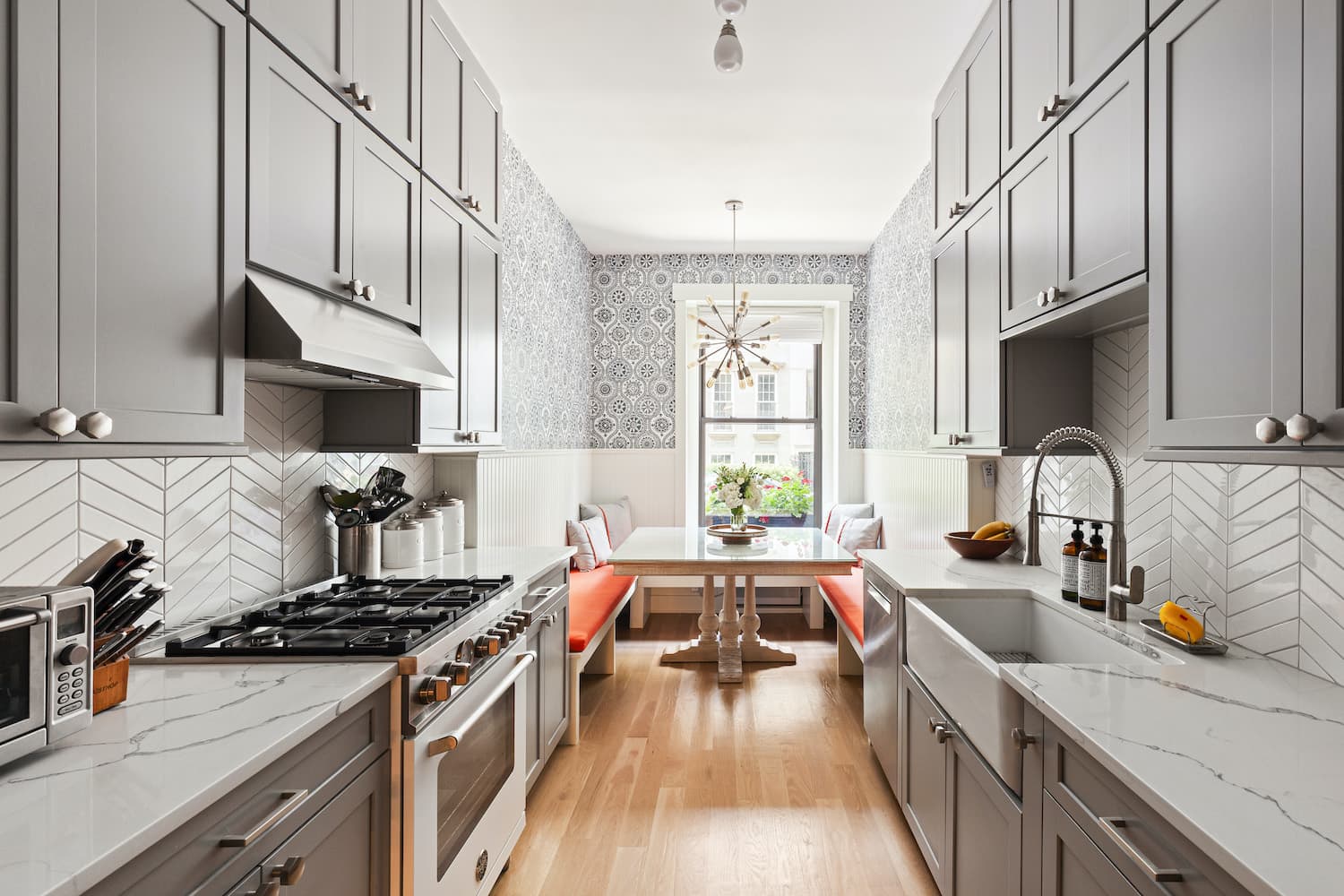
The kitchen in this Manhattan townhouse renovation is a narrow galley-style space attached to the dining area. We wanted to connect the two in a more cohesive manner, so we built custom banquette seating benches in the dining room, with a table in the center acting as both a connector and divider. See the full NYC townhouse renovation before and after.

MANHATTAN APARTMENT RENOVATION
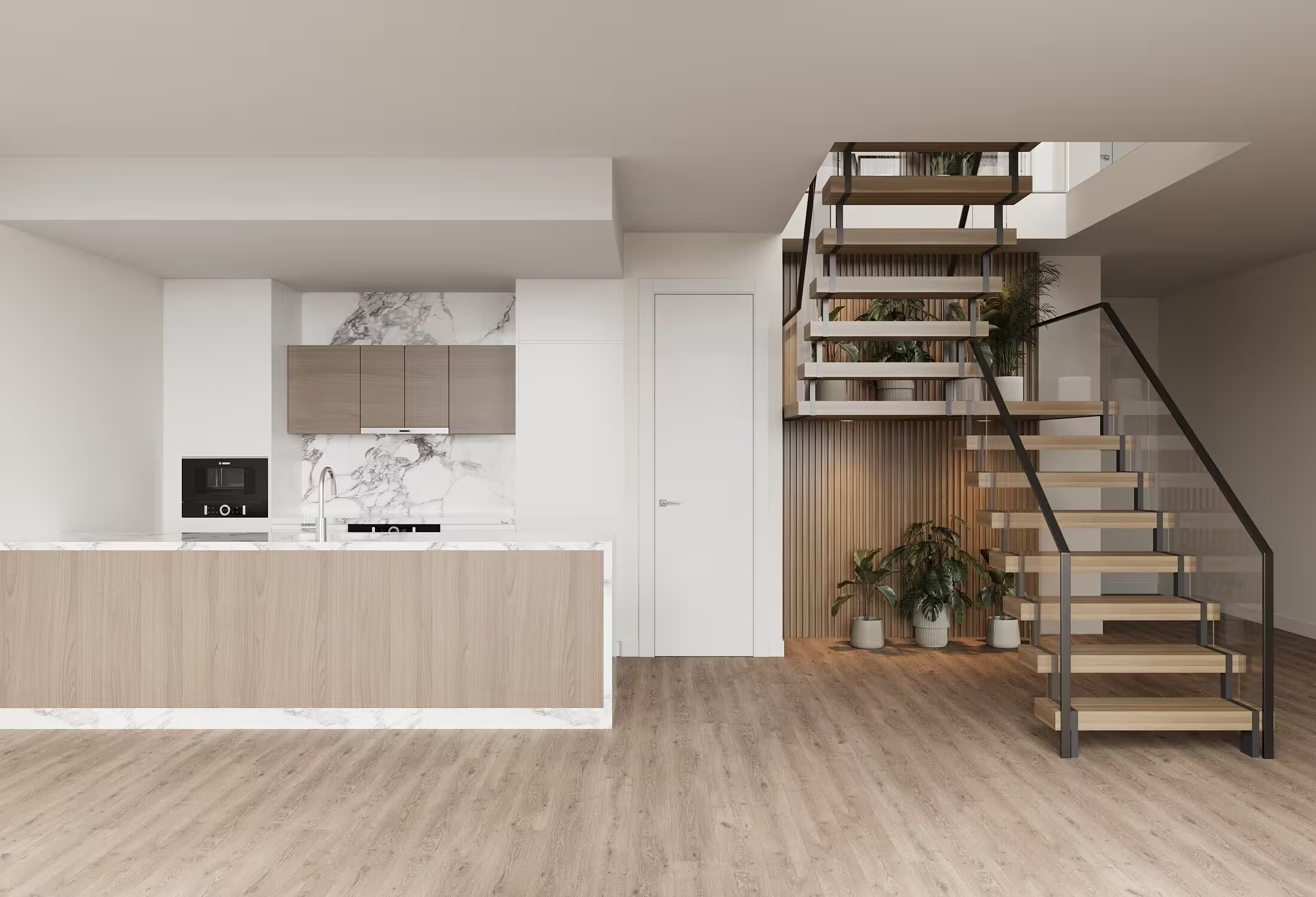
For this apartment renovation in Manhattan, we completely tore down the walls enclosing the small kitchen and created a roomier, more free-flowing space. We then added an island with a waterfall quartz countertop bar to transition from the living area to the kitchen.
All additional space is maximized by the introduction of various levels of custom cabinetry and recessed lighting to ensure no ceiling height was lost. See the full NYC apartment renovation before and after.
WESTSIDE MANHATTAN APARTMENT COMBINATION
This NYC apartment renovation project in Columbus Circle involved the horizontal combination of an existing one bedroom apartment with a newly purchased one bedroom unit next door.
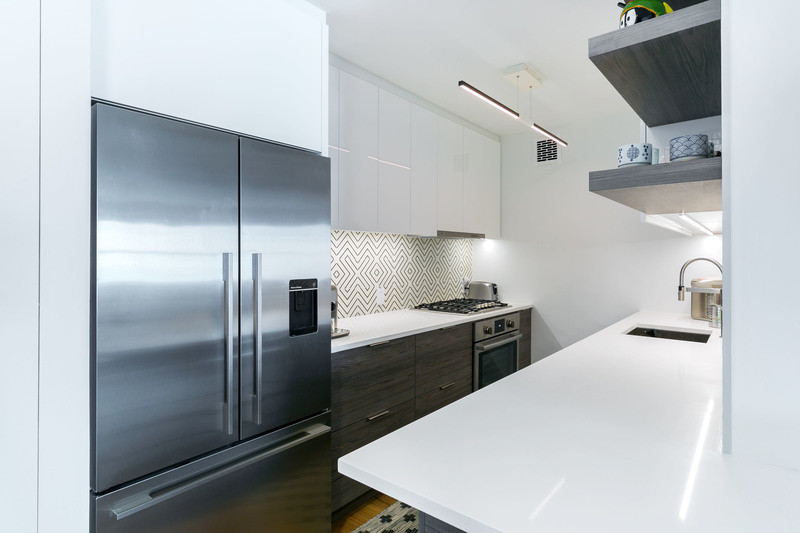
The kitchen square footage was minimal, but with the expanded floor plan, we were able to open up the space by installing a wrap-around countertop seating area, with a blend of custom-sized cabinets and open shelving. We then put the transitional dining area across the doorway, stretching out the perceived kitchen space and tying both spaces together with a mid-century Scandinavian design theme. See the full NYC apartment combination before and after.
Full-Service Design-Build In NYC
A small kitchen gains the most when it is planned as one part of a whole-home renovation, where the layout, the structure, and the systems are resolved together. As a full-service design-build firm, Gallery KBNY carries that work from interior design and architecture through board approvals and construction, so a small kitchen and the home around it move forward as one project.
Gallery KBNY is a full-service design-build firm featured in The New York Times, specializing in the architecture, interior design, and renovation of apartments, co-ops, condominiums, townhomes, and lofts across Manhattan and Brooklyn. Our integrated team of architects, designers, contractors, and project managers manages every phase from board approvals and DOB permitting through design and construction. A founding partner is involved in every project, start to finish. Because architecture, design, permitting, and construction are coordinated under one roof, the process remains streamlined, accountable, and transparent from start to finish. Our work has also appeared in Forbes, Architectural Digest, and Inc., and is backed by 100+ five-star client reviews.
Frequently Asked Questions About Renovating Kitchens In NYC
Is it worth removing a wall to enlarge a small kitchen?
It often is, when the wall is not load-bearing and the building allows the change. Opening a wall merges a cramped kitchen with the living or dining area and creates the open plan many NYC homes are after. Feasibility depends on structure, so a load-bearing wall may call for a beam and engineering, and a co-op will review the work through its alteration agreement. Because the change touches the surrounding rooms, it is best weighed as part of a fuller renovation rather than a kitchen-only project.
How much more storage does custom cabinetry add in a small kitchen?
Meaningfully more, because custom cabinets are built to the room’s exact dimensions rather than to standard box sizes. That removes the filler panels and dead gaps stock cabinetry leaves behind, and it lets runs rise to the ceiling and wrap corners with fitted hardware. In a tight kitchen, that recovered space is often the difference between cabinets that look full and cabinets that actually hold what you use.
Can a small kitchen support an island, or is a peninsula the better choice?
An island works when the room keeps comfortable clearance on every open side, generally around three to four feet, which many small kitchens cannot spare. A peninsula attaches to a wall or cabinet run and delivers much of the same prep surface, seating, and storage in a smaller footprint. In an open plan, either can mark the transition between the kitchen and the living space, so the choice follows the dimensions and the way the home is used.
In a full-home renovation, is it better to expand or relocate the kitchen than to optimize it in place?
Sometimes, and it depends on the building’s systems. Where gas, plumbing, and structure allow, enlarging the kitchen into an adjacent room or relocating it within a combined apartment can resolve a small footprint more completely than working within the existing walls. Those moves reshape the plumbing, gas, and electrical plan for the whole home, so they belong in the architectural phase of a full renovation, decided alongside the rest of the layout.
What design choices make a small kitchen feel larger?
Light and continuity do most of the work. Pale finishes and a consistent material palette reduce visual breaks, open shelving balanced against closed cabinetry keeps the room from feeling boxed in, and integrated lighting brightens counters and interiors without the bulk of fixtures. Carrying the flooring and the sightlines into the adjacent room, where the layout allows, makes the whole space read larger than its measurements.
How do appliance choices change in a small high-end kitchen?
Integration becomes the priority. Panel-ready refrigerators and dishwashers disappear into the cabinetry for a seamless line, counter-depth and slimmer-profile appliances preserve walkways, and a single well-chosen range often serves better than crowding in multiples. Ventilation deserves early attention, since a small kitchen in a co-op without exterior venting may call for a recirculating hood. The goal is appliances that meet how you cook without consuming the room.
Does renovating a small kitchen add resale value in NYC?
A well-executed kitchen is among the strongest contributors to an apartment’s value, and in a small kitchen the gains come from function and finish rather than size. Buyers respond to a layout that works, considered storage, and a quality material palette. The return is greater still when the kitchen is part of a cohesive whole-home renovation, since a buyer reads the apartment as one resolved space.
How does designing a small kitchen differ in a pre-war co-op versus a newer condo?
Pre-war kitchens tend to be more enclosed, with fixed walls, shared plumbing stacks, and tighter electrical capacity, so gaining space often means opening a wall and upgrading systems, all under a co-op’s alteration agreement. Newer condos more often start with open plans and modern infrastructure, which shifts the work toward layout and cabinetry rather than structure. In both, the building’s rules and systems shape what is possible, which is why the assessment comes first.
Manhattan Design-Build
Evaluate Your Manhattan Apartment
Before You Buy
Buying an apartment you plan to renovate? A founding partner walks it with you during the contract period and maps the scope, cost, and timeline, so you know exactly what you're taking on before you sign.
As seen in
Pre-Purchase Assessment
Walk the apartment with us first and understand the full scope, cost, and timeline before you close.
or call us directly
let’s
Design-Build
together