

.png)
.png)


1035 Fifth Avenue, Carnegie Hill
4,000 sq ft
Pre-War Co-Op
Estate Condition
$2,200,000
$550/sq ft
View Project →
.avif)
What does a gut renovation cost in a Manhattan co-op? Gallery KBNY breaks down 2026 pricing from $450 to $650+ per sq ft, board fees and timelines.
March 20, 2026
|
MIN.jpeg)
How Much Does a Gut Renovation Cost in a Manhattan Co-Op? (2026 Guide)
NYC’s leading design-build firm breaks down gut renovation costs for Manhattan co-ops: $450–$650+/sq ft. Co-op board fees, timelines, and luxury finishes explained.
Co-op gut renovations in Manhattan typically involve a higher level of coordination and regulatory oversight than comparable condominium or townhouse projects. Understanding these structural differences early is one of the most important steps in establishing a realistic renovation budget.
Unlike condominium owners, who hold a deed to their apartment, co-op residents are shareholders in the corporation that owns the building. As a result, renovations must satisfy not only NYC Department of Buildings requirements but also the review and approval process established by the co-op board.
This process often includes architectural review by the building’s consulting architect, compliance with alteration agreements, strict contractor insurance requirements, and adherence to house rules governing construction hours and building protection.
Here is how board-specific requirements typically influence a co-op renovation in NYC:
Before demolition can begin, you must submit a formal alteration package to the co-op board. This submission includes architectural drawings, a written scope of work, contractor credentials, insurance documentation, and appliance specifications. The board’s reviewing architect evaluates the plans (typically at the shareholder’s expense) with review fees commonly ranging from $1,500–$3,000. Approval timelines vary by building but often take 6–12 weeks, particularly in buildings where boards meet monthly.
Most Manhattan co-ops require contractors to carry $1M–$2M in general liability coverage, along with workers’ compensation and commercial auto insurance. In some Upper East Side, Upper West Side, and Central Park West buildings, umbrella coverage requirements can reach $5M–$10M and further requires additional coverage to protect against New York’s unique labor laws. These thresholds significantly narrow the pool of qualified renovation firms and are typically reflected in the pricing of experienced co-op renovation teams.
Construction in Manhattan co-ops is almost always limited to weekday daytime hours (typically 9 AM to 4 PM or 8:30 AM to 4:30 PM) with no weekend or holiday work permitted. Once daily setup and cleanup are factored in, this often yields only 6–7 productive hours per day, extending construction schedules relative to projects in private residences.
Furthermore, certain co-op buildings impose daily or weekly penalties for renovations that exceed a certain timeline (oftentimes 120 days). Some renovations, especially larger apartments, must account for the cost of the penalties into the budget if completion of the full renovation within the 120-day period is unrealistic.
Co-op buildings frequently require a refundable renovation deposit ranging from $10,000–$50,000 or more, in addition to application fees, elevator reservation charges, and building protection costs. These expenses can add $15,000–$60,000+ to the overall project investment before construction begins.
Many NYC co-op buildings require certain infrastructure upgrades as part of any renovation. These may include replacement of branch plumbing lines back to building risers, waterproofing of wet areas, and soundproofing assemblies beneath flooring. In more exclusive buildings, additional requirements such as automatic leak detection systems or window replacement may also apply.
In pre-war buildings, renovation projects may also trigger building-wide infrastructure work - including riser replacement or steam line upgrades, which can introduce additional coordination.
.jpg)
For a full gut renovation in a Manhattan co-op, homeowners should typically plan for $450–$550 per square foot for upper mid-tier projects and $550–$650+ per square foot for luxury-level renovations featuring custom millwork, premium appliances, and high-end natural stone.
These ranges include the cost of construction, finishes, typical building-imposed work, but they do not include co-op-specific soft costs such as board review fees, deposits, or professional design fees.
Here is how those numbers translate across typical Manhattan co-op apartment sizes:
| Apartment Size | Upper Mid-Tier ($450–$550/sq ft) | Luxury ($550–$650+/sq ft) |
|---|---|---|
| 1-Bedroom (700–900 sq ft) | $315,000–$495,000 | $385,000–$585,000+ |
| 2-Bedroom (1,100–1,400 sq ft) | $495,000–$770,000 | $605,000–$910,000+ |
| 3-Bedroom (1,600–2,000 sq ft) | $720,000–$1,100,000 | $880,000–$1,300,000+ |
| Classic 6/7 (1,800–2,500 sq ft) | $810,000–$1,375,000 | $990,000–$1,625,000+ |
Many published renovation cost ranges reflect the full market spectrum, including minimal-scope projects using stock materials or limited design involvement. Renovations in Manhattan co-ops that incorporate custom cabinetry, premium materials, integrated architectural design, and full project management typically fall within the $450–$650+ per square foot range.
Cost ranges are useful for planning, but they only tell part of the story. Below are three completed Manhattan co-op renovations from our portfolio with real project costs, scopes, and the specific factors that shaped each budget. These are all-inclusive figures covering architecture, design, materials, labor, permits, and project management.
This Carnegie Hill co-op sits inside one of Fifth Avenue’s most distinguished pre-war buildings. When Gallery took on the project, the apartment was in estate condition, meaning it hadn’t been meaningfully updated in decades. The walls, systems, and finishes all needed to go.
Full gut renovation including central air installation (the building had no existing HVAC infrastructure for the unit), complete kitchen renovation, renovation of all bathrooms, new hardwood flooring throughout, full electrical rewiring and panel upgrade, skim-coating of all walls and ceilings, new doors, hardware, trim, lighting, and custom millwork. Gallery handled architecture, interior design, DOB permitting, co-op board approvals, material procurement, and construction management - all under one contract.
At 4,000 square feet in estate condition, this was a full-systems overhaul. The pre-war building’s existing infrastructure required complete replacement, there was no shortcutting the electrical, plumbing, or HVAC scope. Central air installation in a pre-war building with no existing ductwork is one of the largest single line items in any gut renovation. The apartment’s scale, a true classic layout with formal rooms, multiple bathrooms, a full kitchen, and extensive hallway and closet areas, meant every trade cycle was larger and more time-intensive than a typical two-bedroom.
The $550/sq ft cost reflects an upper mid-tier finish level with quality materials and careful design, not ultra-luxury, but well above basic. This is a realistic benchmark for what a full-systems, full-design gut renovation costs in a pre-war Manhattan co-op in 2026.
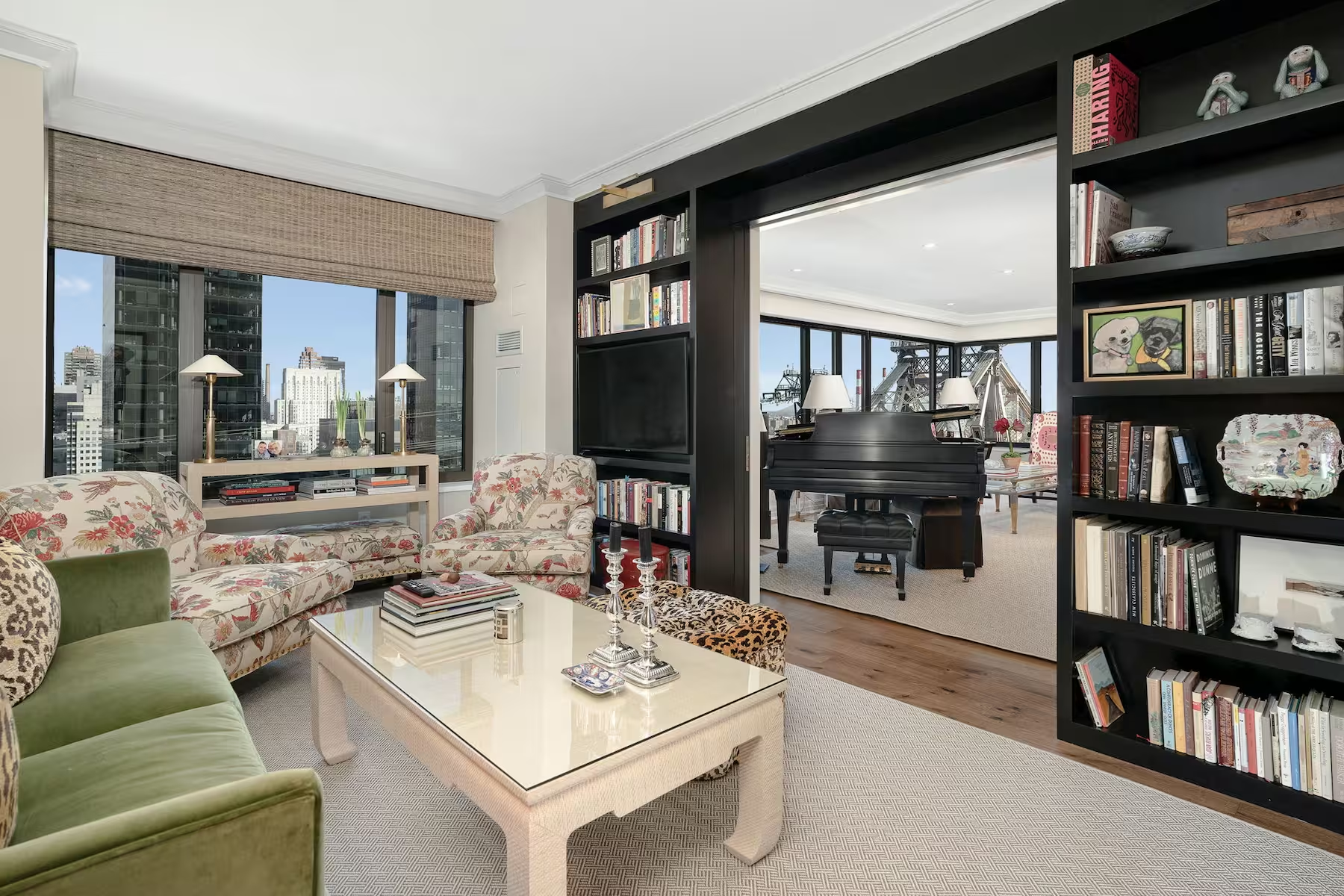
The Sovereign at 425 East 58th Street is a postwar co-op in Sutton Place, one of Manhattan’s most established residential enclaves. This project was a full gut renovation of an 1,800-square-foot apartment, taken down to the studs and rebuilt from scratch.
Complete gut renovation including new kitchen, bathroom renovations, new flooring throughout, full electrical and plumbing replacement, new walls and ceilings, all new finishes, fixtures, and lighting. Gallery managed architecture, design, co-op board approvals, permitting, procurement, and construction.
While postwar buildings generally present fewer structural surprises than pre-war co-ops (drywall instead of plaster, standardized framing, better-condition plumbing), a full gut at this scale still involves complete MEP replacement, custom cabinetry, quality stone and tile, and the co-op-specific soft costs that come with renovating inside a managed building. At roughly $528 per square foot, this project reflects the realistic cost of a full gut renovation in a postwar Manhattan co-op with quality finishes, the type of renovation that most online guides underestimate.
.jpg)
This pre-war co-op on the Upper East Side is an example of a full gut renovation delivered to a mid-tier to upper mid-tier finish level, quality materials and thoughtful design, but without the premium pricing of fully custom luxury finishes.
Full gut renovation including new kitchen, two full bathroom renovations, new hardwood flooring throughout, complete electrical rewiring of the entire apartment (the original wiring was obsolete and did not meet current code), asbestos abatement (identified during pre-construction testing, common in pre-war buildings), all new doors, hardware, trim, baseboards, and lighting.
The asbestos abatement and full rewiring are the two standout line items. Asbestos testing and abatement are required by NYC law before DOB permit filing for any gut renovation in a building of this age, and costs can range from $1,500 for testing alone to $8,000+ for abatement depending on the extent. Full rewiring of a pre-war apartment, replacing obsolete wiring with modern code-compliant wiring and upgrading the electrical panel, is a substantial scope item that adds both cost and timeline. At $690,000, this project demonstrates that a well-executed full gut renovation in a pre-war Manhattan co-op doesn’t have to reach $1 million or more - when the scope is clearly defined, the contingency is managed, and the finish level is calibrated to the client’s priorities.
| Project | Size | Total Cost | Cost/Sq Ft | Building Type | Finish Level |
|---|---|---|---|---|---|
| 1035 Fifth Ave, Carnegie Hill | 4,000 sq ft | $2,200,000 | $550/sq ft | Pre-War (Estate Condition) | Upper Mid-Tier |
| 425 E 58th St, Sutton Place | 1,800 sq ft | $950,000 | ~$528/sq ft | Postwar Co-Op | Upper Mid-Tier |
| 308 E 79th St, Upper East Side | 1,500 sq ft | $690,000 | ~$460/sq ft | Pre-War Co-Op | Mid / Upper Mid-Tier |
Pre-war costs more than postwar, but not always dramatically. Finish level is the biggest variable within a given scope, the difference between a $450/sq ft renovation and a $650/sq ft renovation is rarely the plumbing or electrical. It’s the cabinetry, stone, appliances, and density of millwork detail. These decisions are made during design, not during construction, which is why a design-build model that cost-validates every selection in real time is critical.
In a full gut renovation, the apartment is effectively rebuilt from the structural shell. Existing finishes, mechanical systems, and partitions are removed, allowing the project team to reconstruct the space with updated infrastructure, layouts, and materials.
Not every room contributes equally to the overall renovation investment. Kitchens and bathrooms (often referred to as “wet spaces”) carry disproportionately higher costs because of the concentration of plumbing, electrical work, waterproofing systems, tile installation, and specialty fixtures within a relatively compact footprint.
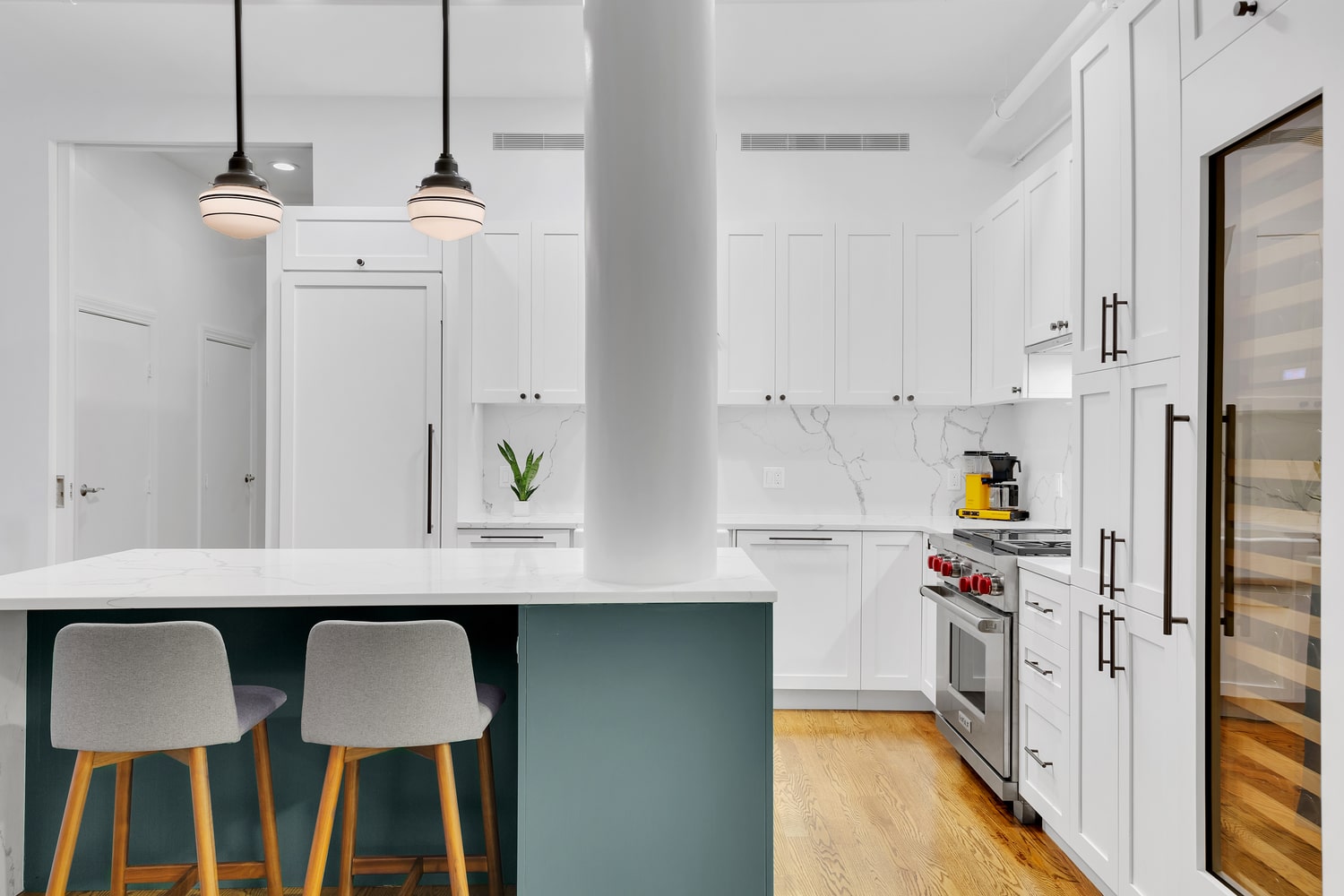
For a typical 150–200 sq ft Manhattan co-op kitchen, upper mid-tier renovation budgets generally range from $75,000 to $110,000. This typically includes upgraded cabinetry (semi-custom or custom), stone or quartz countertops, a full tile backsplash, quality appliances, under-cabinet lighting, and the associated mechanical upgrades.
Luxury kitchens, featuring fully custom millwork, integrated panel-ready appliances, book-matched stone, architectural lighting, and often layout reconfiguration, typically range from $90,000 to $130,000+.
In pre-war co-op buildings, relocating gas lines or installing proper venting for a range hood can introduce an additional $5,000–$15,000 in scope depending on the building’s infrastructure and board requirements.
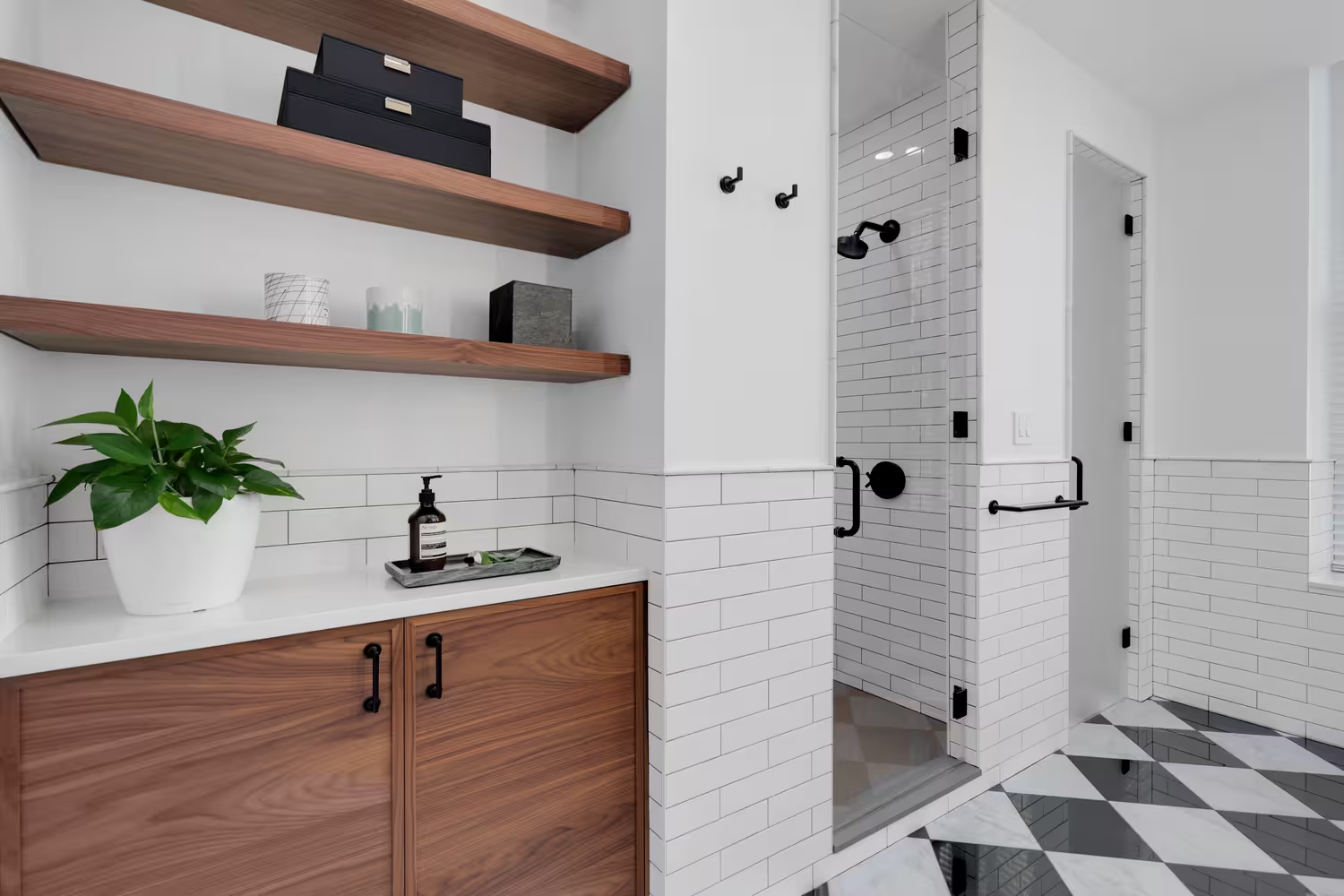
Bathrooms carry some of the highest per-square-foot costs in a gut renovation due to the density of waterproofing systems, tile work, plumbing fixtures, and electrical coordination within a compact area.
Upper mid-tier bathroom renovations typically range from $45,000–$55,000, while luxury bathrooms, incorporating heated floors, frameless glass enclosures, custom vanities, integrated lighting, and premium fittings, commonly exceed $65,000.
If your renovation includes adding a bathroom, a common goal in classic 6 and classic 7 co-op layouts, your design may need to comply with the wet-over-dry rule, which generally prohibits placing bathrooms above dry spaces such as bedrooms or living rooms in the apartment below.
It’s important to note that many buildings allow for creation of wet over dry spaces, especially if there is precedent in the building for doing so.
.avif)
While “dry spaces” such as living and dining rooms carry lower mechanical complexity than kitchens and bathrooms, they still require significant construction work in a full gut renovation.
Typical scopes include full demolition, new framing, electrical upgrades, insulation (particularly in pre-war buildings), drywall or skim-coat plaster, hardwood flooring, base and crown moldings, painting, and lighting installation.
For a 300–500 sq ft combined living/dining area, homeowners should expect approximately $40,000–$60,000 for upper mid-tier scopes and $50,000–$100,000+ for luxury scopes incorporating custom millwork, built-ins, architectural lighting, or specialty wall finishes.
.avif)
A standard bedroom gut renovation in a Manhattan co-op (approximately 120–180 sq ft) typically ranges from $20,000–$35,000 at the upper mid-tier level. This scope generally includes demolition, electrical upgrades, new walls, flooring, closet systems, and finish work.
Luxury bedroom renovations incorporating custom closet millwork, integrated lighting design, acoustic improvements, or smart-home wiring often fall within the $35,000–$50,000+ range.
-min.jpg)
Most renovation cost guides focus solely on the per-square-foot construction price. In Manhattan co-op buildings, however, there's an additional layer of soft costs and regulatory expenses that aren't typically included in a contractor’s bid. These building-specific expenses can add 8–15% to the total project cost.
| Cost Item | Typical Range | Notes |
|---|---|---|
| Alteration Agreement Filing Fee | $250–$500 | Non-refundable, paid to managing agent |
| Board Architect Review | $1,500–$3,000+ | Paid by shareholder; some buildings charge hourly |
| Renovation Deposit (Refundable) | $10,000–$50,000+ | Often 5–10% of project cost; refunded post-inspection |
| Elevator Reservation Fees | $500–$2,000/month | For material delivery; varies by building |
| Hallway / Lobby Protection | $2,000–$5,000 | Masonite runners, elevator pads, corner guards |
| Asbestos Testing (ACP-5) | $1,500–$4,000 | Required by NYC before DOB permit filing |
| DOB Permit Fees | $2,000–$8,000+ | Alt Type 2 or Alt Type 1 depending on scope |
| Expediter Fees | $2,000–$5,000 | To navigate DOB filing and sign-offs |
| Temporary Housing | $5,000–$15,000+/month | Most co-op gut renovations require you to vacate |
| Post-Renovation Board Inspection | $500–$1,000 | Board architect verifies compliance with approved plans |
A realistic soft cost allowance for a Manhattan co-op gut renovation typically ranges from $25,000–$75,000+, depending on the building’s requirements and project scope. An experienced design-build firm familiar with co-op renovations - such as Gallery KBNY - incorporates these costs into the project budget early in the planning process to avoid surprises later.
Not all Manhattan co-op buildings present the same renovation conditions. The decade in which your building was constructed can significantly influence the scope, complexity, and investment required for a renovation.
| Factor | Pre-War Co-Op (pre-1940) | Postwar Co-Op (1945–1980s) |
|---|---|---|
| Wall Construction | Lath and plaster over masonry or terra cotta; heavier demolition, more dust, longer demo timeline | Drywall over metal or wood studs; or plaster, depending on age of building |
| Ceiling Height | 9–10 ft typical; more linear feet of wall, trim, and paint = higher finish costs | 8–8.5 ft typical; standard material quantities |
| Plumbing | Original cast iron and galvanized steel often needs full replacement; risers may be shared with neighbors, requiring coordination | Copper; often in better condition but may still need upgrading |
| Electrical | 40–70 amp service typical; knob-and-tube or BX wiring requires full replacement and panel upgrade | 60–100 amp service more common; wiring usually adequate for modern loads |
| Asbestos | High probability in insulation, pipe wrapping, flooring adhesive, and plaster; testing and abatement required | Lower probability but still possible in floor tiles, joint compound, and insulation |
| Layout Flexibility | Often larger rooms with good proportions but compartmentalized layouts; thick masonry walls may be load-bearing | More standardized layouts; thinner partition walls offer easier reconfiguration |
| Cost Premium | +10–20% over comparable postwar scope | Baseline |
In practical terms, renovating a pre-war co-op typically adds 10–20% additional budget to account for infrastructure upgrades and structural complexity.
Gallery KBNY regularly renovates pre-war apartments throughout the Upper East Side and Upper West Side, and these building-specific variables are carefully evaluated during the planning stage of every project.
.avif)
A gut renovation in a Manhattan co-op typically takes 5–9 months of construction following board approval, with an additional 4–5 months for design, permitting, and board review during the pre-construction phase. Total project duration from initial consultation through move-in generally ranges from 9–14 months.
The most significant timeline variable in co-op renovations is often board approval, not construction itself. A design-build firm that manages alteration agreements, permits, and board communication in-house can frequently reduce the pre-construction timeline compared with coordinating separate architects, contractors, and expediters.
In many cases, yes, particularly if you intend to remain in the apartment for five to ten years or longer, or if you are renovating a newly purchased apartment to suit your lifestyle.
Manhattan co-ops maintain strong value due to their prime locations, building services, and limited housing supply. A thoughtfully executed renovation can significantly improve both livability and long-term market appeal. Key value drivers include:
The market value difference between a one-bath and two-bath apartment of similar size on the Upper East Side or Upper West Side can reach $100,000–$300,000+.
Outdated kitchens are often the most significant value detractor in pre-war apartments. Opening the kitchen to adjacent living areas (where structurally feasible) and incorporating quality materials can substantially improve resale appeal.
Electrical upgrades, new plumbing, and improved HVAC systems may not be visually dramatic, but they address the infrastructure issues that frequently concern buyers during due diligence.
Many classic 6 and classic 7 apartments include formal dining rooms, maid’s rooms, and compartmentalized kitchens. Renovation allows these layouts to be reconfigured into open living spaces, home offices, or expanded storage that better reflect contemporary living.
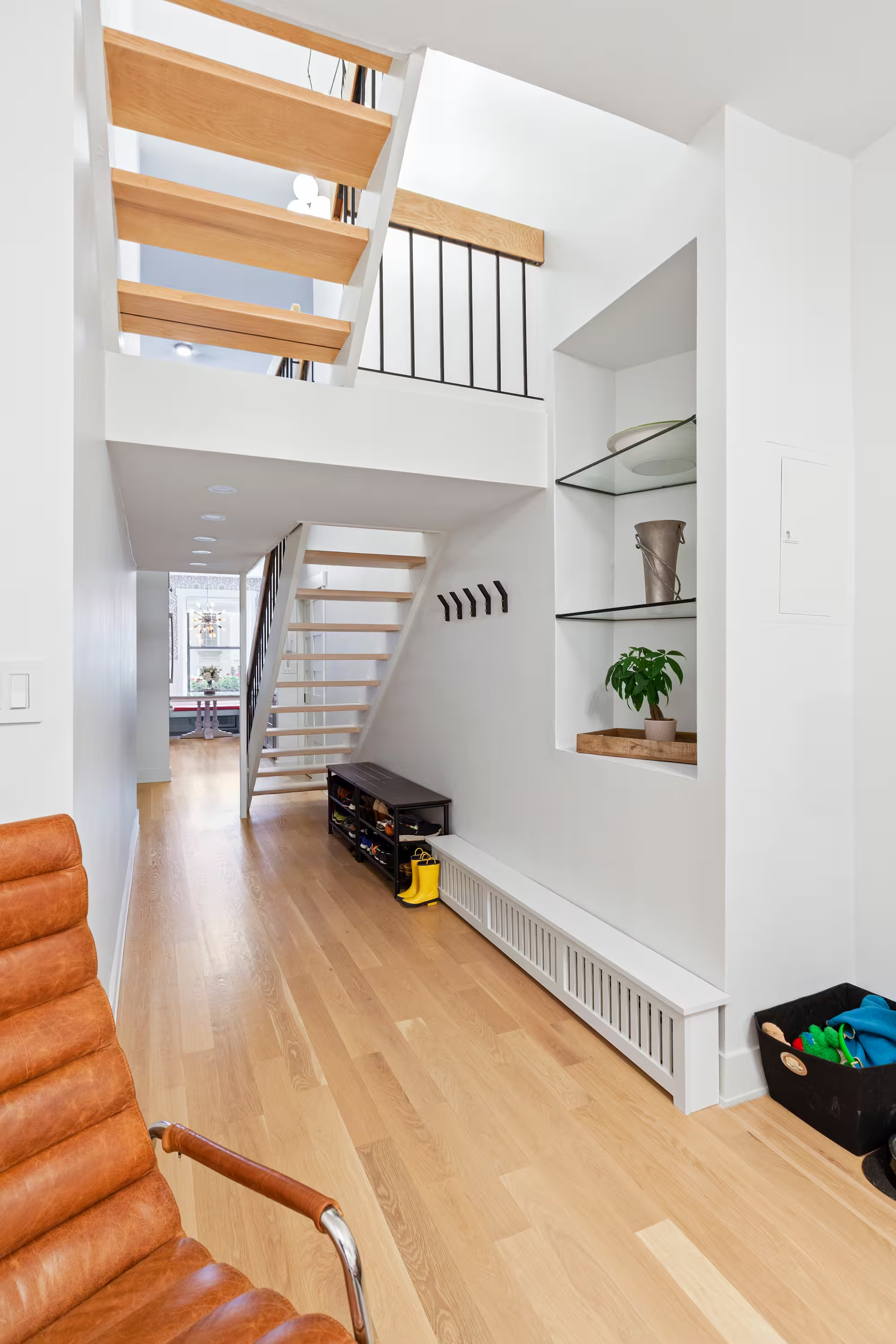
Selecting the right team is one of the most important decisions in a Manhattan co-op renovation. Unlike renovations in private homes or new construction condos, co-op projects require navigating board approvals, alteration agreements, strict insurance requirements, and construction logistics within an occupied residential building.
For this reason, the most successful co-op renovations are typically managed by a full-service design-build firm experienced specifically in Manhattan co-op buildings.
A design-build approach integrates architecture, interior design, permitting, and construction under a single coordinated team, ensuring that planning decisions, regulatory approvals, and construction execution remain aligned from the beginning of the project through final completion.
When evaluating firms for a Manhattan co-op renovation, homeowners should consider the following factors:
Renovating within a co-op building requires familiarity with the board approval process, managing agents, alteration agreements, and building consultants who review renovation plans. A firm experienced in co-op renovations understands how boards evaluate submissions and can structure the architectural plans and alteration package accordingly, helping prevent unnecessary review cycles or approval delays.
In Manhattan co-op buildings, the approval process often involves several layers of documentation, including architectural drawing sets, alteration agreement packages, contractor insurance documentation, appliance and equipment specifications, asbestos testing reports, and DOB permit filings. A design-build firm that manages board submissions, permit filings, and regulatory coordination in-house can significantly streamline this process compared with homeowners coordinating multiple consultants independently.
Most Manhattan co-op buildings require contractors to carry $1M–$2M or more in general liability insurance, with some buildings requiring umbrella policies of $5M–$10M. Not all contractors meet these thresholds. Confirming insurance compliance early in the process ensures that the firm you select is qualified to perform work in your building.
One of the advantages of the design-build model is that architectural planning, interior design, and construction are coordinated by one team. This integrated approach reduces the communication gaps that frequently arise when homeowners hire separate architects, designers, and contractors, a common source of project delays and cost overruns. When one team is responsible for both design and construction, decisions about layout, materials, and construction sequencing can be evaluated holistically.
Before selecting a renovation firm, you should review completed co-op renovation projects, before-and-after project documentation, references from past co-op clients, and experience working in buildings similar to their own. Renovation experience in pre-war Manhattan apartments is particularly valuable, as these buildings often require additional infrastructure upgrades and coordination with building systems.
A professional design-build firm should provide a clear project scope and preliminary investment range early in the planning process. Transparent budgeting helps homeowners understand how decisions about layout changes, materials, and custom millwork affect the overall renovation investment. Firms that rely on vague estimates or verbal pricing often create uncertainty later in the project.
For co-op renovations, the design-build model often provides the most efficient path from concept to completion. Because architecture, design, board approvals, and construction are managed under one roof, homeowners benefit from a single point of accountability, coordinated project planning, streamlined board approvals, and reduced risk of delays between consultants. This integrated approach is particularly valuable in Manhattan co-op buildings, where regulatory requirements and construction logistics must be carefully managed.
Gallery KBNY is a full-service design-build firm featured in The New York Times, specializing in the architecture, interior design, and renovation of apartments, co-ops, condominiums, townhomes, and lofts across Manhattan and Brooklyn. Our integrated team of architects, designers, contractors, and project managers manages every phase from board approvals and DOB permitting through design and construction. A founding partner is involved in every project, start to finish. Because architecture, design, permitting, and construction are coordinated under one roof, the process remains streamlined, accountable, and transparent from start to finish. Our work has also appeared in Forbes, Architectural Digest, and Inc., and is backed by 100+ five-star client reviews.
.jpg)
In 2026, a full gut renovation in a Manhattan co-op typically ranges from $450–$550 per square foot for upper mid-tier projects and $550–$650+ per square foot for luxury renovations incorporating custom millwork, premium materials, and integrated architectural design.
For a 1,800 square foot apartment, this translates to approximately:
• $810,000-$990,000 for upper mid-tier renovation scopes
• $990,000–$1,170,000+ for luxury-level renovations
These ranges generally include construction labor and materials but do not include co-op-specific soft costs such as board review fees, alteration agreement deposits, and building architect approvals. Those additional requirements typically add $25,000–$75,000+ to the overall project investment.
Beyond the base construction cost, Manhattan co-op renovations involve several building-specific fees and regulatory expenses that are not typically included in contractor pricing.
Common additional costs include:
• Alteration agreement filing fee: $250–$500
• Board architect review: $1,500–$3,000+
• Refundable renovation deposit: $10,000–$50,000+
• Elevator reservation fees: $500–$2,000 per month
• Hallway and lobby protection: $2,000–$5,000
• Asbestos testing (ACP-5): $1,500–$4,000
• NYC Department of Buildings permit fees: $2,000–$8,000+
• Temporary housing during construction: $5,000–$15,000+ per month
Collectively, these soft costs often add $25,000–$75,000+ to a Manhattan co-op renovation budget.
A full gut renovation in a Manhattan co-op typically requires 9–16 months from initial consultation to move-in.
This timeline generally includes:
• 3–4 months for design, board approval, and permitting
• 5–9 months for construction, depending on apartment size and renovation scope
The board approval process alone often takes 4–8 weeks, and construction timelines may extend due to co-op house rules that limit work hours, commonly 9 AM to 4 PM on weekdays.
Because of these constraints, renovation schedules in co-op buildings are typically longer than comparable projects in condominiums or private homes.
Board approval for a Manhattan co-op renovation is obtained by submitting a formal alteration package for review by the building’s managing agent and consulting architect.
This submission typically includes:
• Architectural drawings (existing and proposed floor plans, demolition plans, electrical and plumbing layouts)
• Electrical load letter confirming adequate service capacity
• Asbestos testing documentation for demolition areas
• A written scope of work describing the renovation
• Contractor insurance certificates and indemnification documents
• Appliance and equipment specifications
• A signed alteration agreement acknowledging building rules
A practical consideration: Alteration approvals move most efficiently when the architectural plans anticipate the technical concerns commonly raised by a building’s reviewing engineers. Addressing these requirements proactively can help prevent additional review cycles and approval delays.
Yes. Renovating a pre-war Manhattan co-op typically costs 10–20% more than a comparable renovation in a postwar building.
Pre-war buildings (constructed before 1940) often involve additional complexity, including:
• Lath-and-plaster wall construction requiring more labor-intensive demolition
• Original cast-iron plumbing and outdated electrical systems that must be replaced
• Higher ceilings that increase material quantities for walls and trim
• Greater likelihood of asbestos in insulation, flooring adhesive, and pipe wrapping
These factors increase both construction scope and project duration, which in turn raises the overall renovation investment.
In many cases, yes, provided the proposed bathroom location complies with the building’s wet-over-dry rule and the plumbing connections are feasible.
Most Manhattan co-ops prohibit placing wet spaces (bathrooms, kitchens, laundry areas) directly above dry spaces such as bedrooms or living rooms in the apartment below.
During the design phase, your architect will review the floor plan of the unit beneath yours to confirm that the proposed bathroom location complies with the building’s requirements.
Adding a bathroom is often one of the highest-return improvements in a Manhattan co-op renovation, as the value difference between a one-bath and two-bath apartment of similar size can reach $100,000–$300,000+ depending on location and layout.
For a Manhattan co-op gut renovation, a contingency of 10–20% of the construction budget is considered standard industry practice.
Pre-war buildings generally warrant a contingency closer to 15–20%, as demolition frequently reveals hidden conditions such as outdated wiring, deteriorated plumbing risers, asbestos, or structural deficiencies concealed behind plaster walls.
Postwar buildings with fewer unknowns can often work within a 10–15% contingency range.
A thorough pre-construction investigation conducted by an experienced design-build team can reduce (though never completely eliminate) the likelihood of unforeseen conditions.
The most reliable approach is to work with a full-service design-build firm experienced specifically in Manhattan co-op renovations.
Qualified firms should:
• Carry the insurance coverage required by your building
• Employ in-house architects and designers who understand co-op building requirements
• Manage alteration agreement submissions and DOB permits as part of their service
• Provide references and documentation from completed co-op renovation projects
The design-build model places architecture, design, approvals, and construction under one coordinated team, reducing the communication gaps and coordination issues that often arise when homeowners manage separate architects, designers, and contractors.
Yes, many Manhattan buyers begin planning a renovation before closing on their apartment, particularly when purchasing a property that will require a full gut renovation.
Starting the planning process early allows homeowners to:
• evaluate renovation feasibility before completing the purchase
• understand the realistic renovation investment required
• review potential layout improvements with an architect
• prepare architectural plans required for the co-op alteration agreement
• begin the board approval process shortly after closing
In Manhattan co-op buildings, the renovation approval process often involves architectural plan review, alteration agreement submissions, and contractor insurance verification. Because these steps can take several weeks (or sometimes months), early planning can significantly shorten the overall timeline from closing to construction start.
Many buyers choose to consult with a design-build firm during the contract phase so that renovation plans, budget expectations, and board submission materials can be prepared as soon as ownership transfers.
For apartments requiring extensive reconfiguration (such as pre-war co-ops on the Upper East Side or Upper West Side) early planning can also help identify structural constraints, plumbing locations, and wet-over-dry limitations before renovation drawings are finalized.
Renovating a pre-war apartment in Manhattan typically costs $500–$700+ per square foot in 2026, depending on the scope of work, the condition of the existing infrastructure, and the level of finishes involved. Pre-war buildings often require replacing original cast iron plumbing, outdated electrical wiring, and aging mechanical systems, as well as addressing lath-and-plaster walls and potential asbestos-containing materials. For example, a 1,200 sq ft pre-war renovation runs approximately $600,000–$840,000+, and an 1,800 sq ft renovation approximately $900,000–$1,260,000+. Gallery KBNY’s pre-war project at 1035 Fifth Avenue (4,000 sq ft, $2.2M, $550/sq ft) and at 308 East 79th Street ($690,000, mid/upper mid-tier) provide real-world benchmarks for this property type.
Manhattan Design-Build
Buying an apartment you plan to renovate? A founding partner walks it with you during the contract period and maps the scope, cost, and timeline, so you know exactly what you're taking on before you sign.
As seen in
Pre-Purchase Assessment
Walk the apartment with us first and understand the full scope, cost, and timeline before you close.
or call us directly

.avif)