.avif)


.png)
.png)


Small Kitchen Design & Renovation Tips To Maximize Your NYC Kitchen Space
Planning guide for Manhattan and Brooklyn owners with a compact kitchen: what smart design solves within the footprint, and when the answer is architectural.
April 13, 2026
|
%2520Gallery%2520KBNY.webp)
Small Kitchen Design & Renovation Tips To Maximize Your NYC Kitchen Space
Make the most of your small NYC kitchen space with these four tangible tips to account for during your full home renovation planning.
Table of contents
- The Constraint Is Usually The Floor Plan, Not The Kitchen
- What Organization Can Solve: Smart Design Within The Existing Footprint
- What Architecture Can Solve: When The Kitchen Needs To Grow
- Planning The Kitchen As Part Of A Larger Renovation
- FAQs About Kitchen Remodels Amidst Full Home Renovations In NYC
The average Manhattan one-bedroom apartment allocates roughly 90 square feet to the kitchen, against a city minimum of 80. In pre-war buildings, that kitchen is typically an enclosed room with a door, separated from the living and dining area by a wall that was designed for a different era of apartment life. Organizing a kitchen of that size more efficiently produces real improvements. Magnetic strips, open shelving, and hanging pot racks can meaningfully reduce counter clutter and free up cabinet space. But none of those interventions increase the kitchen's square footage, add natural light, or change how the apartment feels to live in day to day.
[#1]The Constraint Is Usually The Floor Plan, Not The Kitchen [#1]
The owners who are most satisfied with their kitchen renovations are the ones who asked a different question before they started: is the kitchen small because of how it is organized, or is it small because of how the apartment is laid out? The first problem is solved by a skilled interior designer working within the existing footprint. The second is solved by an architect with a saw.
[#Redefining]What Organization Can Solve: Smart Design Within The Existing Footprint[#Redefining]
Before escalating to structural work, it is worth being specific about what well-executed storage design and layout optimization actually accomplishes. In a 90-square-foot NYC kitchen, the difference between a poorly organized and a well-organized space is significant in daily life, even when the footprint does not change.
%20copy.webp)
OPEN THE KITCHEN TO THE LIVING AREA VISUALLY
Removing overhead cabinet doors and replacing them with open shelving on the upper wall creates a visual connection between the kitchen and the adjacent room without removing any walls. The shelving requires intentional organization, but in a kitchen where every item is in active use, that discipline tends to be maintainable. The result is a kitchen that reads as part of a larger space rather than a closed room. Costs run $1,500 to $4,000 installed and require no permit or board review.
USE THE WALL AS A FUNCTIONAL SURFACE
Magnetic knife strips, mounted spice storage, and wall-hung utensil rails relocate items from counter and cabinet surfaces to vertical space that would otherwise be dead. A single magnetic strip holding twelve knives frees the equivalent of a drawer and a countertop section simultaneously. These solutions cost $200 to $800 installed and can be completed in a day. They do not require a contractor.
HANG POTS AND PANS
A ceiling-mounted pot rack removes the storage demand that is proportionally highest in most home kitchens. A full set of cookware occupies a disproportionate share of base cabinet real estate when stored flat or stacked. Hung at ceiling height, the same cookware becomes visible, accessible, and visually compelling rather than buried. Installation requires a structural ceiling anchor (more important in pre-war plaster ceilings than in drywall) and costs $800 to $2,500 installed.
PLAN FURNITURE BEFORE COMMITTING TO A LAYOUT
The most preventable mistake in any kitchen renovation is designing the kitchen in isolation from the furniture that will live adjacent to it. An open-concept kitchen that works on a floor plan may not work when the dining table, chairs, and living room sofa are placed. A kitchen designer who does not account for the island clearance against a fully furnished dining area will produce a kitchen that the owner cannot actually use the way the rendering implied. Gallery's design process includes full-apartment furniture planning as part of every kitchen renovation consultation, regardless of whether the rest of the apartment is being touched.
[#3]What Architecture Can Solve: When The Kitchen Needs To Grow[#3]
Organization tips reach their limit quickly. When the kitchen is an enclosed pre-war galley with a single window and a door that opens into a separate dining room, no amount of pot racks and magnetic strips will make it feel like the kitchen the owner actually wants. The physical constraints are architectural, and the solutions are architectural.
MIN.webp)
REMOVE THE WALL BETWEEN THE KITCHEN AND THE LIVING OR DINING AREA
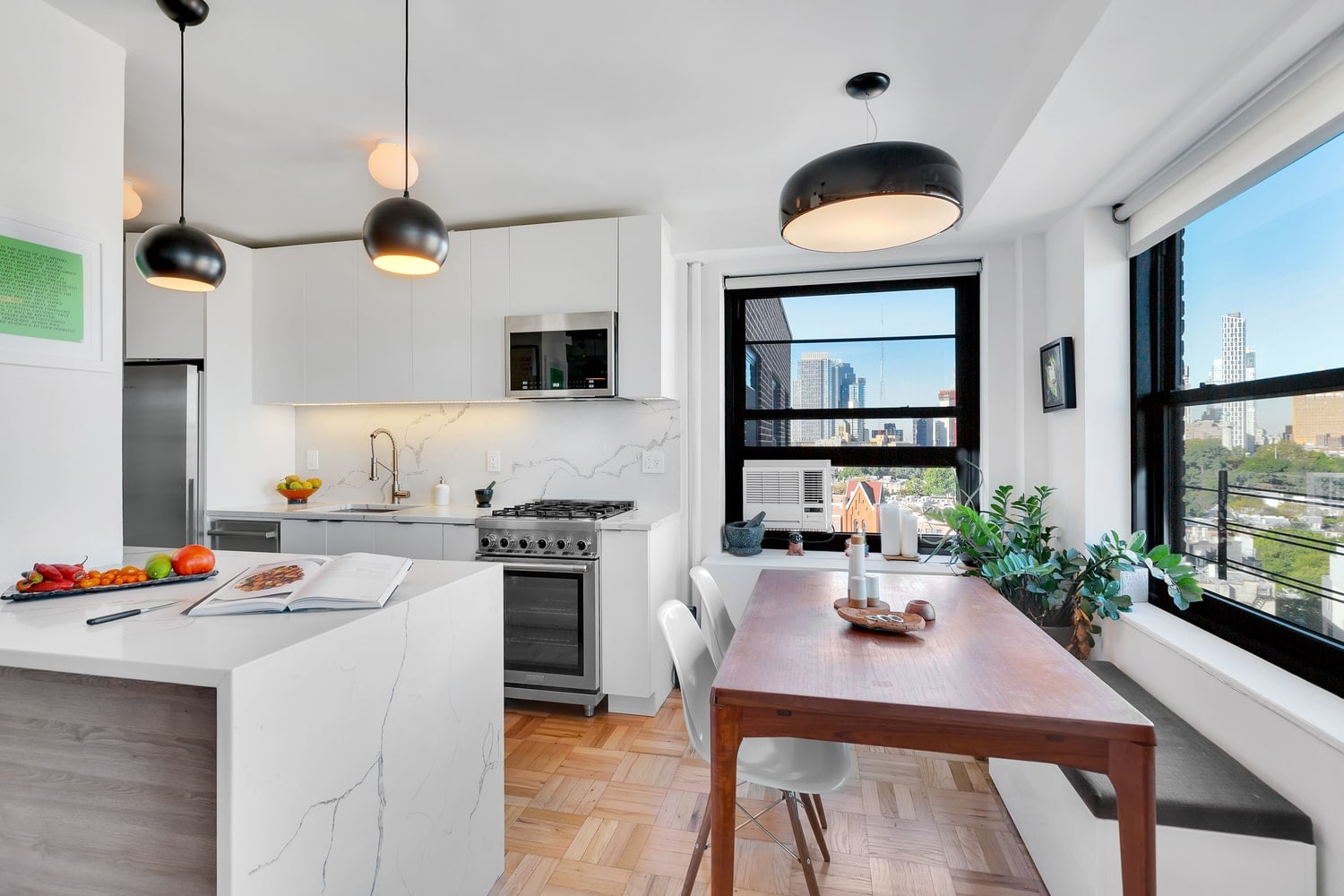
The single highest-impact renovation in a compact pre-war Manhattan kitchen is the removal of the enclosing wall to create an open-plan kitchen and living zone. The kitchen footprint does not change, but the room it occupies becomes continuous with the adjacent living space, which dramatically increases the perceived size of both. The kitchen borrows natural light from the living room windows. The living room gains the visual warmth of a working kitchen. The combined space supports an island or peninsula that a stand-alone kitchen could not accommodate with the required 42-inch clearances.
This scope requires a structural assessment to determine whether the wall is load-bearing. If it is, a beam is required at the header, which adds cost. The renovation involves a DOB permit, a co-op or condo board alteration agreement submission, and a construction schedule of six to twelve weeks. Total cost typically runs $18,000 to $45,000 depending on beam requirements, the extent of kitchen refresh that accompanies the opening, and the finish level of the combined space. The resale premium in the Manhattan market for an apartment that lives as an open plan when the building stock is predominantly enclosed-kitchen pre-war layouts is consistently one of the strongest available from any single-scope renovation decision.
%20copy.webp)
ADD A PENINSULA OR ISLAND TO THE OPEN-PLAN LAYOUT
Once the enclosing wall is removed, the combined kitchen-living zone typically has enough floor area to support a peninsula or island. A peninsula extending from the existing kitchen counter adds 15 to 25 square feet of counter surface, creates a natural dining and seating zone, and provides the storage on its underside that a galley kitchen cannot accommodate. An island, requiring 42-inch clearances on all sides, needs more floor area and may require the kitchen to borrow additional space from the living room, but delivers the visual anchor that defines the space as a designed room rather than a reorganized one.

CONSIDER WHAT A PASS-THROUGH ACCOMPLISHES WHERE FULL WALL REMOVAL IS NOT POSSIBLE
In buildings where a full wall removal requires structural work the board is unwilling to approve, or in kitchens where the wall in question carries mechanical or electrical systems that make removal impractical, a pass-through opening is a meaningful intermediate option. A cased opening or pass-through window in the wall between the kitchen and the dining area creates visual and light connection without removing the full partition. It is less dramatic than a full opening but requires less structural work, lower cost, and typically a simpler board approval path.
[#4]Planning The Kitchen As Part Of A Larger Renovation[#4]
The owners who make the most effective use of their renovation budget are the ones who plan the kitchen renovation with the full apartment in mind, even when they are only ready to act on the kitchen now. Kitchen decisions made in isolation create constraints that are expensive to undo when the broader renovation eventually happens.
Plumbing rough-in locations set during a kitchen-only renovation will either match or conflict with a future open-plan conversion. An electrical panel sized for the kitchen's appliance load may be undersized for a future full-apartment renovation that adds radiant floors, a home office, and a Lutron lighting system. A kitchen floor selected to work with existing apartment floors may not match the floors chosen for the future full renovation. Each of these is a decision that costs little to get right when the kitchen is already open and everything more to correct later.
Gallery's approach to kitchen renovation consultations includes a full-apartment conversation regardless of the contracted scope. Understanding what the owner intends for the rest of the apartment in the next three to five years takes thirty minutes in the first site visit and can save $30,000 to $80,000 in redundant work if the renovation proceeds in phases.
Gallery KBNY is a full-service design-build firm featured in The New York Times, specializing in the architecture, interior design, and renovation of apartments, co-ops, condominiums, townhomes, and lofts across Manhattan and Brooklyn. Our integrated team of architects, designers, contractors, and project managers manages every phase from board approvals and DOB permitting through design and construction. A founding partner is involved in every project, start to finish. Because architecture, design, permitting, and construction are coordinated under one roof, the process remains streamlined, accountable, and transparent from start to finish. Our work has also appeared in Forbes, Architectural Digest, and Inc., and is backed by 100+ five-star client reviews.
[#faq]Frequently Asked Questions About Kitchen Remodels Amidst Full Home Renovations In NYC[#faq]
MY KITCHEN IS 80 SQUARE FEET AND I CANNOT REMOVE ANY WALLS. WHAT RENOVATIONS ACTUALLY IMPROVE IT?
Within a fixed footprint, the interventions with the highest return are the ones that address the kitchen's organizational inefficiency rather than its physical constraints. Full-extension pull-out drawers in every base cabinet convert dead back-of-cabinet space into usable storage and cost $300 to $600 per cabinet installed. Open shelving on the upper wall with integrated under-shelf lighting creates visual depth and illuminates the counter simultaneously. A ceiling-mounted pot rack removes the storage burden that typically occupies 30 percent of a small kitchen's base cabinet space. These three interventions together cost $5,000 to $12,000 installed, require no permit or board review, and produce a kitchen that functions meaningfully better. What they cannot do is make a 80-square-foot enclosed room feel like a 150-square-foot open-plan kitchen. If that is the goal, the conversation is architectural.
HOW DO I KNOW WHETHER THE WALL BETWEEN MY KITCHEN AND LIVING AREA IS LOAD-BEARING?
You do not know without a structural assessment. In pre-war Manhattan buildings, the answer is not predictable from the wall's location or orientation alone. Many partition walls between kitchens and dining rooms in pre-war co-ops are non-load-bearing, which means removing them requires no beam and relatively straightforward demolition and finishing work. Some are load-bearing or carry mechanical systems that make removal more complex. A structural engineer or experienced design-build architect can assess the wall during a site visit by reviewing the building's drawings and taking physical measurements. The cost of that assessment is typically $1,500 to $3,000, and it is the prerequisite for any meaningful conversation about an open-plan conversion. Do not design a kitchen renovation around a wall removal until the structural assessment has confirmed it is feasible.
WHAT IS THE RESALE CASE FOR AN OPEN-PLAN KITCHEN CONVERSION VERSUS A KITCHEN-ONLY GUT RENOVATION IN A PRE-WAR MANHATTAN CO-OP?
The Manhattan market consistently prices open-plan living at a premium over equivalent enclosed-kitchen pre-war apartments. The premium is not simply for the renovation quality but for the way the apartment lives: an apartment that flows from kitchen to living to dining without interruption reads as larger, brighter, and more contemporary than the same square footage divided by walls, even when the total square footage is identical. Observable price differentials in comparable building sales between open-plan and enclosed-kitchen configurations run $150,000 to $300,000 at the mid-to-upper tier of the Manhattan market. A kitchen-only gut renovation without the wall removal produces a meaningfully renovated kitchen but does not change how the apartment reads in a competitive listing context. For owners planning to sell within five years, the open-plan conversion is typically the more efficient use of renovation budget relative to the value it produces at sale.
IF I RENOVATE MY KITCHEN NOW AND WANT TO DO THE FULL APARTMENT IN THREE YEARS, WHAT DECISIONS SHOULD I COORDINATE ACROSS BOTH SCOPES?
Five decisions made during the kitchen renovation have direct consequences for the full renovation three years later. Plumbing rough-in locations should be assessed against the intended full-apartment layout so they do not need to be repositioned. Electrical panel capacity should be sized for the full apartment's eventual load, not just the kitchen, since electricians are already on site and walls are already open. The kitchen floor species and finish should be pre-specified against the full-apartment flooring plan to avoid a visible transition or a refinishing scope. Any wall between the kitchen and an adjacent room should be structurally assessed during the kitchen renovation, even if the decision to open it is deferred, so the future scope is fully informed. The alteration agreement and DOB permit filed for the kitchen renovation can in many buildings be scoped to cover the future work as well, eliminating a second submission, second architectural drawing set, and second board review timeline. Engaging a design-build firm for the kitchen renovation, with explicit instruction to plan for the full renovation, is the most efficient way to ensure these decisions are made correctly the first time.
WHAT DOES "LUXURY KITCHEN" ACTUALLY MEAN IN A SMALL NYC APARTMENT?
In the context of a compact Manhattan or Brooklyn kitchen, luxury is a specification and design quality question, not a space question. A well-designed 90-square-foot kitchen with custom cabinetry, imported stone countertops, a well-selected appliance suite at the appropriate tier, integrated lighting at three levels, and considered hardware reads as a luxury kitchen because of the quality of every element within it. The space does not need to accommodate 15 guests to qualify. What it needs is a design that uses every inch intentionally, materials specified for long-term performance and visual quality, and construction executed to the standard where the fit and finish is visibly correct at close range. Gallery has completed kitchens in pre-war Manhattan apartments under 100 square feet that operate and present at the level of kitchens three times their size because the design discipline compensated for what the footprint could not provide.
Considering an apartment renovation in New York City? View our portfolio of NYC apartment renovation before and afters, learn more about Gallery, or contact us today.
We are a New York Times-featured design-build firm in New York City with a full-service approach to renovations in Manhattan and Brooklyn that includes everything from interior design and architecture services to filing permits and construction management. We’re experts in pre-war apartment renovations, apartment combinations, room creations, full gut renovations and all that falls in between. Let us bring your dream home to life.
Manhattan Design-Build
Evaluate Your Manhattan Apartment
Before You Buy
Buying an apartment you plan to renovate? A founding partner walks it with you during the contract period and maps the scope, cost, and timeline, so you know exactly what you're taking on before you sign.
As seen in
Pre-Purchase Assessment
Walk the apartment with us first and understand the full scope, cost, and timeline before you close.
or call us directly
let’s
Design-Build
together

.avif)