.avif)


.png)
.png)


3 Luxury Kitchen Design Features and Their More Affordable Alternatives
These three feature alternatives will keep your kitchen renovation manageable and on budget without sacrificing the design.
October 16, 2025
|
3 Luxury Kitchen Design Features and Their More Affordable Alternatives
With the proper planning and renovation partner, your dream kitchen design should fit your budget.
Table of contents
- Countertop Selection: Beyond Marble Vs. Quartz
- The Battle Of Brand-Name Appliances
- Custom Cabinetry Alternative(S)
-
The assumption that a high-end kitchen requires the most expensive version of every component is the most reliable way to overspend without improving the finished result. Experienced buyers understand this. The question a sophisticated renovation owner should be asking is not which products are most prestigious but which specifications produce the design outcome they want at a cost the project can sustain.
Gallery KBNY's approach starts with in-depth conversations about how the space will be used, what the finish level needs to achieve, and where in the project the budget produces the most return. From there, the firm sources directly through vendor relationships, passing trade discounts to clients rather than marking them up, and recommends alternatives where the performance differential between a premium and a trade specification is too small to justify the premium. The result is a kitchen that looks and performs at the level the owner expects, without the cost structure of a showroom-driven specification process.
Below are a few examples of some choice features and their alternatives, showing how Gallery’s always looking to offer the best of both worlds (luxury and affordability) for our clients.
[#Marble]Countertop Selection: Beyond Marble Vs. Quartz[#Marble]
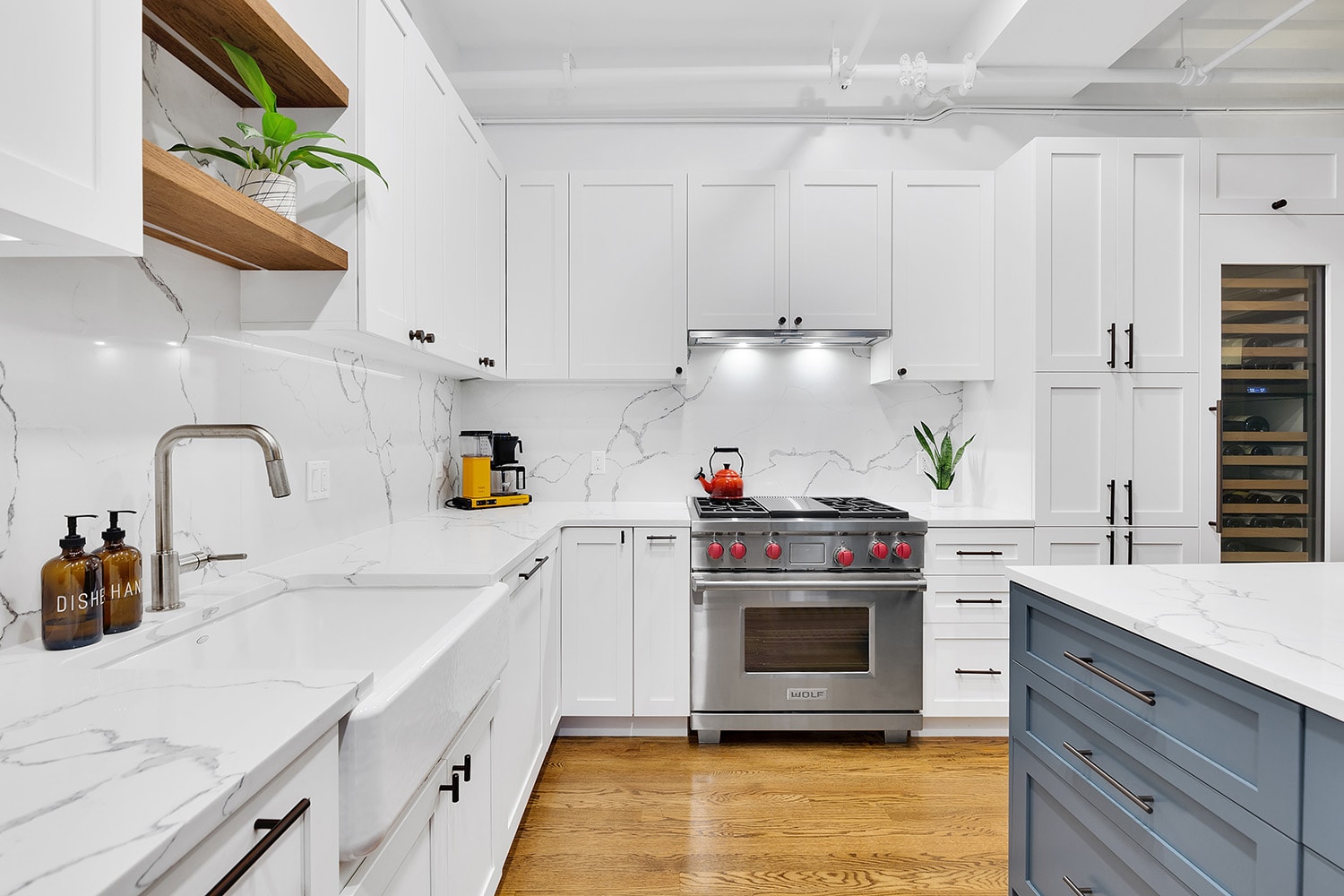
Marble holds a singular position in the market: no other countertop material generates the same immediate visual response. The movement in a Calacatta slab, the depth of veining in a book-matched island are genuinely irreplaceable aesthetic qualities. That aesthetic comes with a real maintenance profile. Marble is a soft stone (Mohs 3), porous without annual sealing, and reactive to acidic foods including citrus, wine, and vinegar. An owner who cooks regularly and expects a countertop to hold its surface without intervention will find marble demanding. An owner who values the look and accepts the care requirement will find it incomparable.
Quartz's functional case is straightforward. Manufactured with roughly 90 percent ground quartz bound in resin, it is non-porous, requires no sealing, resists staining, and takes impact without chipping. Premium quartz series such as Silestone's Calacatta Gold and Caesarstone's Statuario Maximus reproduce marble veining at a quality level that most buyers cannot distinguish at a showing. Installed cost runs $75 to $140 per square foot versus $120 to $250 for marble, and the maintenance cost differential over ten years is meaningful. The limitation is heat: quartz is vulnerable to direct pan placement without a trivet, where marble and natural stone perform better.
.webp)
Two materials the original conversation about this topic rarely covers deserve consideration. Quartzite is a metamorphic natural stone often confused with quartz in showrooms. It is harder than marble (Mohs 7+), less reactive to acids, and visually comparable to high-end marble with its own veining character. It requires periodic sealing but holds its surface far better under daily kitchen use. The challenge in the NYC market is sourcing: quartzite has fewer fabricators and longer procurement windows than marble. Sintered stone (Dekton, Lapitec) represents the highest-durability option available. Fired at extreme temperature and pressure, it resists heat, UV, scratching, and staining at a level no natural stone matches. Its cost runs $90 to $175 per square foot installed, and its large-format slabs can reduce visible seam count in an island-heavy kitchen.
The decision is not about which material is objectively superior. It is about which material's performance profile matches how the kitchen will actually be used, and whether the resale audience the owner is targeting will recognize the choice as an upgrade. In a pre-war co-op targeting the upper end of the Manhattan market, marble is a recognized specification that buyers expect. In a working kitchen where two people cook daily, quartz or quartzite produces a better long-term result with lower ongoing cost.
[#Battle]Appliances: What The Price Differential Actually Buys[#Battle]
Sub-Zero, Wolf, and Miele have earned their market position through sustained performance, well-developed service networks, and design details that matter in a high-specification kitchen. Sub-Zero's dual refrigeration system genuinely extends produce life in ways that single-compressor units do not, and Wolf's dual-stacked burner produces a simmer range that matters to serious cooks. These are not marketing claims. They are engineering decisions with real functional consequences for owners who will use the kitchen extensively.
The question is whether those functional consequences matter to a specific owner's use pattern. For an apartment that functions primarily as a social space, where entertaining is frequent and cooking is occasional, the performance differential between a Sub-Zero and a Thermador column refrigerator is not legible in daily life. The visual case for the luxury tier is real: panel-ready Sub-Zero refrigeration integrating flush into custom cabinetry reads differently than a standard-finish unit with a visible handle. That visual outcome is achievable at the upper-mid tier as well. Bosch and Jenn-Air both offer panel-ready column refrigerators. Thermador's Star Sapphire warranty (5 years parts, 5 years labor) surpasses what the luxury tier typically offers on the same terms.
The professional-style tier, represented by BlueStar, Bertazzoni, and Lacanche, serves a specific design intention rather than a functional one. A 48-inch BlueStar range in a Brooklyn townhouse kitchen makes a visual statement that no Sub-Zero or Wolf range makes in the same way. The custom color program (750+ RAL options) allows an appliance specification that becomes a design element rather than a component. The tradeoff is NYC service infrastructure: BlueStar and Lacanche have fewer authorized technicians in the five boroughs than the major luxury brands. Confirming service availability before specifying is not optional.
Panel-ready specifications require a critical planning discipline regardless of tier. The appliance brand and model must be confirmed before cabinet shop drawings are issued. Refrigerator rough-in dimensions are built into the framing. Panel-ready door specifications are built into the cabinetry. A change after fabrication begins is a significant rework event with real schedule and cost consequences, not a minor adjustment. This is the single most common source of preventable cost in the appliance specification process.

[#Custom]CUSTOM CABINETRY ALTERNATIVE(S)[#Custom]
Fully custom millwork from a New York shop produces results that are genuinely distinct from any other cabinetry option. Inset construction with flush reveals, custom species with hand-applied finish, and interior fittings built to the exact storage configuration the owner needs are outcomes a semi-custom manufacturer cannot fully replicate. The cost range ($1,200 to $3,500+ per linear foot installed) reflects the labor intensity of this work. For a renovation where cabinetry is the primary design expression, and where the owner plans to remain in the apartment for a decade or more, the investment is well-structured.
Semi-custom manufacturers such as Showplace, Cliqstudios, and Dura Supreme offer a range of door profiles, paint matching, and interior configurations that covers most renovation specifications competently. Installed cost runs $500 to $1,100 per linear foot. At this specification level, execution quality and hardware selection do more work than the manufacturer name. A semi-custom cabinet with Waterworks or Armac Martin hardware and a well-considered finish reads as custom to most buyers at a showing. The limitation is that semi-custom manufacturers have fixed box sizes and cannot accommodate the dimensional idiosyncrasies of a specific pre-war kitchen layout without visible gaps or fillers.
Trade-sourced cabinetry, accessible through a design-build firm's vendor relationships rather than a showroom, closes that gap in a different way. These manufacturers produce the same construction quality as the branded lines without the overhead of a showroom presence in the price. Installed cost runs $350 to $750 per linear foot. A resourceful design-build firm draws on relationships with several such manufacturers to give a specific project the finish options it needs. This is one of the concrete financial advantages of working with a firm that has been in the NYC market long enough to build those relationships: the savings go directly to the client rather than to showroom square footage.
Floating shelves as an alternative to upper wall cabinets work in specific kitchen contexts. They read well in lofts and open-plan spaces where the kitchen is visible from the living area and storage demand is distributed across base cabinetry and a pantry. They require a different approach to kitchen organization, where everything visible must be intentional. In a co-op apartment where upper cabinet storage is the primary location for daily-use items, removing it entirely creates a practical problem the design aesthetic cannot fully compensate for. The right application is a kitchen where the upper wall is treated as a display surface and the storage is concentrated in base cabinetry and a dedicated pantry or butler's pantry adjacent to the kitchen.

Assuming your luxury kitchen has to include the most expensive features is one of the biggest mistakes made when renovating. Finding more cost-effective alternatives might not be easy, but resourcefulness like that is expected when working with a full-service design-build firm in New York City like Gallery.
MIN.webp)
Gallery KBNY is a full-service design-build firm featured in The New York Times, specializing in the architecture, interior design, and renovation of apartments, co-ops, condominiums, townhomes, and lofts across Manhattan and Brooklyn. Our integrated team of architects, designers, contractors, and project managers manages every phase from board approvals and DOB permitting through design and construction. A founding partner is involved in every project, start to finish. Because architecture, design, permitting, and construction are coordinated under one roof, the process remains streamlined, accountable, and transparent from start to finish. Our work has also appeared in Forbes, Architectural Digest, and Inc., and is backed by 100+ five-star client reviews.
[#faq]Frequently Asked Questions About Kitchen Renovations In NYC [#faq]
HOW SHOULD A MANHATTAN CO-OP OWNER THINK ABOUT COUNTERTOP SELECTION RELATIVE TO THEIR EVENTUAL RESALE POSITION?
The answer depends on two variables: the price point of the eventual sale and the maintenance tolerance of the current owner. At the upper end of the Manhattan co-op market, apartments trading above $3 million, marble is a recognized specification that buyers expect in a fully renovated kitchen. The material's visual quality at that price point is a market signal, and its presence or absence affects buyer perception at showing. Below that threshold, premium quartz in a well-chosen veining pattern produces a comparable visual outcome with a meaningfully lower maintenance burden and shorter procurement lead time. The more consequential specification decision at any price point is the quality of fabrication: clean miters, consistent reveals, and proper edge profiles are what experienced buyers actually notice.
WHAT IS THE PRACTICAL COST OF SPECIFYING SUB-ZERO AND WOLF VERSUS AN UPPER-MID TIER ALTERNATIVE IN A FULL GUT RENOVATION?
For a typical Manhattan kitchen gut renovation, roughly 150 to 200 square feet with a full appliance suite (refrigerator, range or cooktop plus wall oven, dishwasher, and wine storage), the installed cost differential between a full Sub-Zero and Wolf specification and an equivalent upper-mid tier specification from Thermador or Jenn-Air runs $18,000 to $35,000. That differential is real money that can be redirected toward countertop material, cabinetry specification, or lighting. Whether the functional and aesthetic return on that differential justifies the cost is a project-specific question. For an owner who cooks seriously and will be in the apartment for ten or more years, the Sub-Zero sealed system warranty and Wolf burner performance are meaningful. For an owner who entertains frequently and cooks occasionally, the visual argument for the luxury tier is the only one that holds, and that argument is partially addressable through panel-ready integration at the upper-mid tier.
WHAT SHOULD AN OWNER VERIFY BEFORE ACCEPTING A FLOATING SHELF SPECIFICATION AS A SUBSTITUTE FOR UPPER CABINETRY?
Storage math is the first check. Count the linear feet of upper cabinet storage the current kitchen provides and determine where that storage relocates in the new design. Open shelves eliminate enclosed storage and require every displayed item to function as part of the design. In a kitchen where the upper cabinets hold everyday dishware, spices, small appliances, and pantry overflow, removing them without equivalent storage in another location creates a practical deficit that no aesthetic argument compensates for. The second check is structural: pre-war plaster walls require specific fastener selection for shelf brackets. A shelf that holds 30 pounds of dishware in drywall requires a different anchoring approach than one in original lime plaster. The third consideration is how the space reads at resale: floating shelves read as a design choice in a loft or contemporary renovation and as an incomplete kitchen in a co-op apartment where buyers expect enclosed storage.
WHEN A DESIGN-BUILD FIRM PASSES TRADE DISCOUNTS TO CLIENTS, HOW DOES THAT CHANGE THE SPECIFICATION CONVERSATION?
It changes it materially. When clients access materials through a designer or firm that marks up its vendor relationships, the budget conversation is distorted from the outset: the real cost of each specification decision is obscured by a layer of margin that has nothing to do with the material's value. Gallery's approach inverts this: vendor discounts pass directly to the client, which means the cost comparison between a premium and a trade specification is transparent and accurate. A client who understands that a trade-sourced cabinet at $500 per linear foot and a recognized brand at $900 per linear foot are producing equivalent quality can make an informed decision about whether the brand premium earns its cost. Most often, the savings on cabinetry and appliances fund the specification upgrades that produce the most visible return: stone slabs, hardware, and lighting.
IS THE CHOICE BETWEEN MARBLE AND QUARTZ RELEVANT TO CO-OP BOARD APPROVAL?
No. Countertop material selection is a cosmetic specification decision that falls entirely within the scope of work covered by a standard co-op alteration agreement. No additional DOB filing or board review is required as a function of which countertop material is chosen. The board approval process addresses structural modifications, plumbing relocations, electrical upgrades, and anything that affects the building's common elements or adjacent apartments. A material swap at the countertop level, including a complete replacement with a different material, does not trigger any additional regulatory review beyond the standard building permit and alteration agreement already in place for the kitchen renovation.
Manhattan Design-Build
Evaluate Your Manhattan Apartment
Before You Buy
Buying an apartment you plan to renovate? A founding partner walks it with you during the contract period and maps the scope, cost, and timeline, so you know exactly what you're taking on before you sign.
As seen in
Pre-Purchase Assessment
Walk the apartment with us first and understand the full scope, cost, and timeline before you close.
or call us directly
let’s
Design-Build
together

.avif)